
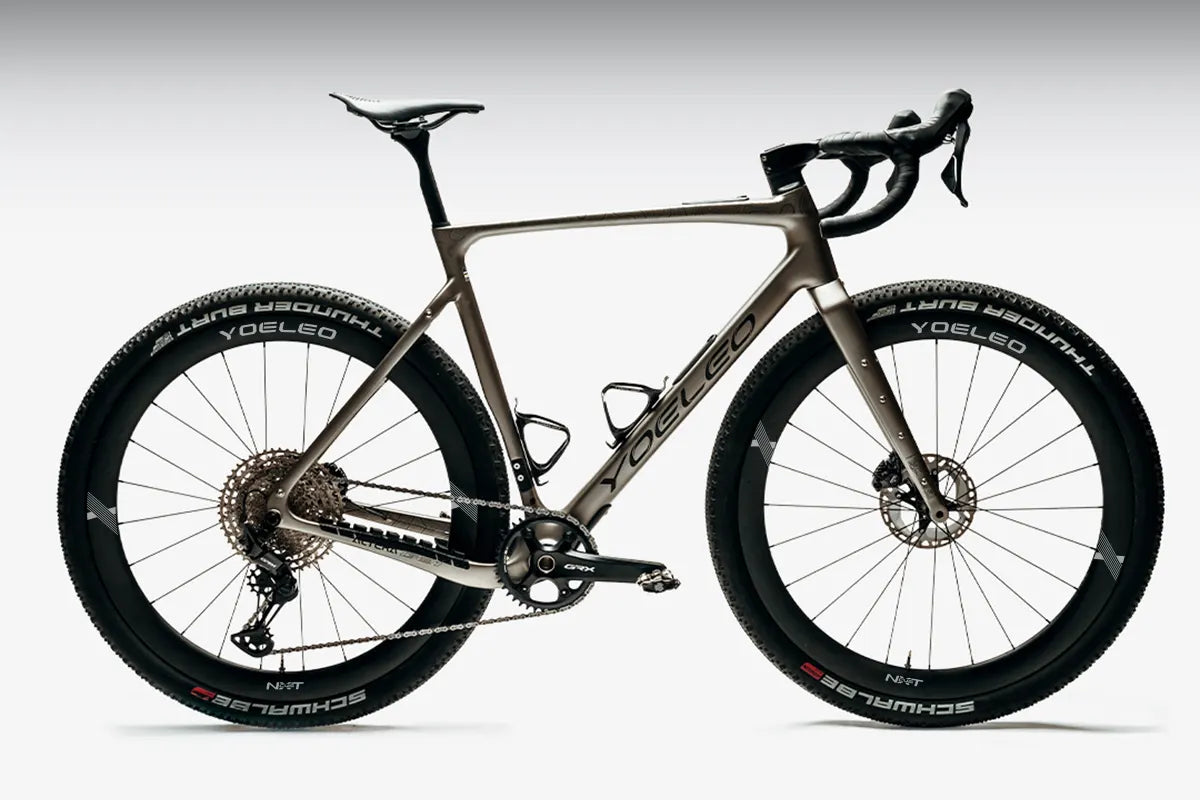
You have a bike that fits. After months of dial-in — saddle height, reach, bar drop — you don't think about position anymore. You just ride. Then a new frame catches your eye, and the familiar dread sets in: what if the fit is wrong? What if you spend significant money and end up sitting three centimetres too stretched, too cramped, or too upright?

This is the exact moment most cyclists either give up on buying a new frame online, or take a gamble and hope for the best. There is a better path. Stack and reach are the two measurements that tell you, with far more precision than any size label, whether a frame will put you in the same position you already love.
|
STACK & REACH IN 30 SECONDS
• Stack = vertical distance from bottom bracket centre to top of head tube. Controls how high your hands sit.
• Reach = horizontal distance from BB centre to top of head tube. Controls how stretched out you are.
• A matching stack AND reach across two frames means identical position — regardless of brand or size label.
• Stack-to-reach ratio (S:R) tells you geometry character: above 1.5 is relaxed/upright; below 1.4 is aggressive/race.
|
Why Frame Size Labels Lie
A 54 cm frame from one brand is not the same as a 54 cm frame from another. The measurement tradition varies — some brands measure centre-to-centre, others centre-to-top, and the seat tube angle changes what that number even means for rider position. Frame size is a rough guide at best.

Stack and reach cut through that ambiguity. They are absolute measurements from a fixed reference point — the bottom bracket — to a fixed destination: the top-centre of the head tube. Because every frame uses the same reference points, you can compare any two frames directly and know, before you buy, whether the front-end position will match.
How to Measure Your Current Stack and Reach
You do not need a fitting studio. You need a plumb bob, a tape measure, a level surface, and about twenty minutes.
-
Stand the bike on a flat floor.
-
Find the bottom bracket centre — the axle running through the crank spider. Mark it with tape on the seat tube.
-
Find the top-centre of the head tube — where the top cap sits at the top of the steer tube bearing race.
-
Measure the vertical distance between those two points: that is your stack.
-
Measure the horizontal distance between those two points: that is your reach.
-
Write both down. These are your fit fingerprint.
If you do not want to measure physically, most brands publish geometry charts with stack and reach per size. Find your current frame geometry chart, locate your size, and read off the numbers.
Translating Stack and Reach Across Brands
Once you have your numbers, the process is straightforward: find a frame whose published stack and reach fall within plus or minus 5 mm of your target values. Within that window, stem length and spacer height can close any remaining gap without compromising handling.
|
Stack delta
|
Reach delta
|
Fix with
|
|
+5 to +10 mm
|
+5 to +10 mm
|
Remove one 5 mm spacer and shorten stem 5-10 mm
|
|
+5 to +10 mm
|
Within 5 mm
|
Remove one 5 mm spacer only
|
|
Within 5 mm
|
+5 to +10 mm
|
Shorten stem 5-10 mm
|
|
Within 5 mm
|
-5 to -10 mm
|
Extend stem 5-10 mm or add bar spacer
|
|
Beyond 15 mm in either
|
Any
|
Move to adjacent frame size — do not compensate with extreme stems
|
Stems over 130 mm or under 70 mm affect handling character. The goal is to find a frame where stack and reach already sit close, then use the stem and spacers for fine-tuning — not as the primary adjustment.
The Stack-to-Reach Ratio: Geometry Character at a Glance
Divide your stack by your reach. The result tells you the posture character of the frame immediately, without reading a long geometry table. A ratio above 1.5 places you in a more upright, endurance-oriented position. A ratio below 1.4 is race-aggressive, putting more weight forward.
|
S:R ratio
|
Character
|
Best for
|
|
Above 1.55
|
Very upright
|
Long-distance touring, daily commuting, new riders
|
|
1.45-1.55
|
Endurance sport
|
Gran fondo, all-day gravel, relaxed road
|
|
1.38-1.45
|
Performance
|
Fast road riding, racing training, lightweight climbing
|
|
Below 1.38
|
Race aggressive
|
Criterium, time-trial-adjacent, experienced racers
|
When you change frame character — say, moving from a 1.50 to a 1.40 ratio — expect to feel the difference even if stem and spacer adjustments close the stack and reach gap. The handling is different even when the static position is matched.
Gravel vs Road: Why the Numbers Differ
Gravel frames typically carry a taller stack for the same reach, compared to road frames. This is deliberate: a more upright position reduces fatigue over long hours on rough terrain, and leaves room for wider tire clearance in the front triangle. If you are moving from a road frame to gravel, expect the S:R ratio to climb and your body position to open up slightly.
When comparing gravel frames to each other, use the same stack and reach method. The sizing logic applies equally; the absolute numbers will just trend higher than an equivalent road frame.
Decision Table: Which Frame Size Should I Order?
|
Your current stack
|
Your current reach
|
Frame to look for
|
|
550-565 mm
|
370-380 mm
|
Smaller compact road frame or size S gravel
|
|
565-580 mm
|
380-390 mm
|
Mid-compact road; size M gravel or 52-54 cm road
|
|
580-595 mm
|
390-400 mm
|
Standard 54-56 cm road or size M-L gravel
|
|
595-615 mm
|
400-415 mm
|
Larger 56-58 cm road; size L gravel
|
|
Above 615 mm
|
Above 415 mm
|
Size 58 cm+ road or XL gravel
|
How Yoeleo R-Series and G21 Make the Stack-Reach Decision Easy
Every Yoeleo frameset — R11, R12, and Altera G21 — comes with a full geometry chart covering stack, reach, seat tube angle, head tube angle, wheelbase, and trail for every available size. You can compare those numbers directly against your current frame before placing an order. That kind of transparency is how DTC efficiency works in practice: no guesswork, no size-chart ambiguity, just the actual numbers you need.

The R11 is engineered for performance road geometry — lower stack-to-reach ratio, designed for riders who want to replicate an aggressive race-bike position. The R12 carries a more accessible ratio, making it the right match if your current bike puts you in a slightly more open, endurance-oriented stance. The Altera G21 runs a generous stack for its reach, which means most road riders moving to gravel will find they can go down a size versus their road frame while maintaining a comfortable position.
|
HOW YOELEO MAKES FIT CONFIDENCE PART OF THE PURCHASE
• Full published geometry — stack, reach, and all angles — for every size of R11, R12, and Altera G21
• Engineered for riders who know their numbers and want to verify fit before they buy
• DTC efficiency means no dealer markup to compensate for — the same budget buys more frame
• Six-year frameset warranty: a fit investment that holds its value over the long term
• Size-chart support available via jasmine@yoeleobike.com for riders who want a second opinion on sizing
|
Frequently Asked Questions
What is the difference between stack and reach on a bike?
Stack is the vertical distance from the bottom bracket to the top of the head tube; reach is the horizontal distance between the same two points. Together they define where your hands sit relative to your pedals — the two axes that determine your riding position.
Is stack or reach more important for bike fit?
Both matter equally but for different aspects of fit. Reach controls how stretched your torso is; stack controls how high your hands sit. Changing one without matching the other shifts your weight distribution and can alter handling feel even when one measurement is correct.
How much stack and reach difference is acceptable between frames?
A difference of plus or minus 5 mm in either dimension can typically be resolved with stem and spacer adjustments without compromising handling. Differences beyond 15 mm generally require moving to a different frame size rather than compensating with stem length extremes.
What is a good stack-to-reach ratio for endurance road cycling?
An S:R ratio between 1.45 and 1.55 suits most endurance road riders — upright enough for long-distance comfort, aggressive enough for efficient power output. Race-oriented riders typically prefer ratios of 1.38 to 1.44.
Share:
Custom Bike Paint: Does Color Cost You Speed?
Between Two Bike Sizes? How to Choose Buying Online