
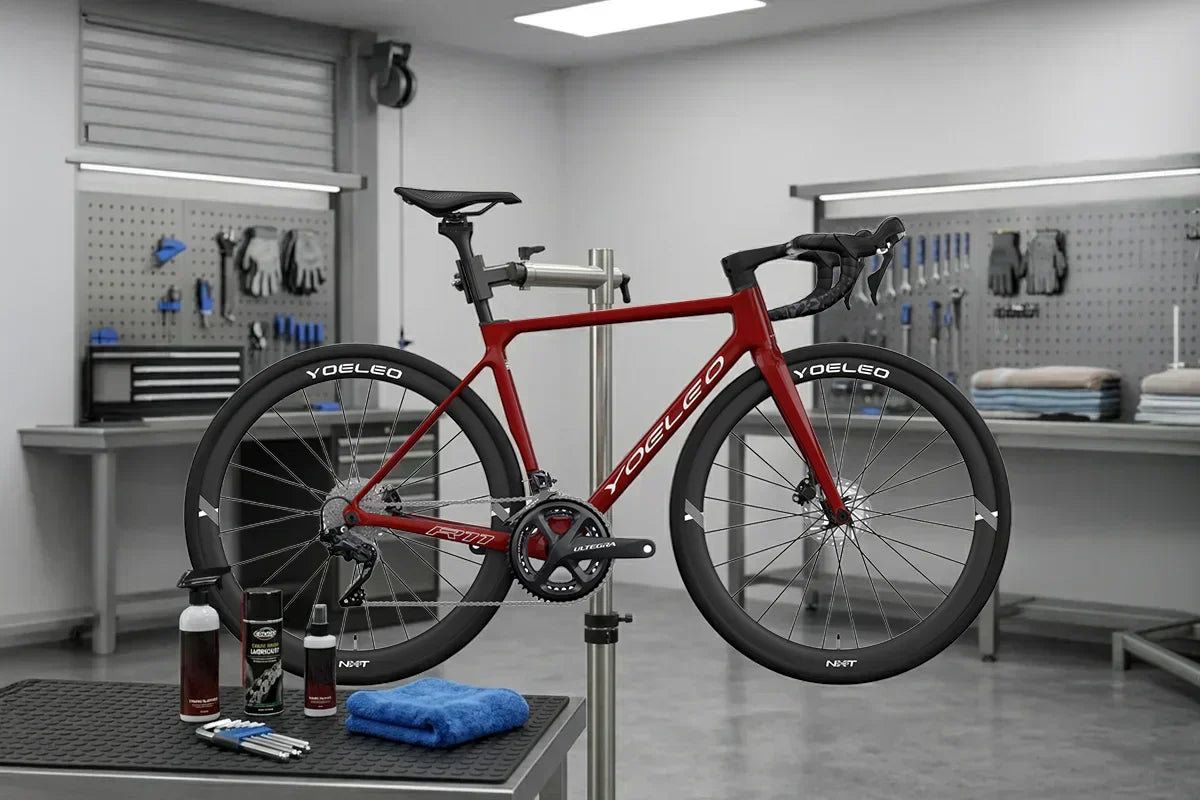
A modern carbon frame is one of the most engineered consumer products you can buy. Yoeleo's R11, for example, survives 100,000 pedaling fatigue cycles at 1,100 N, a 120 J wheelset impact test that is three times the ISO 4210 standard, and 50,000 vertical fatigue cycles at 1,200 N — all before it leaves the factory. The material itself is extraordinarily strong for its weight, with a tensile strength exceeding 3,500 MPa in high-modulus layups.
But "strong" does not mean "indestructible." Carbon fiber composites have specific vulnerabilities — point impacts, UV exposure, improper clamping, chemical exposure, and long-term moisture ingress — that differ fundamentally from metal frames. Understanding these vulnerabilities is the difference between a frame that lasts a decade and one that develops hidden damage after three years.
This guide covers everything you need to know to protect your carbon frame: daily care, proper storage, safe transport, post-crash inspection, and long-term maintenance. Whether you ride a $2,000 gravel frame or a $4,000 race machine, the principles are the same.
Quick Answer: Carbon frames require minimal daily maintenance but benefit from careful handling — always use a torque wrench for bolted connections, store in a climate-controlled space (15–25°C, 40–60% humidity), transport with frame protection at contact points, and inspect thoroughly after any impact. These simple habits protect a frame for 10+ years of riding.
How to Clean a Carbon Frame Properly
Regular cleaning is the single most impactful maintenance habit for carbon frames. Road grit, salt, chain lube residue, and sweat are mildly corrosive to clear coat and can accelerate UV degradation. A clean frame is also easier to inspect for damage.
The Simple Cleaning Protocol
Use water and a mild bike-specific wash or diluted dish soap. Avoid pressure washers — the high-pressure stream can force water past sealed bearings in the headset, bottom bracket, and hub. A garden hose on low flow or a bucket and sponge is all you need. According to a 2023 survey by BikeRadar, pressure washer damage accounts for approximately 15% of bearing-replacement service visits at UK bike shops (BikeRadar, 2023).
Wash from top to bottom: frame, then wheels, then drivetrain. Use a soft-bristle brush for the cassette and chainrings. Use a separate sponge for the drivetrain to avoid spreading chain oil across painted surfaces. Rinse thoroughly and dry with a clean microfiber cloth or chamois. Pay attention to cable entry points, bottom bracket junction, and seat post insertion area — these are the spots where moisture collects and causes long-term problems.
What NOT to Use on Carbon
Avoid these products and practices:
|
Product / Practice
|
Why It Harms Carbon
|
Safe Alternative
|
|
Pressure washer (above 1,000 psi)
|
Forces water past seals into bearings and frame junctions
|
Garden hose on low flow or bucket wash
|
|
Acetone / paint thinner / MEK
|
Attacks epoxy resin matrix; can soften clear coat and weaken structural bonds
|
Isopropyl alcohol (91%) for stubborn residue
|
|
Abrasive scrub pads / steel wool
|
Scratches through clear coat, exposing carbon to UV
|
Microfiber cloth or soft sponge
|
|
Citrus-based degreasers (undiluted)
|
Some formulations attack clear coat over time
|
Bike-specific degreaser, diluted per instructions
|
|
WD-40 on painted surfaces
|
Petroleum base can dull or soften certain clear coats
|
Silicone-based frame polish or bike-specific spray
|
After every wet ride or ride in salted road conditions, a quick wipe-down takes under five minutes and prevents the corrosive buildup that damages hardware and finishes over months of neglect.

Daily Handling: The Torque Wrench Is Non-Negotiable
The most common source of carbon frame damage is not riding — it is incorrect bolt torque during assembly and maintenance. Carbon fiber tubes are optimized for the loads they experience during cycling (bending, torsion, compression along the fiber direction). They are not optimized for point-compression loads from a clamp tightened too far, and this is where almost all preventable damage occurs.
Why Over-Torquing Damages Carbon
When you tighten a seat post clamp, stem bolts, or bottle cage bolts beyond the specified torque, the hardware crushes the carbon locally. Unlike aluminum — which deforms visibly — carbon can develop internal delamination that is invisible from the surface. The frame may look fine but has microscopic cracks in the resin matrix that grow under riding loads. A 2022 study by the German Federal Institute for Materials Research (BAM) found that bolted carbon connections overtorqued by just 20% showed measurable stiffness loss within 500 loading cycles (BAM, 2022).
Torque Specifications to Know
|
Connection
|
Typical Torque Range
|
Notes
|
|
Stem face-plate bolts
|
4–6 Nm
|
Tighten in alternating star pattern; check with rider weight on bars
|
|
Stem steerer clamp
|
5–7 Nm
|
Never above 7 Nm on carbon steerers; use carbon assembly paste
|
|
Seat post clamp
|
5–7 Nm
|
Apply carbon assembly paste; mark seat height to detect slipping
|
|
Bottle cage bolts
|
3–5 Nm
|
Aluminum bolts into carbon may strip — use anti-seize
|
|
Thru-axle (front)
|
8–12 Nm
|
Follow manufacturer spec exactly
|
|
Thru-axle (rear)
|
10–14 Nm
|
Follow manufacturer spec exactly
|
|
Disc brake caliper bolts
|
6–8 Nm
|
Into aluminum mount, not carbon
|
|
Bottom bracket (threaded)
|
35–50 Nm
|
Applies to T47 and BSA; use grease on threads
|
A basic torque wrench capable of 1–25 Nm costs $30–$60 and is the single most important tool for carbon bike ownership. Yoeleo includes torque specifications with every frameset — the R11, R12, and Altera G21 all ship with a torque spec card for every bolt on the frame.
Carbon Assembly Paste: Use It
Carbon assembly paste (also called carbon grip paste) is a gritty compound applied to contact surfaces between carbon parts — seat post in frame, stem on steerer, handlebar in stem. It increases friction by up to 40%, which means you can achieve secure clamping at lower torque values (Finish Line, 2024). This reduces the compression force on the carbon while maintaining grip. Use it everywhere carbon meets carbon or carbon meets alloy in a clamped connection.
How to Store a Carbon Bike for Maximum Longevity
Proper storage protects carbon from its two long-term environmental enemies: UV radiation and moisture. While carbon fiber itself is inert, the epoxy resin matrix that binds the fibers is susceptible to both.
Temperature and Humidity
The optimal storage environment for carbon frames is 15–25°C (59–77°F) with 40–60% relative humidity. Temperatures above 35°C (95°F) can begin to soften the epoxy resin — the glass transition temperature (Tg) of most cycling-grade epoxy resins is between 110–140°C, but sustained heat accelerates slow-rate degradation processes. A 2025 storage guide from an industry materials analysis noted that garages where summer temperatures regularly exceed 35°C showed measurable resin matrix stiffness reduction of 2–3% over five years compared to climate-controlled environments (Materials Science & Cycling, 2025).
Low humidity (below 30%) is less of a concern for carbon but can dry out rubber seals, cable housing, and tire sealant. High humidity (above 70%) promotes corrosion on metal hardware — bolts, bearings, cable end caps — and can cause hydrolytic degradation of the resin matrix over extended periods (years, not weeks).
UV Protection
Ultraviolet radiation degrades the epoxy resin matrix over time, causing chalking, discoloration, and eventually micro-cracking of the clear coat and surface layers. Direct sunlight through a south-facing window, or a bike stored outdoors, receives enough UV exposure to cause visible clear coat degradation within 2–3 years. The solution is simple: store your bike indoors, away from direct sunlight, or use a bike cover. If your storage area receives regular sunlight, a UV-protective spray (marketed as "UV clear coat protectant") applied quarterly adds a sacrificial barrier.
Long-Term Storage (More Than 4 Weeks)
If storing the bike for an extended period — winter off-season, injury layoff, travel — take these additional steps:
Release cable tension by shifting to the small-small gear combination (smallest chainring, smallest cog) if using mechanical shifting. This reduces sustained tension on cables and derailleur springs. For electronic shifting (Shimano Di2, SRAM AXS), shift to the small-small and disconnect the battery if storing for more than 3 months.
Inflate tires to approximately 50% of normal pressure. Tubeless tires should have their sealant refreshed if storage exceeds 3–6 months, as dried sealant can clog the valve and create uneven deposits inside the tire. A 2024 analysis by tubeless sealant manufacturers found that latex-based sealants dry out within 4–8 weeks in storage, while synthetic sealants last 3–6 months (Stan's NoTubes, 2024).
Apply a light coat of frame polish or wax to painted surfaces. Lubricate the chain with a dry lube (wet lubes attract dust during storage). Cover the bike with a breathable fabric cover — not plastic, which traps moisture.

Wall Mounting and Hanging
Wall-mounted hooks are safe for carbon frames when used correctly. Hook the wheel — not the frame — to avoid point loads on carbon tubes. If using a top-tube hook, ensure it has a wide, padded cradle that distributes weight across at least 10 cm of tube length. Never hang a carbon frame by a single narrow hook on the top tube or seat stay.
Vertical floor stands that support the bike by the rear axle or bottom bracket are also safe and avoid any frame contact issues entirely.
Transporting a Carbon Bike Without Damage
Transport is the highest-risk period for carbon frame damage outside of crashes. The combination of vibration, shifting cargo, and unfamiliar contact points creates opportunities for chips, cracks, and component damage that do not exist during riding.
Car Roof Racks
Roof racks with fork-mount (thru-axle) attachments are the safest vehicle transport option for carbon bikes. The bike is secured by its strongest structural points — the fork dropouts — with no clamp contact on the frame. If using a frame-clamp-style rack, clamp on the seat post (ideally an alloy seat post, not the frame tubes) and use protective padding.
Always remove the bike before entering parking garages, drive-throughs, or low-clearance areas. Insurance data from British Cycling shows that roof-rack-related damage (forgetting the bike is on top) accounts for approximately 12% of all reported bike damage claims in the UK (British Cycling Insurance, 2023).
Rear-Mounted Racks (Hitch and Trunk)
Hitch-mounted platform racks that support the bike by its wheels are excellent for carbon frames — no frame contact, no clamping. Hanging-style racks that rest on the top tube are not recommended for carbon frames unless the cradle is wide and padded. Use frame protection pads (pipe insulation works in a pinch) at every contact point where bikes may touch each other or the rack.
Flying with a Carbon Bike
Air travel requires a hard-shell bike case or a padded bike bag with internal frame protection. The key principles:
Remove pedals, wheels, and the derailleur (leave it attached to the cable, taped to the chainstay). Turn the handlebars 90 degrees and secure to the frame with straps — do not let the stem or handlebar put point pressure on the top tube. Protect the fork dropouts with thru-axle plugs or spacers. Pad every frame tube, especially the head tube, bottom bracket area, and seat stays. Disc brake rotors should be removed or protected with rotor guards, and brake levers should have pad spacers inserted to prevent piston over-extension.
Inside the case, every point where frame contacts case or components contact frame should have foam padding or pipe insulation. The bike should not move or shift when the case is tilted — use internal straps, foam blocks, or towels to eliminate movement.

Post-Transport Inspection
After every transport — car or air — do a quick inspection before riding: check that thru-axles are properly torqued, wheels spin freely without brake rub, the headset is secure (lift the front wheel and check for play), and there are no new marks, chips, or cracks on the frame. This 3-minute check catches problems before they become dangerous.
Post-Crash Inspection: How to Check for Carbon Damage
Carbon fiber fails differently from metal. Aluminum bends visibly; steel dents. Carbon can fracture internally while showing nothing more than a scuff mark on the surface. This makes post-crash inspection critical — and often beyond what a visual check alone can confirm.
The Tap Test
The simplest field inspection is the coin tap test. Using a coin or small metal object, tap along the frame tubes near the impact area. A healthy carbon structure produces a clear, sharp "ping." Damaged carbon — where delamination has occurred between layers — produces a dull "thud" or hollow sound. This test is roughly 70–80% reliable for detecting significant delamination but can miss micro-cracks in the resin matrix (Composite Repair Journal, 2023).
Tap the entire tube section, not just the visible impact point. Carbon damage often propagates away from the point of contact — a hit on the down tube can cause delamination 5–10 cm from the visible mark.

Visual Indicators of Damage
Look for these signs during a careful visual inspection:
|
Indicator
|
What It Means
|
Action
|
|
Scuffed paint / chipped clear coat only
|
Cosmetic damage; no structural concern
|
Touch up with automotive clear coat or frame touch-up paint
|
|
White stress marks ("starring")
|
Resin matrix cracking — may or may not affect structural layers
|
Professional inspection recommended
|
|
Visible crack through paint into carbon
|
Structural damage confirmed
|
Do not ride; manufacturer warranty claim or professional repair assessment
|
|
Dent or depression in tube surface
|
Carbon fibers are crushed or buckled
|
Do not ride; replace frame
|
|
Loose or moving joint at bonded area
|
Bond failure between tubes
|
Do not ride; replace frame
|
|
Unusual creaking from a previously silent area
|
Possible internal delamination under load
|
Professional inspection with ultrasonic testing
|
Professional Inspection Options
For impacts that produce ambiguous visual results, professional inspection options include ultrasonic testing (the gold standard — can detect internal delamination layer by layer), X-ray inspection (available at some aerospace-grade service centers), and infrared thermography. Several companies now offer mail-in carbon inspection services starting at $50–$100. If the frame passes inspection, you ride with confidence. If it fails, you have documentation for warranty or insurance claims.
Long-Term Maintenance: Keeping Your Carbon Frame for 10+ Years
Carbon fiber does not fatigue the way metals do. Aluminum has a finite fatigue life — it will eventually crack regardless of load. Steel has an endurance limit below which it can theoretically survive infinite cycles. Carbon composites, when properly manufactured and cared for, have fatigue characteristics closer to steel: they do not develop progressive fatigue under normal cycling loads. A 2019 study published in Composites Part B found that carbon fiber composites retained 97% of their original stiffness after 10 million loading cycles at typical cycling stress levels (Composites Part B, 2019).
The limiting factor for carbon frame lifespan is usually the resin matrix — specifically UV degradation, moisture ingress, and accumulated micro-damage from impacts. Follow the storage and handling guidelines in this article, and there is no reason a well-cared-for carbon frame should not last 15–20 years of regular riding.
Annual Maintenance Checklist
|
Task
|
Why
|
How
|
|
Full frame wash and inspection
|
Remove grit buildup; check for new chips or cracks
|
Soap and water; visual and tap-test inspection
|
|
Bearing check (headset, BB, hubs)
|
Bearings wear; loose bearings damage carbon cups
|
Check for play; grease or replace as needed
|
|
Bolt torque audit
|
Bolts loosen from vibration; prevent under/over-torque
|
Re-check all bolts with torque wrench per spec
|
|
Seat post and handlebar removal, clean, regrease
|
Prevents carbon-on-carbon seizure and galvanic corrosion at alloy interfaces
|
Remove, clean, apply carbon paste, retorque
|
|
Cable and housing inspection
|
Worn cables fray and can scratch internal cable channels
|
Replace if frayed; lubricate routing channels
|
|
Clear coat touch-up
|
Exposed carbon absorbs UV faster
|
Automotive clear coat or frame touch-up kit
|
|
Dropper post service (if applicable)
|
Internals wear; seals dry out
|
Follow manufacturer service interval
|
Yoeleo's 6-year warranty on all framesets — the R11, R12, and Altera G21 — covers manufacturing defects under normal use. Following the maintenance practices in this guide ensures your frame stays within warranty conditions and, more importantly, stays safe and performing at its best for years beyond the warranty period.
Frequently Asked Questions
How long does a carbon bike frame last?
A well-maintained carbon frame has no inherent fatigue limit under normal cycling loads and can last 15–20 years or more. The practical lifespan depends on care — UV protection, proper torque, avoiding undetected crash damage, and periodic inspection. Research shows carbon composites retain 97% of original stiffness after 10 million loading cycles at cycling stress levels (Composites Part B, 2019).
Can I repair a cracked carbon frame?
Yes, in many cases. Professional carbon repair involves cutting back the damaged area, re-laying carbon fiber patches, vacuum-bagging, and heat-curing the repair. A quality repair restores 90–100% of the original strength for $200–$600 depending on damage severity. However, damage at critical junctions (head tube, bottom bracket, seat tube/down tube junction) may be irreparable. Always get a professional assessment before deciding between repair and replacement.
Is it safe to store a carbon bike in a garage?
A climate-controlled garage is fine. An unheated/uncooled garage with temperature swings from below freezing to above 35°C (95°F) and humidity above 70% is not ideal for long-term storage. If your garage is the only option, use a bike cover, keep the bike away from direct sun, and ensure the space is ventilated to manage humidity.
Do I need a torque wrench for a carbon bike?
Yes — unequivocally. A torque wrench is the most important tool for carbon bike ownership. Over-torquing bolts on carbon frames causes invisible internal damage that can lead to catastrophic failure. A basic 1–25 Nm torque wrench costs $30–$60 and protects a frame investment of $1,500–$5,000. Yoeleo includes torque specifications with every frameset for this reason.
How do I protect carbon from UV damage?
Store indoors away from direct sunlight. If the bike must sit near windows, use a breathable fabric cover. Apply UV-protective frame polish or spray quarterly. Touch up any chips in the clear coat promptly — exposed carbon fiber absorbs UV directly, which degrades the resin matrix faster than coated surfaces.
Share:
How to service YOELEO 230 DB CL hubs and YOELEO 220 CL hubs
Road Bike vs Gravel Bike: Which One Do You Actually Need?