
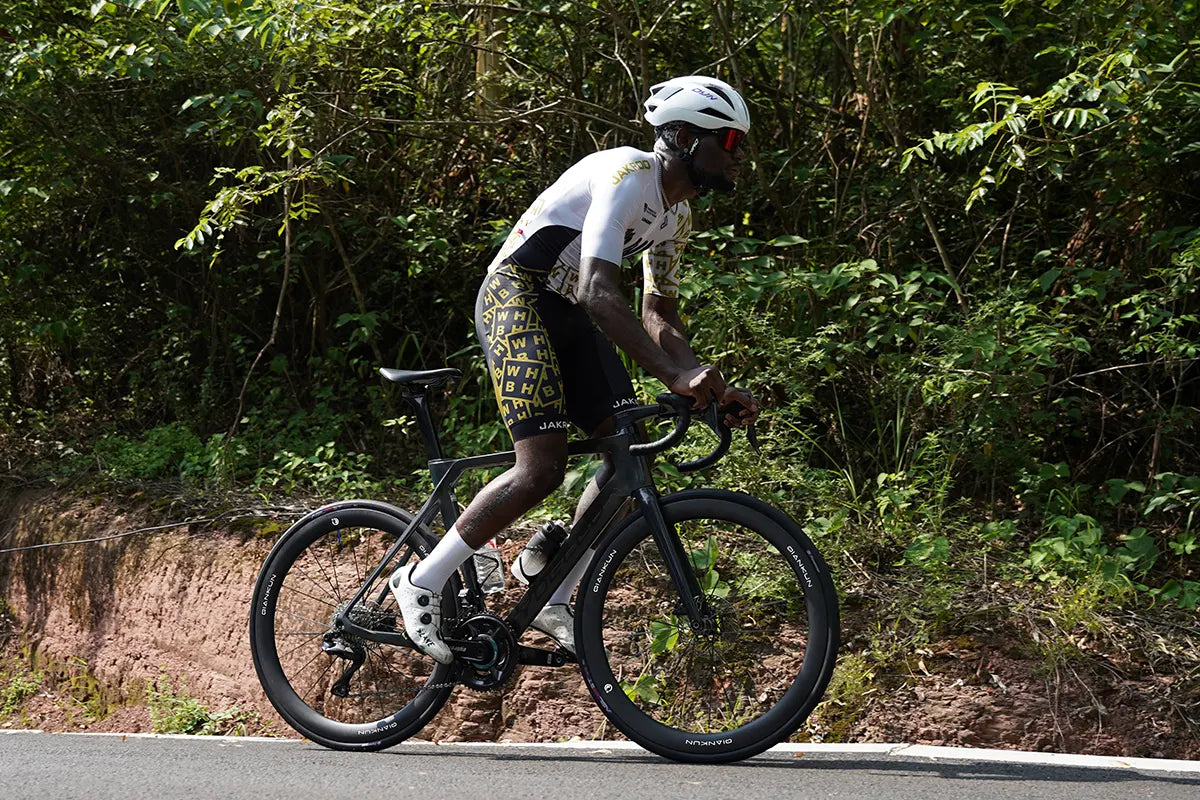
You find a carbon frame that looks incredible — low, aggressive, everything a race bike should be. You buy it. Three weeks later your lower back is screaming, your neck aches after an hour, and every training ride feels like a fight rather than a flow. The frame is not broken. The fit is.

Geometry is the single biggest variable in whether a bike feels alive or punishing — and it matters far more than gram counts or carbon grades. Yet most buyers focus on weight and aero stats while barely glancing at stack, reach, or head-tube angle. This guide fixes that.
|
ENDURANCE VS RACE GEOMETRY IN 30 SECONDS
• Race geometry: lower stack, longer reach, steeper head angle — faster handling, more aerodynamic, demands flexibility and core strength
• Endurance geometry: higher stack, shorter reach, slacker head angle — more stable, upright, forgiving over long miles
• The winner is the one that fits your body, your weekly volume, and your goals — not the one that looks fastest in photos
• Stack and reach are the two numbers that matter most; everything else follows from them
|
What Geometry Numbers Actually Mean
Stack is the vertical distance from the bottom bracket to the top of the head tube. Reach is the horizontal distance between those same two points. Together they define where your body sits relative to the pedals — and how much effort your muscles spend holding that position hour after hour.
A race frame typically runs 10–20mm less stack and 5–15mm more reach than an endurance frame in the same nominal size. That gap sounds small. On the bike, it translates to a dramatically different position: more hip rotation, more hamstring stretch, more demand on core stability. Riders with strong glutes, flexible hips, and high weekly volume handle it well. Most recreational riders do not.
Head Angle, Wheelbase, and How the Bike Handles
Head-tube angle and wheelbase determine handling feel. A steeper head angle — common on race frames — makes steering quicker and more responsive. That feels exhilarating at race speeds and in tight criterium corners. It also demands constant input, which gets tiring on six-hour sportives.
A slacker head angle, combined with a longer wheelbase, gives the bike more straight-line stability. The bike tracks better on rough chip-seal, reacts less sharply to crosswinds, and requires less active steering effort. Independent reviews of endurance-oriented frames consistently note that riders feel less fatigued at the end of long rides — not because the frame is slow, but because it is not fighting them.
The Comfort Variables: Stack, Seatpost, and Tire Clearance
Stack is not the only comfort lever. Seatpost compliance, tire width, and tire pressure all feed into what your body actually feels at the end of an hour. A race frame with a 32mm tire at moderate pressure can ride noticeably smoother than an endurance frame on 25mm tires inflated too hard.
That said, a race geometry frame with a compliant seatpost still cannot move the handlebar height up 20mm. Stack sets a ceiling that no component swap can raise without a stem swap or spacer stack — and both compromise the fit and the aesthetics the original geometry was designed for. Choose the geometry first, then fine-tune with components.
Who Race Geometry Actually Suits
Race geometry rewards riders who train five or more days a week, have spent time getting a professional bike fit, and ride at average speeds where aerodynamics starts to matter meaningfully — generally above 35 kph on flat terrain. It also suits shorter-duration efforts: criteriums, time trials, fast club rides where position can be sustained for 90–120 minutes without strain.

If you are building fitness, returning after time off, or riding primarily for enjoyment and distance rather than pace, race geometry asks more of your body than it gives back. The aerodynamic gain from a lower position is real, but it is measurable only above certain speeds and only when that position is actually held — which an uncomfortable rider cannot do for long.
Who Endurance Geometry Actually Suits
Endurance geometry suits a wider range of riders: those logging 8–15 hours per week across mixed terrain, riders returning from injury, anyone prioritizing consistency over peak speed, and riders who want one bike to cover sportives, gravel roads, and commutes. The higher stack lets you ride longer before fatigue sets in, and the slacker handling builds confidence in descending and crosswinds.

Endurance geometry does not mean slow. At the speeds most non-professional riders sustain, the aero penalty versus a race frame is minimal — and is more than offset by the ability to stay in the drops or on the hoods without shifting weight off the saddle every few minutes to relieve back pain.
Geometry Comparison: Race vs Endurance (Size 54cm Reference)
|
Dimension
|
Race Frame (typical)
|
Endurance Frame (typical)
|
What It Means
|
|
Stack
|
560–575mm
|
580–600mm
|
Higher = more upright, less hamstring demand
|
|
Reach
|
385–400mm
|
375–390mm
|
Longer = more stretched out, more aero
|
|
Head Tube Angle
|
73–74°
|
71–72°
|
Steeper = quicker steering, more rider input
|
|
Wheelbase
|
985–1,000mm
|
1,005–1,025mm
|
Longer = more stable, better tracking
|
|
Tire Clearance
|
28–32mm
|
30–35mm
|
Wider = more comfort, more grip options
|
A Practical Matching Framework
|
Rider Profile
|
Ideal Geometry
|
Why
|
|
Experienced racer, 5+ days/week, bike-fit done
|
Race
|
Aero position is sustainable; handling reward is real
|
|
Sportive rider, 3–4 days/week, mixed distances
|
Endurance or relaxed race
|
Comfort over long days; speed still competitive
|
|
Returning rider / building fitness
|
Endurance
|
Injury-avoidance; position more forgiving
|
|
All-road / mixed terrain rider
|
Endurance or gravel-specific
|
Tire clearance and stability over varied surfaces
|
|
Time trialist or criterium specialist
|
Race
|
Short efforts where aero position can be held
|
The Right Frame for Your Riding Style — Yoeleo's Range
Yoeleo offers three carbon frameset options, each engineered for a different point on the geometry spectrum. All are tested beyond ISO 4210 standards — 100,000 pedaling-fatigue cycles at 1,100N, independently verified by engineering reviewers including Hambini and Cyclist's Hub.
The R11 is Yoeleo's race-geometry road frameset: a low stack, extended reach, and stiff carbon construction designed for riders who want every watt transferred efficiently and every climb as light as the frame allows. It rewards riders who are committed to position and fit. The R12 carries more endurance-friendly proportions in an aero package — wider tire clearance, accessible stack — suited to riders who want speed on long days without sacrificing comfort. The Altera G21, Yoeleo's gravel frameset and the frame that took a double podium at the 2025 UCI Gravel World Championships, adds 53mm tire clearance and a longer wheelbase for riders who want one carbon frame that covers everything from fast road days to loaded adventure riding.
|
HOW YOELEO MATCHES GEOMETRY TO RIDER
• R11: race-geometry aero road frame, engineered for high-volume riders who can hold an aggressive position — tested to 100,000 pedaling-fatigue cycles at 1,100N
• R12: endurance-accessible road frame with aero shaping — more stack, wider tire clearance, six-year warranty
• Altera G21: gravel-optimized geometry, 53mm tire clearance, UCI Gravel Worlds double podium in 2025 — designed for all-road versatility
• All framesets UCI-approved and independently validated (Hambini, Peak Torque, Cyclist's Hub)
• DTC efficiency means the engineering investment goes into the carbon, not the retail channel
|
Frequently Asked Questions
What is the difference between endurance and race geometry on a road bike?
Race geometry uses lower stack, longer reach, and a steeper head angle for aerodynamics and sharp handling. Endurance geometry uses higher stack, shorter reach, and a slacker angle for comfort and stability over long rides.
How do I know if I need race or endurance geometry?
If you ride five or more days a week with a professional bike fit and sustain speeds above 35 kph, a race frame may suit you. If you prioritize long-distance comfort, consistency, or are building fitness, endurance geometry is the better match.
Can I make a race frame more comfortable with a different stem or bars?
You can fine-tune fit with stems and spacers, but geometry sets a ceiling. A race frame's lower stack cannot be raised significantly without compromising handling — choose the right geometry first, then adjust components around it.
Is endurance geometry slower?
At recreational and sportive speeds, the aero penalty of a higher stack is minimal and is easily offset by the ability to sustain effort longer without pain. At speeds above 40 kph and for durations under 90 minutes, race geometry offers a measurable advantage — for riders who can hold the position.
Share:
Build Bike From Frameset at Home: Step-by-Step Guide
Gravel Bike for Road Riding: Fast All-Road Setup Guide