
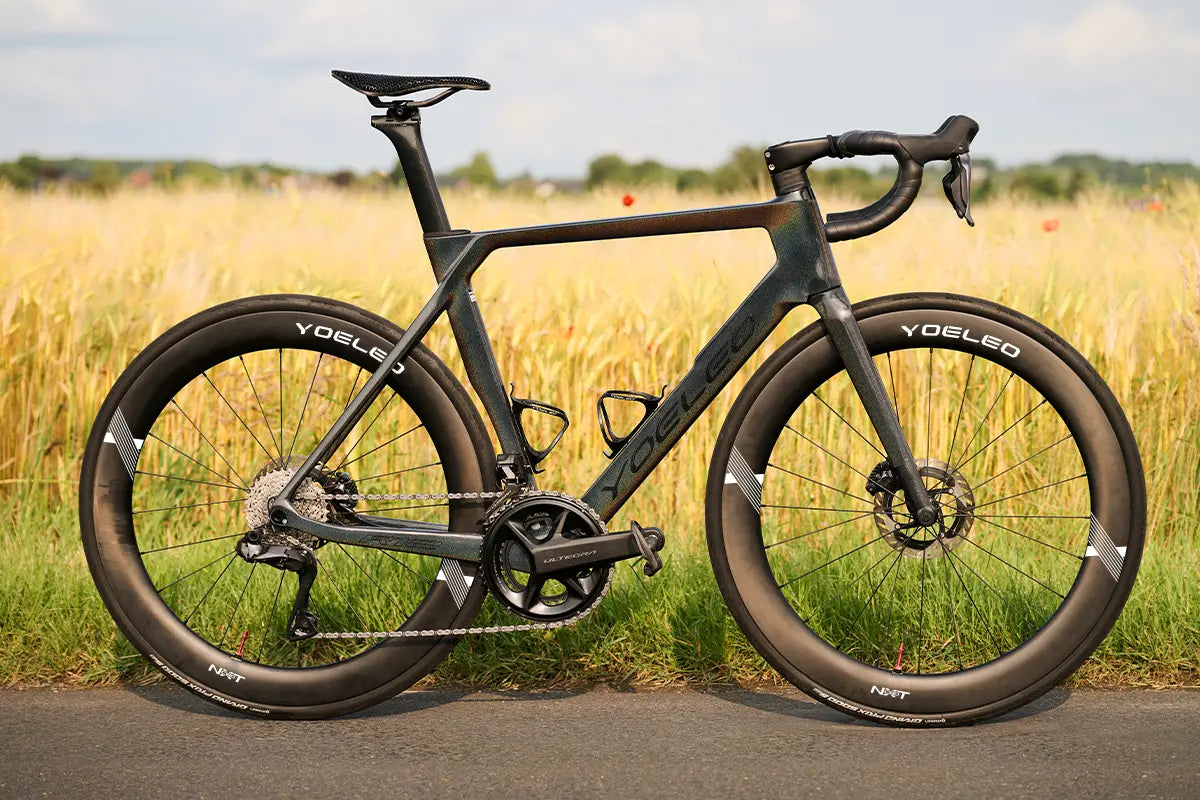
Most wheel brands publish the numbers they choose. Wind tunnel charts without axes. Weight claims without methodology. Spoke tension “averages” without individual readings. We’ve been guilty of some of that ourselves.
So we decided to do something different with the SAT C60 DB PRO NxT SL2. We shipped a production set — not a cherry-picked sample — to Hambini’s independent test facility in Hamburg for a full wind tunnel evaluation, spoke tension measurement, bearing vibration analysis, and build quality assessment. The test was conducted on 16 February 2025 using calibrated instrumentation from Fischer, Mitutoyo, Fluke, and Schenk, under controlled conditions at –3°C, 94% relative humidity, and 999 mbar atmospheric pressure.
What follows is everything that came back. Good numbers. Imperfect numbers. And what each one actually means for riding.
SAT C60 DB PRO NxT SL2: Key Specs
|
Specification
|
Value
|
|
Rim Depth
|
60mm front and rear
|
|
Internal Width
|
23mm
|
|
External Width
|
30.6mm (front) / 30.8mm (rear)
|
|
Bead Type
|
Hooked, tubeless-ready
|
|
Spokes
|
Pillar Wing 20 Aero (stainless steel), 2.4mm chord, 1.2mm thick
|
|
Spoke Count
|
24 (12 left / 12 right per wheel)
|
|
Hub
|
Yoeleo 36T Ratchet, disc brake
|
|
Weight (front wheel)
|
648g (Hambini-measured)
|
|
Tire Compatibility
|
Optimized 28–30c, compatible 25c+
|
|
Price
|
$1,049 USD
|
What Does a Hambini Full Wheel Test Actually Measure?
A Hambini Road Bike Wheel Test Certificate covers four categories: rim geometry and balance, spoke tension consistency, hub bearing health, and aerodynamic performance across yaw angles. Each test uses calibrated, lab-grade instrumentation — not the Park Tool tensiometer and digital caliper you’d find in a bike shop. The certificate is numbered, dated, and signed.
This matters because most “test data” published by wheel brands is self-reported. Hambini’s lab is independent, has no commercial relationship with Yoeleo, and has publicly destroyed products from brands far larger than ours when the data warranted it. The incentive structure is credibility, not sponsorship.

Build Quality: What the Spoke Tension Numbers Tell You
Spoke tension consistency is arguably the most revealing quality metric for a factory-built wheel. Uneven tension creates weak points that lead to broken spokes, loss of trueness, and premature rim fatigue. A well-built wheel should show minimal deviation from the average tension across all spokes.
Front wheel results:
The left side averaged 120.08 units with a deviation of just 2.98. The right side averaged 121.42 units with a deviation of 5.75. That left-side number is genuinely impressive — it’s the kind of consistency you’d expect from a hand-built wheel by a specialist wheelbuilder, not a factory production line.
Rear wheel results:
Left side: 126.33 average with 5.57 deviation. Right side: 125.08 average with 3.66 deviation. The higher average tension on the rear is standard practice — rear wheels carry more load and need more pre-tension to maintain trueness under asymmetric drivetrain forces.
|
Position
|
Avg Tension
|
Deviation
|
Assessment
|
|
Front Left
|
120.08
|
2.98
|
Excellent
|
|
Front Right
|
121.42
|
5.75
|
Good
|
|
Rear Left
|
126.33
|
5.57
|
Good
|
|
Rear Right
|
125.08
|
3.66
|
Very Good
|
To put these numbers in context: a spoke tension deviation under 5 is considered very good for a factory wheel. Over 10 starts to indicate quality issues. Three of the four positions here fall well within that window, and the fourth (front right at 5.75) is still solidly in acceptable territory.
We’re not going to pretend every number is perfect. The rear left deviation of 5.57 is higher than the front left’s 2.98 — that’s a real measurement from a real production wheel, and it reflects the inherent challenge of building rear wheels with their asymmetric spoke angles. But all four positions are within the range where you’d ride the wheel confidently for thousands of kilometers without retensioning.
Wheel Balance and Rim Geometry
Wheel balance affects how a wheel feels at speed — an unbalanced wheel creates vibration that increases with velocity, much like an unbalanced car tire. The Hambini test measures out-of-balance moment in grams per millimeter (g·mm).
The front wheel measured 215 g·mm at 26°, with an Ixx Delta of 96% relative to reference — meaning it’s 96% of the way to perfect rotational symmetry. The rear wheel measured 294 g·mm at 31°, with an Ixx Delta of 112%. The front number is very close to optimal. The rear is slightly higher, which is typical — rear wheels have more mass asymmetry due to the freehub body and cassette interface.
For reference, most riders won’t perceive balance differences below about 300–400 g·mm. The front wheel falls well under that threshold. The rear is at the lower end of the perceptible range, and in practice the cassette and tire dominate the balance equation on the rear.
Hub and Bearing Health: Vibration Analysis Explained
This section is technical, but it’s important. Hambini tests hub bearings using vibration frequency analysis — the same methodology used in industrial bearing diagnostics. Four specific frequencies are measured at each bearing position: BPFO (ball pass frequency, outer race), BPFI (ball pass frequency, inner race), BSF (ball spin frequency), and FTF (fundamental train frequency). A spike in any of these frequencies indicates a specific type of bearing defect.
Across all four bearing positions (front left, front right, rear left, rear right), the vibration amplitudes remained in the low to moderate range with no alarm-level spikes. This means no detectable defects on the outer races, inner races, rolling elements, or bearing cages. The bearings are operating within normal tolerance and the hub-to-bearing fit falls in the “Good” range.
The hub uses OEM bearings with JIS sizes 15267 (front), 6902 (rear), and 6802 (freehub), all with CN (normal) clearance. Radial and axial float measured 0.07mm and 0.07mm respectively — within spec for smooth operation without excessive play.
Aerodynamic Performance: Wind Tunnel Sweep Results
The aerodynamic testing is where this gets interesting for riders who care about speed. The wheels were tested in Hambini’s open-section wind tunnel in Hamburg, mounted with Continental GP5000 tires inflated to 28.5mm measured width, Shimano IceTech disc rotors (160mm front, 140mm rear), in an open tunnel configuration with forced induction and flow straighteners.
What the sweep curves show:
Both the front and rear wheels produced a smooth U-shaped drag profile from –20° to +20° yaw angle. The key characteristics are a low drag valley centered around 0° to ±5° yaw — where most riders spend the majority of their riding time in moderate crosswind conditions. As yaw increases toward ±20°, drag rises gradually without any abrupt spikes or stalls.
This smooth transition is the critical finding. Many deep-section wheels suffer from an aerodynamic “cliff” at certain yaw angles — a sudden drag increase that manifests as a physical jolt in gusty crosswinds. The NxT C60’s 30.6mm external width paired with the 60mm depth appears to provide enough aerodynamic stability to avoid this behavior across the full –20° to +20° range.
The front and rear sweep curves track each other closely, indicating the wheel pair was designed as a matched system rather than as individual rims that happen to share a depth. This front-rear balance helps maintain predictable handling when crosswinds shift.

What We’d Improve: Honest Assessment
No product is perfect, and publishing only the good data would undermine the point of this exercise. Here’s what we’d work on:
Rear spoke tension deviation: The 5.57 left-side deviation on the rear wheel, while within acceptable bounds, leaves room for improvement. Our target for the next production batch is to bring all positions under 5.0. This requires tighter QC tolerances on the rear lacing — something we’re actively calibrating.
Rear wheel balance: 294 g·mm is adequate but not outstanding. We’re investigating whether valve stem weight distribution or rim joint placement adjustments can bring this closer to the front wheel’s 215 g·mm.
Absolute aero values: The sweep curves show shape and trend, but we’d like to publish absolute drag numbers with defined baselines in future testing. This would allow direct numerical comparison with other wheelsets tested in the same facility.
Who Should Ride the NxT C60 (and Who Shouldn’t)
This wheel makes sense for you if: you want a deep-section aero wheel for racing, fast group rides, or flat-to-rolling terrain, and you value third-party validated build quality and aerodynamics at a price point that doesn’t require a second mortgage. The 23mm internal width with hooked rim supports a wide range of modern tires from 25c to 30c, and the smooth aero profile means you won’t be fighting the wheel in crosswinds.
Consider the C50 instead if: you ride a lot of mixed terrain including climbs, want a slightly lighter wheel (1,330g vs 1,340g pair), or simply prefer more moderate depths for everyday riding. The 10mm depth reduction trades a small amount of aero efficiency for better handling in very strong crosswinds.
Consider the C35 if: climbing is your primary focus. At 1,260g, the C35 is the lightest option in the NxT lineup and better suited for mountainous terrain where weight savings outweigh aero gains.

Frequently Asked Questions
Is the Hambini test independent?
Yes. Hambini’s test facility operates independently of any wheel manufacturer. Yoeleo paid for the test but had no input on methodology, no advance review of results, and no ability to suppress unfavorable findings. The certificate is published in full, unedited.
What tires were used in the wind tunnel test?
Continental GP5000 at 28.5mm measured width on both front and rear, with Shimano IceTech disc rotors (160mm front, 140mm rear). Tire choice significantly affects aero results, so this context matters for any comparison.
How does spoke tension deviation under 6 compare to competitors?
Most factory-built wheelsets in the $800–$2,000 range achieve deviations between 4 and 10. Below 5 is considered very good. Below 3 (as seen on our front left) approaches hand-built quality. Independent testing by Cyclist’s Hub (Petr Minarik) has found Yoeleo wheels to have better trueness than several comparably priced competitors.
Can I see the full test certificate?
Yes. The complete Hambini Road Bike Wheel Test Certificate (Document Version 2.8) is available for download as a PDF on this page. We encourage you to read it alongside this interpretation.
Is the NxT C60 suitable for heavy riders?
The NxT C60 is built with Toray T1000 carbon rims and Pillar Wing 20 Aero stainless steel spokes, impact-tested at 120J (three times the 40J industry standard). Combined with consistent spoke tension across all positions, the wheel is designed for riders across a wide weight range. That said, if you’re over 95 kg and ride rough roads, consider the C50 for its slightly more forgiving depth profile.
Share:
Stainless vs Carbon Spoke Wheelsets: NxT SL2 or QianKun CS — Which Should You Buy?
How to Set Up Tubeless Road Bike Wheels: Complete Guide (2026)