
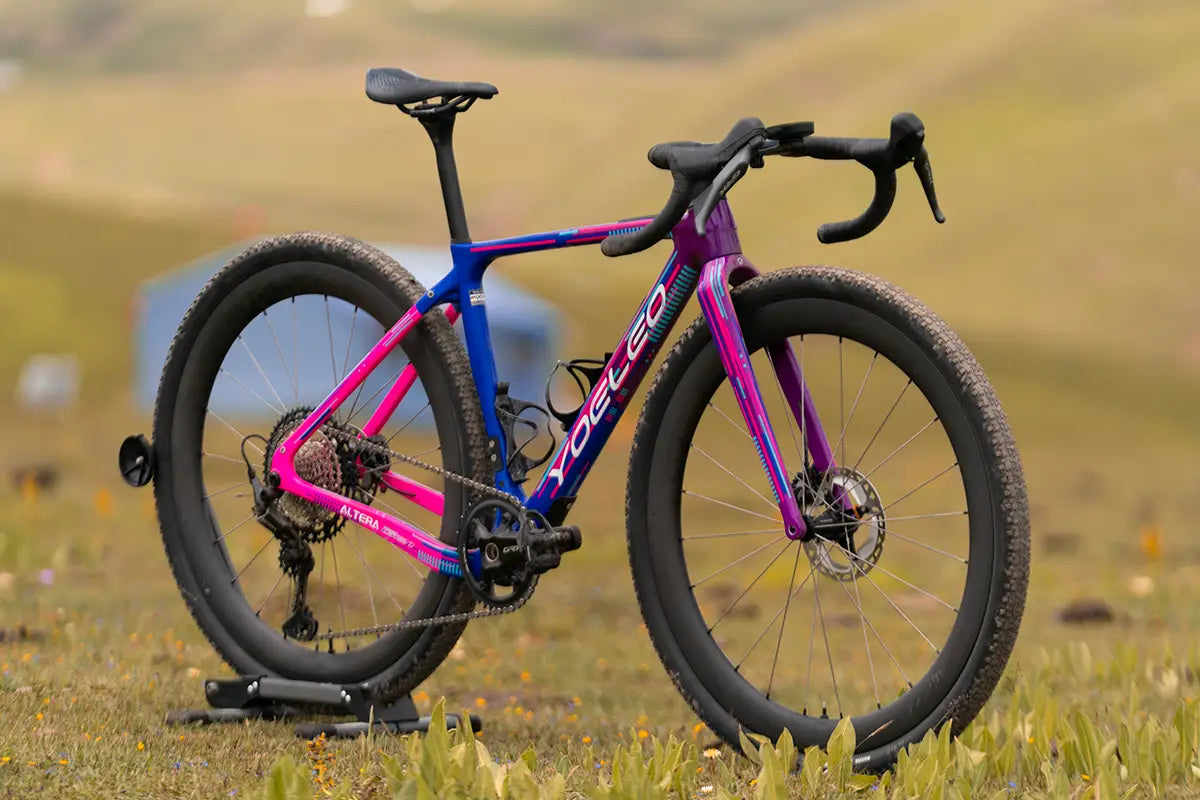
A gravel frame’s geometry is the sum of a dozen decisions made by the engineering team. Each number answers a question: how aero can the rider sit, how predictable is the steering on loose surfaces, how does the bike accelerate, how does it corner at speed. Most geometry charts show the numbers. This post explains what the G21’s numbers actually do.
The short version: the G21 is engineered as a race-capable all-rounder with bikepacking capability baked in. It is not a pure race frame and it is not a pure adventure frame — it is the rare combination of both, validated by a UCI Gravel Worlds double podium and by riders using the same frame to cross Europe with loaded forks.
|
GEOMETRY PHILOSOPHY
• Race-capable: UCI-legal, 700×53mm clearance, long wheelbase for stability
• Fit-progressive: reach and stack scale consistently across all 7 sizes
• All-terrain: trail figure optimized for loose gravel predictability
• Bikepacking-ready: fork mounts, in-frame storage, 27.2mm dropper-compatible post
|
What is the G21’s geometry chart?
The full chart across all 7 sizes. Numbers in mm unless noted.
|
Size
|
Reach
|
Stack
|
HTA
|
STA
|
BB Drop
|
Chainstay
|
Wheelbase
|
|
45cm
|
373
|
512
|
69.0°
|
75.0°
|
79
|
433
|
1015
|
|
49cm
|
373
|
531
|
69.5°
|
75.0°
|
79
|
433
|
1030
|
|
52cm
|
379
|
549
|
70.0°
|
74.0°
|
79
|
433
|
1042
|
|
54cm
|
383
|
566
|
70.0°
|
73.5°
|
79
|
433
|
1055
|
|
56cm
|
387
|
586
|
71.0°
|
73.0°
|
79
|
433
|
1065
|
|
58cm
|
390
|
611
|
71.0°
|
73.0°
|
79
|
433
|
1078
|
|
60cm
|
396
|
640
|
71.0°
|
73.0°
|
79
|
433
|
1090
|

These are reference numbers — always confirm with the current Yoeleo spec sheet before sizing. What they mean is more interesting than the numbers themselves.
What does the reach/stack progression actually do?
Reach grows by 10mm per size. Stack grows by about 22mm per size. This is a deliberate choice — the reach-to-stack ratio stays close across the range, which means a 52 rider and a 58 rider get the same handling character. On poorly scaled gravel frames, small sizes handle "short and tall" (choppy, upright) while large sizes handle "long and low" (stretched, unstable). The G21 avoids both.
The ratio sits in a race-leaning range — lower stack, more reach — which puts the rider in a slightly forward position that weights the front wheel. On gravel, a weighted front wheel is what gives you grip on loose descents. Too upright, and the front slides out. Too aggressive, and the rider fatigues. This ratio is the balance point.

Why the head tube angle matters more than you think
72 degrees head tube angle, paired with the G21’s 45mm fork offset, produces roughly 68 to 70mm of trail across most sizes. This is the race-gravel sweet spot. Trail below 65mm feels twitchy on fire roads and forces constant micro-corrections. Above 72mm, the bike resists quick line changes in technical sections.
The 70mm trail figure is what lets the G21 hold a line on loose gravel without fighting the rider. Pravilova’s winning move at UCI Gravel Worlds 2025 was on a loose descent — her ability to commit to a fast line there was the trail figure working as intended.

Chainstay length: why it scales
Chainstays grow from 420mm on the smallest sizes to 430mm on the largest. Fixed chainstay length across sizes (common on cheaper frames) creates a handling mismatch — on small frames, a 430mm chainstay makes the bike feel too long; on large frames, a 420mm chainstay makes the bike feel unstable under power.
Scaling chainstays by size keeps weight distribution consistent front-to-rear. A 60cm rider and a 49cm rider both get the same percentage of body weight over the rear wheel — which is the actual variable that controls power transfer and climbing traction. This is not a luxury; it is basic geometry that many frames skip because it is more expensive to tool.

BB drop: stability versus pedal clearance
72mm bottom bracket drop is on the lower side of gravel frames, which means the rider sits lower in the bike — more stable through corners, more confidence on loose surfaces. The tradeoff is pedal clearance. With 170mm cranks and 45mm tires, the G21 has adequate clearance on all but the most extreme gravel sections. If you plan to run 650b wheels (which lower the BB further by about 8mm), switch to 165mm cranks to regain clearance.
Wheelbase: why it ranges from 1015 to 1090mm
Wheelbase grows with frame size, as it should, but the scaling is designed to keep the weight distribution ratio consistent rather than just accommodating longer frame tubes. A longer wheelbase is more stable at speed, less agile in tight corners — the G21 biases toward stability, which is the right call for a gravel frame where fast descents on loose surface are a regular occurrence.
Compare the G21’s 1055mm wheelbase in 54cm to a race road bike’s 985mm in the same size. That 70mm difference is what makes gravel descents at 60kph feel controlled instead of sketchy.
FAQ
What size Altera G21 should I buy?
Compare the G21’s reach and stack numbers (at the size you are considering) to your current bike’s reach and stack. If your current bike fits well, match those numbers. For a gravel-specific fit, target 5 to 10mm more reach and similar stack — a slightly more stretched position for gravel’s aero and weight-distribution needs.
Is the G21 better for racing or bikepacking?
Both. The geometry is race-capable (UCI-legal, podium-proven) but the frame has in-frame storage, optional pannier-mount forks, and dropper-compatible seatpost. It is one of the few gravel frames that does both without compromising either — the setup choices are in the build, not the frame.
Can I run 650b wheels on the G21?
Yes, the frame accepts 650b as a secondary configuration. Expect the BB to sit about 8mm lower than with 700c, so switch to 165mm cranks to preserve pedal clearance. Tire sizes up to 2.1 inches work with 650b; the limiting factor is rim width and chainstay mud clearance.
What is the weight limit for the G21?
105kg (231lb) rider weight limit. This is the tested ceiling for warranty; frames typically handle more but the warranty specifies 105kg. Loaded bikepacking weight counts against this limit — plan accordingly.
Does the G21 use a standard or proprietary seatpost?
Standard 27.2mm round seatpost. This is deliberate — it keeps dropper post compatibility open (most droppers are 30.9 or 31.6, but 27.2mm droppers exist) and gives the seatpost more flex than a D-shaped proprietary design. Compliance at the seatpost is a meaningful contributor to ride quality on long gravel rides.
Share:
Altera G21 Color Guide: How to Choose the Right Finish for Your Gravel Build
Gravel Bikepacking vs Gravel Racing