
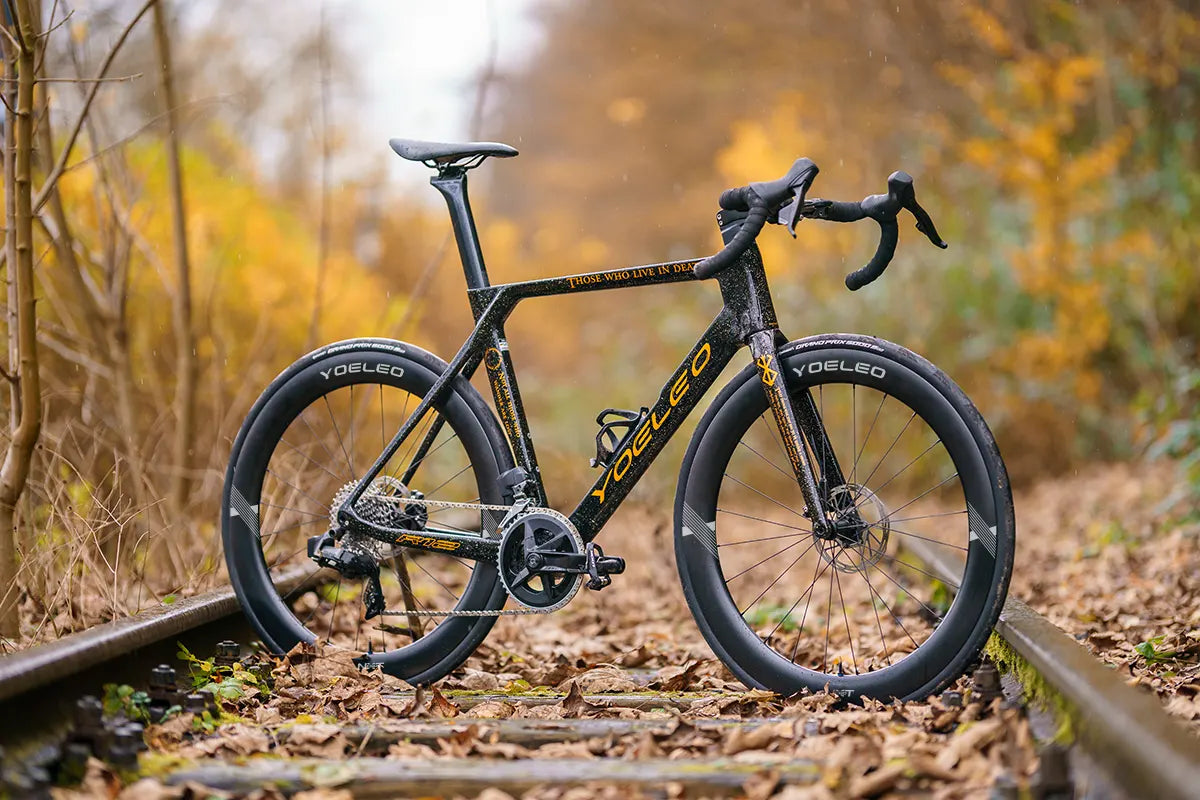
Every rider who's ever considered a custom paint job has had the same quiet thought: but will it make my bike slower? It's the aesthetic athlete's dilemma in one question — the pull between a frame that's unmistakably yours and a frame stripped to its fastest possible form.

The cycling internet doesn't help. One camp treats color as a vanity tax that costs you watts and grams. The other treats raw, unpainted carbon as the only “serious” finish. Both are missing the point. Let's put real numbers on custom bike paint, kill a couple of myths, and balance technical excellence with the way you want your bike to look.
|
THE 30-SECOND ANSWER
• A full custom paint scheme adds ~80–200 g — real, but small
• On an 800 g frame, paint is ~140–180 g (17–22% of bare frame weight)
• Matte vs gloss makes no measurable aero difference — it's looks, not speed
• Raw carbon still needs a UV clear coat, so the weight saving is smaller than it sounds
|
Does Custom Bike Paint Affect Performance?
Barely. A full custom paint scheme typically adds 80–200 grams to a frame — real but small — and finish choice has no meaningful effect on aerodynamics. The performance cost of color is far smaller than riders fear.
Color costs you a little weight and essentially zero speed. What it buys you — identity, protection, and the feeling of riding something that's actually yours — is the part the spec-sheet crowd never weighs.
The Real Weight of Color
Paint is heavier than nothing, but it's not the anchor people imagine. On most frames a complete paint job adds somewhere between 80 and 200 grams depending on colors and clear coats.

On an 800-gram carbon frame, paint and clear coat typically account for 140–180 grams — roughly 17–22% of bare frame weight, according to frame-painting data shared across cycling forums including Weight Weenies. That sounds dramatic as a percentage, but it's about the weight of a gel flask. On a 7–8 kg bike you'll never feel 150 grams of paint on a climb — you'll feel a skipped breakfast more.
And “raw carbon to save weight” comes with an asterisk: bare carbon must be protected from UV light or the resin degrades, so even a stripped frame needs a thin clear coat (15–20 g) or regular waxing. The weight you save by going naked is smaller than the marketing suggests, and the maintenance is higher.
The Matte-vs-Gloss Myth
Matte and gloss finishes perform identically on the road. The aerodynamic difference is too small to measure in real-world riding, so the choice is about looks and upkeep, not speed.
You'll see claims that matte's micro-roughness creates an aero advantage. In practice the texture is far too fine to change drag at the speeds humans ride — as forum testing and aerodynamicists consistently conclude, finish is “more for looks than anything else.” Gloss is easier to clean; matte resists minor scuffs but shows fingerprints and is harder to touch up. Pick the one you like looking at.
|
Finish choice
|
Approx. added weight
|
What it actually changes
|
|
Raw carbon + thin clear coat
|
~15–20 g
|
Lightest, but needs UV protection; generic look
|
|
Single solid color
|
~80–120 g
|
Clean, durable, easy to touch up
|
|
Multi-color / custom scheme
|
~140–200 g
|
Maximum identity; negligible speed cost
|
Why Color Is Identity, Not Vanity
A bike's finish is the one part of its engineering you experience before you turn a pedal. Dismissing it as vanity misunderstands why people ride the bikes they ride.
Performance brands have always known this. Iconic paint schemes become iconic because they make a fast object feel meaningful to the person riding it. Your colorway is how the bike becomes yours rather than one of a thousand identical frames at the start line. For a credibility-first brand that's not a contradiction with engineering — it's the emotional payoff the engineering earns.
The Honest Trade-Off
Raw carbon is the lightest and shows off the layup, but it's visually generic and needs UV care. A custom scheme adds maybe 150 grams you'll never feel and gives you a bike no one else has. Neither choice is wrong — but only one of them you'll smile at in the garage. The “serious riders ride raw” idea is mostly aesthetics dressed up as performance.
What to Look For in a Custom Paint Program
Good custom paint is a craft process, not a checkbox. Before you order, look for a program that shows you the work.
Three things separate a real custom program from a color picker. A design conversation: a designer who turns your references into a mock-up you approve before anything is sprayed. Proof before it ships: physical photos of the finished frame so there are no surprises in the box. And honest lead times: quality paint takes weeks, and a brand that's upfront about that is doing it properly.
Where Craft Meets Technical Excellence
This is the balance the aesthetic athlete is really after — a frame engineered to perform and finished to mean something. It's also where a direct-to-consumer model quietly changes the math.
Yoeleo offers custom paint across the R11, R12, and Altera G21 in four approaches — FADED gradients, bold CUT color-blocks, clean CLASSIC solids, and fully bespoke CUSTOMIZED designs. A designer works from your references, you approve a mock-up, and you receive physical photos of the finished frame before it ships. The full custom route takes around 50 days — and that's craft time, not a delay. Hand-finishing a frame to an exact spec simply takes that long to get right.

|
HOW YOELEO BALANCES SPEED AND IDENTITY
• Four paint approaches: FADED, CUT, CLASSIC, CUSTOMIZED
• Designer mock-up + your approval before any paint is sprayed
• Physical photos of the finished frame sent before shipment
• ~50-day craft time — the cost of getting a bespoke finish exactly right
• Factory-direct keeps premium finishing within reach (accessible premium value)
|
So, will color make your bike slower? Functionally, no. What it will do is make a technically excellent frame unmistakably yours — and that was always the point.
Frequently Asked Questions
How much weight does custom paint add to a bike frame?
A full custom paint job typically adds 80–200 grams, depending on colors and clear coats. On an 800-gram carbon frame, paint accounts for roughly 140–180 grams — about 17–22% of bare frame weight, but a negligible fraction of total bike weight.
Is raw carbon lighter than a painted frame?
Yes, but less than people think. Raw carbon still needs UV protection — a thin clear coat (15–20 grams) or regular waxing — or the resin degrades. The real-world weight saving over a single solid color is often under 100 grams.
Does matte or gloss paint affect speed?
No. The aerodynamic difference between matte and gloss is too small to matter at real riding speeds. Choose based on looks and maintenance: gloss cleans more easily, while matte hides minor scuffs but shows fingerprints and is harder to touch up.
How long does a custom bike paint job take?
Quality custom paint usually takes several weeks. Yoeleo's full custom process runs around 50 days, covering design mock-up, your approval, hand-finishing, and pre-shipment photos. That window is craft time — the cost of getting a bespoke finish exactly right.
Share:
Why Is Bicycle Frame Stiffness Crucial? Bottom Bracket, Steering & Comfort
Stack & Reach Bike Fit: Match Any New Frame