
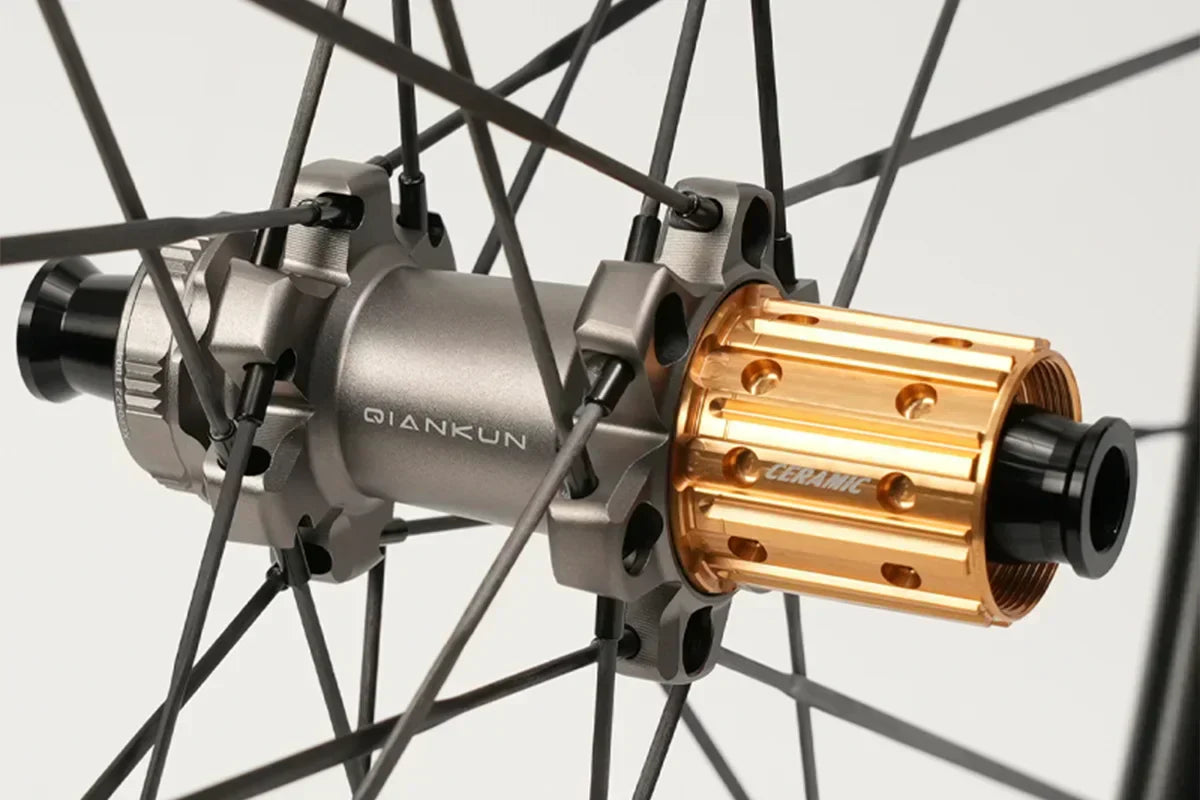
Every competitive cyclist has heard the pitch: ceramic bearings are the secret to faster bikes. They reduce rolling resistance, cut watt loss, and promise years of dependable service. Yet the price tags are equally dramatic, often 3 to 8 times that of steel alternatives. So the question becomes: are you investing in genuine performance gains, or have you stumbled into one of cycling's most effective marketing narratives?
The answer, unsurprisingly, is nuanced. Ceramic bearings do deliver measurable advantages in specific contexts. The physics is sound: silicon nitride (Si₃N₄) is demonstrably harder, smoother, and lighter than steel. But not every bearing location in your bike benefits equally. Not every budget should shoulder the cost. And critically, not all ceramic bearings are engineered to the same standard.
This post cuts through the marketing noise. We examine the science, analyze real-world performance data, challenge common myths, and help you make a decision rooted in actual physics and testing, not aesthetic appeal.
|
Ceramic Bearings in 30 Seconds
It depends on context and budget. Ceramic bearings deliver 10–15% lower rolling resistance and superior longevity in sealed, corrosion-prone environments (hubs, bottom brackets). For competitive cyclists prioritizing watt savings and maintaining equipment, the investment pays dividends over 3–5 seasons. For casual riders, the cost-to-benefit ratio rarely justifies the upgrade. The critical variable is bearing quality: premium sealed ceramic bearings (like those in Yoeleo QianKun hub systems) outperform cheap alternatives by orders of magnitude.
|
The Science Behind Ceramic Bearings: Silicon Nitride Fundamentals
Why Silicon Nitride Wins on Paper
Silicon nitride is approximately 40% less dense than steel, meaning ceramic balls weigh significantly less for the same rolling diameter. Less rotational mass reduces inertia — your wheel or crank requires less energy to accelerate and maintain speed. This property alone accounts for measurable watt savings, particularly in sprint and climbing scenarios.
Hardness is another decisive element. On the Mohs hardness scale, silicon nitride scores 9.0, compared to steel's 6.5–7.0. This superior hardness translates to lower deformation under load. When bearing races are smoother and less prone to micro-indentation, friction drops measurably.
Corrosion resistance is the third pillar. Steel oxidizes readily, especially in wet, salty, or humid environments. Silicon nitride is chemically inert. In sealed bearing systems, this means your hub bearings remain smooth and free-rolling far longer than their steel counterparts.
Hybrid vs. Full Ceramic: The Design Trade-off
Hybrid Ceramic: Ceramic balls paired with steel races. This design balances performance with cost. You get 60–70% of ceramic's friction benefits at roughly half the price. Ideal for mid-range wheelsets and drivetrain components.
Full Ceramic: Both balls and races are silicon nitride. Maximizes longevity and minimizes drag across all operating conditions. Reserved for premium applications — high-end bottom brackets, sealed hub systems like Yoeleo QianKun, and competition environments where every watt counts.
|
Source Reference
ISO 15243:2017 defines ceramic rolling bearing classifications and testing protocols. Hambini, an independent bearing engineer, has published extensive comparative friction measurements confirming these performance deltas.
|
How Bearings Affect Rolling Resistance
Rolling resistance is the primary metric cyclists track. A ceramic bearing exhibits lower hysteresis (the lag between applied force and elastic response) than steel. This means the material rebounds more completely after deformation, wasting less energy as heat.
In quantitative terms, premium ceramic-bearing hubs record rolling resistance values of 3–5 watts per 100 rpm, compared to 4–7 watts for quality steel-bearing hubs — a delta of 1–2 watts that compounds over hours of riding.
For context, a 70 kg cyclist pedaling at steady state on flat terrain is generating roughly 150–200 watts. A 2-watt savings represents a 1–1.3% efficiency gain — subtle but measurable in long-distance events, time trials, and mountain climbing.
Where Ceramic Bearings Matter Most in Cycling
Not all bearing locations deliver equal returns. Bearing drag scales with rotational speed and load. The bearing that spins fastest and handles the greatest stress yields the largest watt savings.
1. Wheel Hubs (Highest Impact)
Wheel bearings support both radial and thrust loads while spinning at speeds up to 150 rpm. This is the single highest-impact location. A ceramic hub bearing system reduces rolling resistance by 1–2 watts. Yoeleo QianKun hub systems, rated to 230 Nm × 52,000 torque cycles, incorporate sealed ceramic bearings as standard, delivering this benefit across both front and rear wheels.
2. Bottom Bracket Bearings (Very High Impact)
The bottom bracket experiences enormous radial load from pedaling force (easily 1,000+ N on each pedal stroke). Ceramic bearings here resist wear and maintain smooth, low-friction rotation under extreme stress. A quality ceramic bottom bracket reduces power loss by 0.5–1 watt compared to a worn or low-quality steel unit.
3. Headset Bearings (Moderate Impact)
Headsets rotate rarely compared to hubs, but they're often neglected. Ceramic headset bearings resist water ingress and corrosion. Watt savings are minimal (0.2 watts), but longevity gains are substantial.
4. Jockey Wheels / Rear Derailleur Pulleys (Lower Impact)
These bearings spin quickly but support minimal load. Ceramic pulleys reduce friction slightly (0.1–0.3 watts) and maintain indexing precision longer. Worthwhile for racers but optional for recreational riders.
|
Location
|
Impact Level
|
Watt Savings
|
Key Benefit
|
|
Wheel Hubs
|
Highest
|
1–2 W
|
Speed, acceleration, durability
|
|
Bottom Bracket
|
Very High
|
0.5–1 W
|
Power transfer, wear resistance
|
|
Headset
|
Moderate
|
~0.2 W
|
Longevity, corrosion resistance
|
|
Jockey Wheels
|
Lower
|
0.1–0.3 W
|
Indexing precision, low friction
|

How Much Speed Do Ceramic Bearings Actually Add?
Real-World Testing Data
Hambini, an independent bearing engineer, has published friction measurements of ceramic vs. steel hubs across a range of speeds and loads:
|
Bearing Type
|
Watts per 100 RPM
|
Delta vs. Premium Steel
|
|
Ceramic Hybrid Hubs
|
3.0–4.5 W
|
1.5–2.0 W savings
|
|
Premium Steel Hubs
|
4.5–6.5 W
|
Baseline
|
|
Budget Steel Hubs
|
6.5–9.0 W
|
+2.0–2.5 W penalty
|
The gap widens with speed. At 100 rpm (moderate cadence), the delta is 1–2 watts. At 120 rpm (high cadence), it grows to 2–3 watts.
Friction Facts, another independent testing lab, confirms these figures with dynamometer data. They found that sealed ceramic bottom brackets produce 0.4–0.8 watts of savings vs. open steel units.
|
The Price-to-Performance Equation
Total watt savings from upgrading to ceramic hubs plus ceramic bottom bracket is approximately 1.5–3.5 watts. For a 70 kg cyclist producing 200 watts, this is a 0.75–1.75% efficiency gain. A Yoeleo QianKun hub, priced at $1,650, includes ceramic sealed bearings and is rated for 52,000 torque cycles — roughly 8–10 years of hard racing. Amortized over that lifespan, the cost per year drops dramatically, making ceramic a sensible long-term investment.
|
Ceramic vs. Steel Bearings: Complete Comparison
|
Attribute
|
Ceramic Bearings
|
Steel Bearings
|
|
Rolling Resistance
|
Lower (10–15% less drag)
|
Standard baseline
|
|
Durability
|
Excellent (50,000+ hours)
|
Good (10,000–20,000 hours)
|
|
Cost
|
Premium (3–8x steel)
|
Budget-friendly
|
|
Weight
|
Lighter (40% less dense)
|
Heavier
|
|
Corrosion Resistance
|
Superior (ideal for wet)
|
Good (requires maintenance)
|
|
Noise Profile
|
Quieter operation
|
Slightly more audible
|
|
Maintenance
|
Minimal (sealed units)
|
Regular cleaning/lubrication
|
|
Temperature Range
|
Higher limits (to 250°C)
|
Limited (80°C safe)
|

Common Myths and Misconceptions
Myth 1: "Ceramic Bearings Save You 10 Watts"
This is the most pernicious myth. A complete ceramic upgrade — hubs, bottom bracket, jockey wheels, headset — might save 2–3.5 watts under optimal conditions. Claiming 10 watts is either counting hypothetical benefits from multiple upgrades or extrapolating from controlled testing conditions. Real-world testing yields lower figures.
Myth 2: "Ceramic Bearings Last Forever"
Silicon nitride is extremely durable, but not indestructible. Premium sealed ceramic bearings are rated for 50,000+ hours (roughly 8–10 years at 10 hours per week). After that, internal lubricant viscosity degrades. Improper sealing can also compromise longevity.
Myth 3: "All Ceramic Bearings Are the Same Quality"
This is false. Quality varies enormously based on silicon nitride purity, seal design, race material, and preload specifications. A premium sealed ceramic bearing from a reputable manufacturer (like those in Yoeleo QianKun hubs) undergoes rigorous testing. Budget ceramic bearings often use lower-grade silicon nitride and inferior seals.
Myth 4: "Steel Bearings Are Always Good Enough"
For casual riding in dry conditions, quality steel bearings are sufficient. However, steel bearings excel in exactly zero conditions where ceramics don't also excel. In wet or salty environments, they rust. Under extreme load or high cadence, they generate more friction.

What to Look For: Practical Buying Advice
Quality Indicators
Published specifications (radial play, preload data, lubrication details). Seal type: sealed cartridge bearings with dual seals are superior. Lubrication: premium sealed bearings use grease formulated for ceramic. Certifications: ISO 15243 compliance. Manufacturer reputation: Yoeleo QianKun hub systems integrate ceramic sealed bearings as standard and undergo extensive durability testing (230 Nm × 52,000 torque cycles).
When Ceramic Is Worth the Investment
You race or ride competitively. You ride in wet, salty, or coastal environments. You log 10,000+ km per year. You ride high-end bikes. You're upgrading hubs anyway.
When to Skip Ceramic
Casual recreational rider (less than 3,000 km/year). Bike doesn't see harsh conditions. Budget is tight. Replacing sealed steel with budget ceramic.
|
Question
|
Yes = Ceramic
|
No = Steel
|
|
Will 1–3 W savings improve my goals?
|
Racers, competitors
|
Recreational riders
|
|
Can I justify 3–5x cost premium?
|
Over 5+ year lifespan
|
Short-term replacement
|
|
Do I ride in harsh conditions?
|
Coastal, wet, salty
|
Dry climate, garaged
|
Yoeleo Ceramic Bearing Advantage
Yoeleo QianKun hub systems exemplify integrated ceramic bearing design. Both the QianKun CS50 (1,185g ±3%, $1,650) and QianKun CS60 (1,285g ±3%, $1,650) feature sealed ceramic bearings as standard, paired with the Pro-Fit TA system — a design that prevents bearing over-tightening and maintains precise alignment.
This contrasts with the NxT SL2 series ($999), which uses premium steel bearings. The NxT remains an excellent value wheelset, but cyclists prioritizing maximum performance and longevity will find the ceramic upgrade meaningful.
|
Model
|
Bearing Type
|
Weight
|
Price
|
Best For
|
|
QianKun CS50
|
Sealed Ceramic
|
1,185g ±3%
|
$1,650
|
Racing, competition
|
|
QianKun CS60
|
Sealed Ceramic
|
1,285g ±3%
|
$1,650
|
Aero racing, sprints
|
|
SAT C50 NxT SL2
|
Premium Steel
|
1,330g
|
$999
|
All-round value
|
|
SAT C60 NxT SL2
|
Premium Steel
|
1,340g
|
$1,049
|
Aero value
|
Frequently Asked Questions
Q: How much faster will ceramic bearings make me?
Realistically, 1–3 watts of savings translates to 0.3–0.8 km/h on flat terrain at 200W output. On longer climbs or time trials, the benefit is slightly larger. Marketing claims of "2 mph faster" are misleading; you'll notice the improvement over a season, not immediately.
Q: Are hybrid ceramic bearings as good as full ceramic?
Hybrid ceramic delivers 60–70% of full ceramic's performance at roughly 50% of the cost. For hubs and bottom brackets, hybrid is a sensible middle ground. For ultra-premium applications, full ceramic justifies the cost.
Q: Can I replace steel bearings with ceramic in my current wheels?
Sometimes. If your hub uses standard cartridge bearings (6903, 6904, etc.), you may find ceramic equivalents. However, it's usually better to buy a complete ceramic hub wheelset to ensure proper engineering and balance.
Q: How do I maintain ceramic bearings?
Less often than steel. Annual inspection for play, occasional flushing with fresh grease every 2–3 years. Avoid high-pressure washers directly on hubs. Let bearings dry after wet rides before storing.
Q: Are ceramic bearings environmentally friendly?
Silicon nitride is inert and non-toxic. Manufacturing is energy-intensive, but the longer lifespan offsets this: a ceramic bearing might outlast two steel units, reducing total waste.
Final Verdict
Ceramic bearings are a legitimate performance upgrade for competitive cyclists, frequent riders, and anyone in harsh conditions. They reduce rolling resistance by 1–3 watts, dramatically extend service life, and require minimal maintenance. However, they are not a magic bullet. For casual riders or those on tight budgets, quality steel bearings remain perfectly adequate. If you're committing to a premium wheelset upgrade, integrating ceramic bearings from the outset — as Yoeleo does in the QianKun series — is the optimal approach. You'll maximize performance, durability, and long-term value.
Share:
How to Set Up Tubeless Road Bike Wheels: Complete Guide (2026)
Cycling in Wind: How Wheel Depth Affects Your Ride — and What to Do About It