
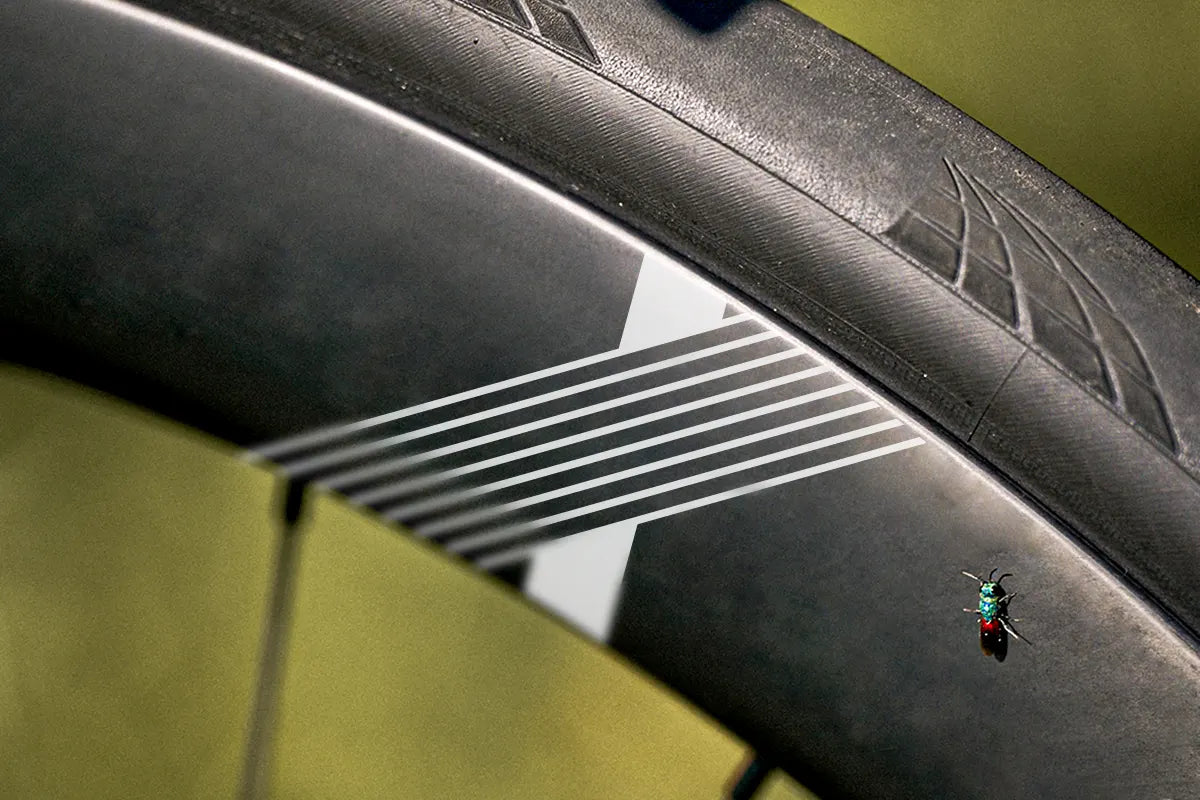
Five years ago, a 25mm tire on a 17mm internal rim was "normal." Today that same setup feels dated, slow, and harsh — and most riders can't quite explain why. The answer isn't the tire. It's the rim underneath it. The width of your rim quietly decides how your tire holds air, how it corners, how comfortable your ride feels, and how much drag you push through the air all day. Get the rim-and-tire pairing right and you unlock free speed and grip without touching your engine.
This guide explains what wider rims actually do, the 105% rule that governs aero, and how to land on the right width and depth for the riding you do.
Wider Rims in 30 Seconds
A wider rim spreads the tire bead farther apart, which makes the tire sit taller and rounder, hold more air volume, and run at lower pressure. The result is more grip, more comfort, lower rolling resistance, and — when the rim is wider than the tire — better aerodynamics.
Internal width controls tire shape and feel. External width controls aerodynamics. Modern performance road rims have grown to 21–23mm internal and roughly 30–32mm external to suit the 28–30mm tires most riders now run.
What "Rim Width" Actually Means
There are two numbers, and confusing them is the most common mistake riders make.
Internal width is the distance between the inner rim walls where the tire bead seats. It decides the tire's shape: a wider internal bed pulls the tire into a taller, rounder, higher-volume casing. Road rims have moved from 15mm (a decade ago) to 19–23mm today (BikeRadar, 2024).
External width is the full outer width of the rim, including the walls. This is the number that matters for aerodynamics, because air flows over the rim-and-tire system as a single shape.
|
KEY INSIGHT
• Internal width is a ride-feel number. External width is an aero number. A great modern rim optimizes both — wide enough inside to support a 28–30c tire, and wide enough outside to keep airflow attached.
|
A modern example: the NxT SL2 road platform uses a 23mm internal and 32mm external profile across the range, a deliberate choice to suit the 28–30c tubeless tires that now dominate road riding.
The Science: How a Wider Rim Reshapes Your Tire
A tire is not a fixed shape. It is a flexible casing whose profile is defined by the rim it sits on. Widen the rim and three things change at once.
First, the casing gets wider and more stable, shifting from an unsupported 'light-bulb' shape into a sturdy U-shape profile. A 28mm tire mounted on a 23mm internal rim often measures 29–30mm wide. While the wider rim bed actually drops the tire's vertical height slightly, it drastically increases total air volume and prevents the tire from squirming under lateral loads. Tires routinely measure wider than their label on modern rims (ETRTO sizing accounts for this).
Second, air volume rises. More volume means you can run lower pressure for the same load without pinch-flat risk. Lower pressure means the tire conforms to the road surface instead of bouncing over it — the single biggest factor in real-world rolling resistance on imperfect roads.
Third, the contact patch reshapes. A rounder, better-supported casing puts a more consistent contact patch on the ground when you lean the bike, which is why wide-rim setups feel more planted in fast corners.

|
KEY INSIGHT
• You don't lower rolling resistance by pumping tires harder. On real roads, a supple tire at lower pressure on a wide rim rolls faster than a narrow, rock-hard setup — because it isn't wasting energy bouncing.
|
The 105% Rule: Where Width Becomes Aerodynamics
The most-cited principle in wheel aerodynamics is the 105% rule: for the system to stay aerodynamically clean, the rim's external width should be at least 105% of the tire's measured width.
When the rim is wider than the tire, air flowing off the tire reattaches smoothly to the rim and stays attached longer before separating. When the tire bulges wider than the rim, air hits the tire and detaches immediately, creating a turbulent wake and an aero penalty (wind-tunnel data, multiple independent labs).
In practice: if your 28mm tire measures 30mm mounted, you want a rim around 31–32mm external to satisfy 105%. This is exactly why external widths have grown alongside tire widths — the two have to be designed together.
|
WATCH-OUT
• A wide tire on a narrow old rim is the worst of both worlds — you lose the aero benefit and the tire sits in an unsupported, squared-off shape. Width only pays off when rim and tire are matched.
|
How Wider Rims Change Your Actual Ride
Comfort: Lower pressure on a higher-volume tire absorbs road buzz that a narrow, high-pressure setup transmits straight to your hands and saddle. Over a long ride this is the difference between fresh and fried.
Grip: A rounder, better-supported casing keeps more rubber in contact when cornering and braking, raising the limit before the tire lets go.
Rolling resistance: On real-world surfaces, the supple-tire-plus-wide-rim combination measurably lowers the watts lost to rolling — gains that compound over every hour you ride (bicyclerollingresistance.com testing methodology).
Aerodynamics: A 105%-compliant rim-and-tire shape cuts drag versus a mismatched setup, and the benefit grows with speed because drag rises with the square of velocity.
Matching Internal Width to Tire Size
Use measured width, not labeled width, and pair it to your rim's internal bed. The table below reflects modern ETRTO-aligned pairings for road and all-road riding.
|
Internal Rim Width
|
Best Tire Range (labeled)
|
Typical Measured Width
|
Best For
|
|
19mm
|
25–28c
|
~26–29mm
|
Older race wheels, 25c setups
|
|
21mm
|
26–30c
|
~28–31mm
|
Modern road all-rounder
|
|
23mm
|
28–32c
|
~30–33mm
|
Current performance road standard
|
|
25mm
|
30–40c
|
~32–42mm
|
All-road / light gravel
|
|
27mm+
|
40–53c
|
~42–55mm
|
Gravel and adventure
|

A 23mm internal rim paired with a **labeled 28c tire** is today’s ultimate aerodynamic sweet spot. On this wide bed, a 28c tire inflates to a measured 29.5mm to 30mm. Paired with a 32mm external rim, this satisfies the 105% rule perfectly. If you choose to size up to a 30c or 32c tire for maximum comfort or gravel riding, you will gain incredible traction and compliance, though you will sacrifice some of that optimal high-speed aero edge as the tire footprint approaches the width of the rim footprint.
Finding Your Ideal Road Wheel Depth
Width is only half the system. Depth — how tall the rim is — controls the aero-versus-handling balance. Here is the short version; for a full depth-by-depth breakdown, see our carbon wheelset rim depth guide.
What rim depth does
A deeper rim is more aerodynamic but heavier and more affected by side wind. Independent testing consistently shows that moving from a shallow ~30mm rim to a ~50mm rim captures roughly 80–85% of the total available aero gain, while keeping crosswind side-force manageable. Going deeper than 60mm adds only a few more watts but noticeably more wind sensitivity.
A simple depth framework
-
35mm — lightest and most stable in wind. Best for climbing, technical roads, and lighter riders.
-
50mm — the all-rounder. Around 80–90% of the aero benefit of deep rims with composed handling. The right answer for most riders.
-
60mm — aero-focused for fast, flatter, predictable-wind routes and stronger riders.
-
88mm — time-trial specialist for flat courses with calm wind only.
|
THE WIN
• For most road riders, a 50mm-deep rim with a 23mm internal width and a 28–30c tubeless tire is the modern do-everything setup — fast in the wind it'll actually meet, grippy in corners, and comfortable for hours.
|
Crosswind feel is driven by the *rate of change* of side force in a gust, not the absolute force — which is why a well-shaped 50mm rim can feel calmer than a poorly shaped 40mm one. Depth choice is about the wind you actually ride in, not the deepest number you can buy.
Common Myths About Rim Width
Myth: Wider rims are slower because they're heavier. Reality: the small weight increase is dwarfed by lower rolling resistance and better aero when rim and tire are matched. On real roads, wider usually nets faster.
Myth: A 28c tire is always 28mm wide. Reality: measured width depends on the rim. The same 28c tire can measure 29–31mm depending on internal width, which changes both fit and aero.
Myth: Higher pressure is always faster. Reality: above a certain point, more pressure increases vibration losses and reduces grip. Wide rims let you run lower, faster, more comfortable pressures.
What to Look For in a Modern Wheel
When you compare wheels, look past the depth number alone and check the full width-and-strength picture:
-
Internal width of 21–23mm for road, so it supports a modern 28–30c tire properly.
-
External width near 105% of your mounted tire width for clean aerodynamics.
-
Hooked, tubeless-ready rim if you want the widest tire compatibility and pressure headroom.
-
Verified impact strength, because a wide, low-pressure tubeless setup puts real load into the rim sidewall on rough roads.
This is where engineering choices show. The NxT SL2 road wheels are built around a 23mm internal / 32mm external profile, run hooked and tubeless-ready, and are tested to 120J of rim impact — three times the 40J industry and UCI benchmark — so the wide, low-pressure setups they're designed for hold up to real roads. It's a worked example of width, depth, and strength designed as one system rather than a spec sheet of separate numbers.

Frequently Asked Questions
Do wider rims make a noticeable difference?
Yes. Moving to a 21–23mm internal rim with a matched 28–30c tire improves comfort, cornering grip, and real-world rolling resistance, and can cut drag when the rim is at least 105% of the tire's measured width. The change is one most riders feel immediately.
What tire width should I run on a 23mm internal rim?
A 28–32c tire is ideal on a 23mm internal rim. It will typically measure 30–33mm, giving a supportive, round casing for grip and comfort while keeping the rim wider than the tire for clean aerodynamics on a ~32mm external profile.
Is rim width or rim depth more important?
They solve different problems. Internal width sets ride feel — comfort, grip, and rolling resistance. Depth sets the aero-versus-crosswind balance. For most riders, a 21–23mm internal width with a 50mm depth is the best all-around combination.
Does a wider rim let me run lower tire pressure?
Yes. The higher air volume of a tire on a wide rim supports the same load at lower pressure without pinch-flat risk, which lowers rolling resistance on real roads and improves comfort. Always stay within your tire and rim pressure ratings.
Share:
Rotating Mass Cycling: Why Wheel Grams Count Twice
The Physics of Yaw: How Modern Rims Tame Crosswinds