
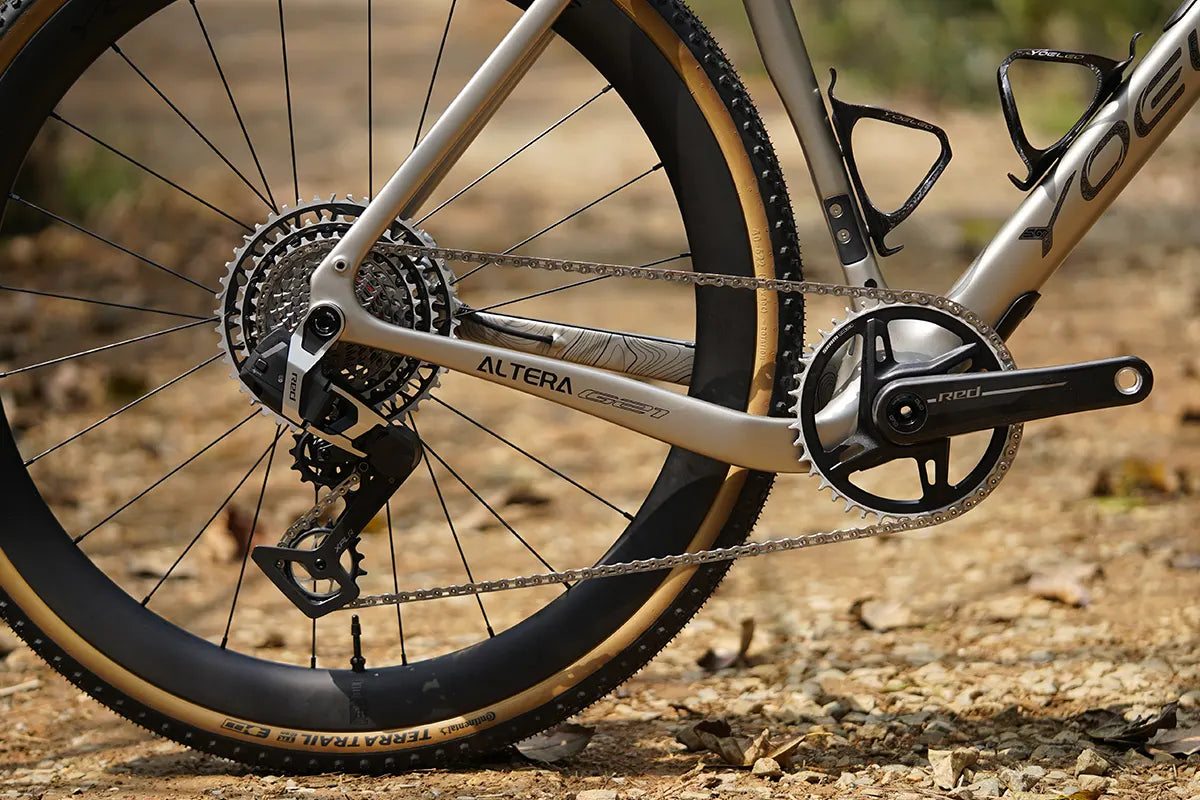
You have found a frameset you want. The geometry is right, the weight is where you need it, and the price makes sense. Then the compatibility question arrives, and suddenly you are reading about BB386 and flat-mount and UDH standards with no clear picture of whether the groupset sitting in your garage — or the one you were planning to buy — will actually fit. The fear of buying wrong stops a lot of people mid-build.
Compatibility is not as complicated as the part-number ecosystem makes it seem. There are five variables to check, and each one has a short answer. Work through them in order, and the uncertainty resolves quickly.
|
GROUPSET COMPATIBILITY IN 30 SECONDS
• Check five things in order: BB standard, brake mount, cable routing type, derailleur hanger, and tire clearance.
• Modern carbon framesets support Shimano, SRAM, and Campagnolo — mechanical and electronic — with the right BB adapter.
• Flat-mount disc (road) and post-mount disc (MTB) are not interchangeable — verify before you buy calipers.
• Tire clearance is a hard limit; the frame spec is the ceiling, not the recommendation.
|
Mechanical vs Electronic: Does the Frame Care?
Modern carbon road and gravel framesets are groupset-agnostic on the mechanical-vs-electronic axis. A frame with internal routing accepts Shimano Di2 wiring, SRAM eTap AXS batteries, and traditional mechanical cables through the same housing ports. The frame itself does not distinguish between them.
What changes is your cable routing approach. Electronic groupsets use fewer cables — rear derailleur wire and junction box only; no front derailleur cable if running 1x — which simplifies full-internal routing. Mechanical groupsets route two housing cables. More friction points, but no battery charging and no firmware updates to manage.
Bottom Bracket Standards: The One That Trips Everyone Up
The bottom bracket shell is the most common compatibility mistake in custom builds. Different shells require different BB cups, and the wrong combination either does not thread in or does not press correctly, damaging the shell permanently.
|
BB standard
|
How it installs
|
Common on
|
|
BB86 (press-fit)
|
Cups press into 86.5mm wide shell
|
Shimano-designed frames; some high-end road frames
|
|
BB386 (press-fit oversized)
|
Cups press into 86.5mm wide x 46mm bore shell
|
Larger chainring clearance; wider crank stance
|
|
T-47 (threaded)
|
30mm spindle cups thread into 47mm bore shell
|
Increasingly common on gravel; preferred for home builders
|
|
BSA/English (threaded)
|
1.37 inch x 24tpi threading; left cup reverse thread
|
Many MTB frames; some older road frames
|
|
PF30 (press-fit)
|
30mm bore cups press-fit
|
Some road frames; less common post-2022
|

Most road BB standards accept adapters — a BB86 shell can accept a BSA-threaded adapter sleeve, which then accepts any standard threaded bottom bracket. Adapters add minimal weight but do add potential creak points. Matching spindle diameter (24mm for Shimano, 30mm for SRAM GXP/DUB, 30mm for Campagnolo Ultra Torque) to the correct BB is the other half of the equation.
Brake Mount Standards: Flat-Mount vs Post-Mount
Flat-mount disc is the standard on all current road and performance gravel framesets. The caliper bolts directly into recessed threads in the frame and fork, giving a cleaner look and lighter assembly. Post-mount is the older standard found on mountain bikes and some trail-gravel bikes — the caliper attaches to two parallel threaded bosses via an adapter. They are not interchangeable without an adapter.

All current Yoeleo R-series and Altera G21 framesets use flat-mount disc. If you are specifying calipers, buy flat-mount — specifically the road flat-mount variant, which has different bolt spacing from MTB flat-mount.
Cable Routing: Internal, Semi-Internal, or External?
Cable routing type affects which groupsets are easiest to install and service, not which groupsets are compatible. Full-internal routing frames look clean but require routing tools and patience during builds. Semi-internal routing exits briefly at some points and is easier to work on. External routing is straightforward but uncommon on performance carbon frames.
If you are building with wireless electronic shifting (SRAM eTap AXS or Shimano Di2 wireless), full-internal routing becomes much simpler — only the brake hoses route internally. No rear derailleur cable. No shift housing. The clean aesthetic of a full-internal frame becomes genuinely easy to maintain.
Derailleur Hanger Compatibility
Derailleur hangers are frame-specific on most road frames — different manufacturers use proprietary hanger shapes. For gravel framesets, the Universal Derailleur Hanger (UDH) standard is increasingly common. UDH accepts SRAM Transmission rear derailleurs (T-Type) directly and is backward-compatible with most other derailleurs via a simple adapter. If you plan to run SRAM T-Type, confirm UDH before buying the frame.
Tire Clearance: The Hard Ceiling
Tire clearance is not a suggestion. The published clearance figure is the maximum tire width the frame and fork will accept with the specified wheel width. Running a tire wider than that figure risks contact with the chainstay or fork under load.
|
Frame
|
Published max clearance
|
Practical recommendation
|
|
Up to 32mm tire
|
28-30mm for most road use; 32mm for gravel-light
|
|
|
Up to 32mm tire
|
28-30mm; matches NxT SL2 23mm internal rim well
|
|
|
Altera G21 (1x)
|
Up to 700x53mm
|
700x40-50mm for mixed gravel; 700x50-53mm for rough terrain
|
Rim internal width affects effective tire width: a 23mm internal rim makes a 28c tire sit closer to 30c. Verify your intended rim and tire combination with the manufacturer's published pairing chart before assuming clearance is adequate.
How Yoeleo R-Series and G21 Cover the Compatibility Spectrum
Yoeleo's frameset lineup is designed to accept the full range of modern groupset configurations without requiring obscure adapters or proprietary parts. The R11 and R12 run flat-mount disc, standard front derailleur mounts, and internal routing compatible with mechanical and electronic systems. The Altera G21 adds T-47 threaded BB for straightforward installation, UDH for SRAM T-Type compatibility, and a 53mm tire clearance ceiling that accommodates dedicated gravel racing tires.

Every Yoeleo frameset publishes full compatibility tables — BB standard, brake mount, routing type, derailleur hanger, and tire clearance — in the product specification. You can cross-reference your intended groupset against those specs before placing an order. That transparency is the DTC model working as designed.
|
HOW YOELEO TAKES THE GUESSWORK OUT OF COMPATIBILITY
• Full compatibility specs published per frameset — BB standard, brake mount, routing, derailleur hanger, tire clearance
• Altera G21: T-47 threaded BB + UDH + 53mm clearance — a builder-friendly gravel frameset specification
• DTC efficiency means no dealer markup on spec advice — the information is public and the engineering is transparent
• Six-year warranty and direct support: jasmine@yoeleobike.com for compatibility questions before you order
|
Frequently Asked Questions
Can I use a Shimano groupset on a frameset designed around SRAM?
Yes. Modern road and gravel frames are groupset-agnostic — the brake mount, BB shell, and cable routing accept any major groupset brand with the correct BB adapter for the spindle diameter. The only exception is derailleur hanger shape, where proprietary hangers differ between brands.
What bottom bracket do I need for Shimano 105 or Ultegra on a BB386 shell?
Shimano road cranksets use a 24mm spindle. On a BB386 shell, you need a BB386-to-24mm adapter — either a threaded cup adapter or a press-fit cup with 24mm bore. Brands like Wheels Manufacturing and Token make reliable options in both formats.
Is flat-mount disc the same for road and mountain bike?
No. Road flat-mount and MTB flat-mount use different bolt spacing. Road flat-mount is frame-specific (140mm or 160mm rotor direct mount). Using MTB flat-mount calipers on a road flat-mount frame requires an adapter and is generally not recommended for weight and clearance reasons.
What is UDH and do I need it?
UDH (Universal Derailleur Hanger) is a standardized hanger shape compatible with SRAM T-Type Transmission rear derailleurs. You need UDH specifically if you plan to run SRAM T-Type. For Shimano Di2, GRX, or mechanical groupsets, any standard proprietary hanger works correctly.
Share:
Between Two Bike Sizes? How to Choose Buying Online
Build Bike From Frameset at Home: Step-by-Step Guide