
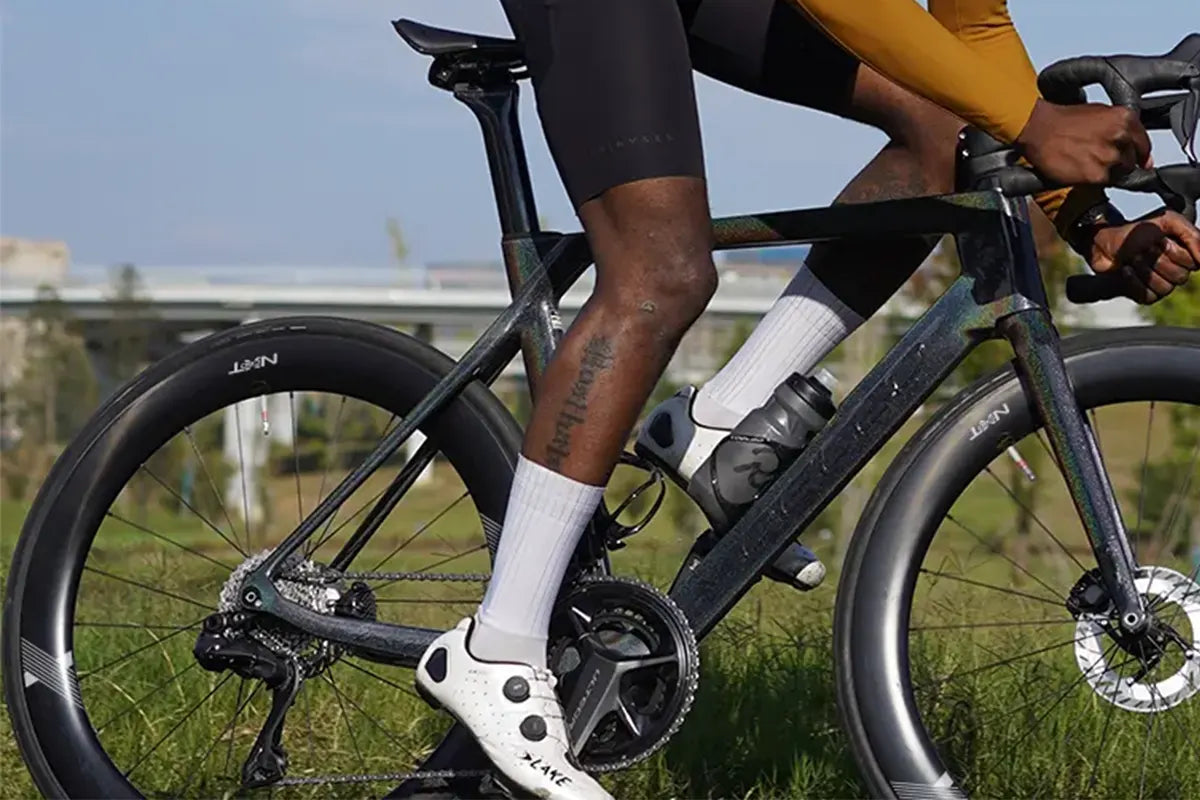
Cleat Setup and Knee Pain: A Step-by-Step Method
Your knee starts complaining somewhere around the 40 km mark. Not sharp, just a dull ache at the front of the kneecap or wrapped around the outside, worse the longer you ride. You check your saddle height. You check it again. Nothing changes, because saddle height was never the problem.
Cleat position moves your foot relative to the pedal axle in three directions at once, and each one maps to a different kind of knee pain. Get the fore/aft wrong and the knee works through a longer lever arm than it should. Get the rotation wrong and the knee tracks sideways on every stroke, thousands of times per hour. Most riders never touch their cleats after the shop installs them, so a shoe shipped in a slightly wrong position stays wrong for years.
This is the method a fitter runs through with you, minus the studio. It won't fix every knee issue, and past a certain point you need a professional set of eyes rather than another five minutes with an Allen key. Most cleat-related knee pain, though, responds to the same handful of adjustments, done one at a time.
What Cleat Position Actually Has to Do With Your Knee
Cleat position determines the angle and load path of your knee through every pedal stroke, and each pain location points to a different cause.
Anterior knee pain, the ache at the front around or just below the kneecap, usually means the ball of your foot sits too far forward of the pedal spindle. Your quad pushes through a longer lever arm to complete the stroke, and the kneecap gets pulled harder against the femur on every rotation.
Posterior pain, at the back of the knee, often points the other way: the cleat is too far back, and the calf and Achilles take over more of the stroke than they should, pulling the knee into a position it doesn't naturally sit in.
Medial pain (inside) and lateral pain (outside) are usually rotational. If your foot is locked into an angle that doesn't match how your leg wants to track, the knee absorbs the twist instead of the cleat. This shows up with fixed, zero-float cleats on a rider whose natural pedalling angle isn't perfectly straight, which describes most riders.

Setting Fore/Aft Position Over the Metatarsal Head
Find the widest part of your foot and locate the first metatarsal head, the bony bump just behind your big toe. Mark it on the outside of the shoe with a pen while wearing it, pressing a finger in from the sole side, or asking someone to mark it from outside.

A common starting reference is to place that mark somewhere between directly over the pedal spindle and 5-6 mm behind it. This is roughly the baseline used in most professional fit protocols, not a fixed rule for every rider. Anterior knee pain usually means the cleat needs to move back, which shortens the effective lever arm at the front of the stroke. Posterior or Achilles-adjacent pain usually means it needs to move forward.
Move the cleat 2-3 mm at a time. That's small, but it changes the load path more than it looks like it should. Ride at least two 30-minute sessions at each position before judging it. Pain tied to fore/aft position tends to build gradually across a ride rather than disappear in the first five minutes.
Getting Rotation and Float Right
Float is the number of degrees your heel can swing side to side before the cleat locks. Zero float means the foot is fixed in one rotational position for the entire pedal stroke. That's fine for a rider whose natural pedalling angle is dead straight. It's a problem for almost everyone else.

Shimano SPD-SL cleats come in three float options: red is fixed at zero degrees, blue gives 2 degrees, yellow gives 6 degrees. Look Keo runs a similar system, with black fixed, red at 4.5 degrees, and grey at 9 degrees. If you don't know your natural angle, start with a floating cleat rather than a fixed one. A fixed cleat set at the wrong angle forces the knee to twist on every stroke instead of letting the shoe pivot slightly to match your leg.
To find your natural angle, set the bike on a trainer, pedal easily with the cleats loose enough to move freely, and let your heel settle wherever it wants to sit through a few dozen strokes. Mark that angle, tighten the cleat there, and ride it. Rotational cleat pain tends to show up during the pedal stroke itself rather than after the ride, which is a useful way to tell it apart from fore/aft pain.
Lateral Stance Width and Q-Factor
Moving the cleat side to side on the shoe changes your stance width at the pedal. A stance that's too narrow pushes the knee outward through the stroke; too wide pulls it inward.
Most cleats have a small range of lateral adjustment built into the mounting slot, usually a few millimetres either way. If that's not enough, a wedge or shim under the cleat, varus tilting the forefoot one way and valgus the other, addresses a leg-length or foot-alignment difference cleat position alone can't fix. This is where home adjustment reaches its limit, since diagnosing which wedge you need without pressure-mapping equipment is guesswork.
A rough field test: watch your knee tracking from the front on a trainer, ideally filmed in slow motion. A knee that consistently drifts inward at the top of the stroke, on both legs, points toward a stance or rotation issue rather than fore/aft.
A Systematic Method, Not a Guessing Game
Change one variable at a time. Fore/aft first, since it's the easiest to isolate and reverse. Then rotation. Then lateral position last, since it has the smallest margin and is the easiest to overcorrect.
Mark your current position with a paint pen before you move anything, so you can get back to a known baseline if a change makes things worse.
Give each change a real test window. A short spin around the block won't reproduce 40 km of accumulated load, so ride the same route or duration each time.
|
Pain location
|
Likely cleat cause
|
First adjustment to try
|
|
Front of knee (anterior)
|
Cleat too far forward
|
Move cleat back 2-3 mm
|
|
Back of knee (posterior)
|
Cleat too far back
|
Move cleat forward 2-3 mm
|
|
Inside of knee (medial)
|
Foot rotated in, or stance too narrow
|
Add float, widen stance 1-2 mm
|
|
Outside of knee (lateral)
|
Foot rotated out, or stance too wide
|
Add float, narrow stance 1-2 mm
|
|
Pain only under load (climbing, sprinting)
|
Fixed cleat locking a bad angle
|
Switch to a floating cleat, 4.5-6°
|
Worked example: 72 kg rider, anterior knee pain after 40 km
A 72 kg rider reports a dull ache at the front of the left knee that starts around 40 km into a ride and worsens toward the end. The right knee is fine.
Step 1: mark the current cleat position on the left shoe before touching anything. The metatarsal mark sits 8 mm ahead of the pedal spindle centre, wider than the usual starting range.
Step 2: move the left cleat back 3 mm. Ride 45 minutes. The ache is still present but now starts closer to 55 km instead of 40 km.
Step 3: move the left cleat back another 3 mm, 6 mm total from the original position, landing close to spindle-neutral. Ride 45 minutes. No ache through the full ride.
Step 4: check the right cleat against the same reference. It was already close to neutral, consistent with the pain having been isolated to the left knee only.
When to Stop Adjusting and See a Professional
If pain persists after two or three rounds of careful adjustment, each tested over a real ride, stop guessing and book a proper bike fit or see a physiotherapist or sports medicine clinician. Cleat position is one variable in a chain that includes saddle height, crank length, and your own leg-length symmetry, and a fitter with pressure-mapping equipment can isolate what a mirror and an Allen key can't.
This guide is a mechanical starting point, not a diagnosis. Persistent or worsening knee pain, swelling, or pain that continues off the bike is a reason to see a clinician regardless of what your cleats are doing.
Frequently Asked Questions
Why does only one knee hurt if my cleats are set the same on both sides?
Bodies aren't symmetric. A small difference in leg length, foot shape, or old injury history means identical cleat settings can suit one leg and not the other. Set each shoe by feel and pain response rather than assuming both sides need the same number.
Can new cleats fix knee pain, or is it the shoe?
New cleats reset wear but don't change position on their own. If pain started after fitting new cleats, check that the fore/aft and rotation match your previous setup, since a shop reinstall can shift both without you noticing.
How much float do I actually need?
Most riders do well with 4.5-6 degrees of float rather than zero. Riders who already know their pedalling angle is dead straight, usually from a professional fit, can run fixed cleats without issue. When in doubt, start with float.
Will moving my saddle fix knee pain instead of the cleats?
Sometimes, but it's a different fix for a different symptom. Saddle height affects pain tied to leg extension, near the top or bottom of the stroke. Cleat position affects pain tied to foot angle and load path. Change one variable at a time so you know which one worked.
Share:
Saddle Height and Setback Without a Fit Studio
Wrapping Bar Tape on an Integrated Cockpit