
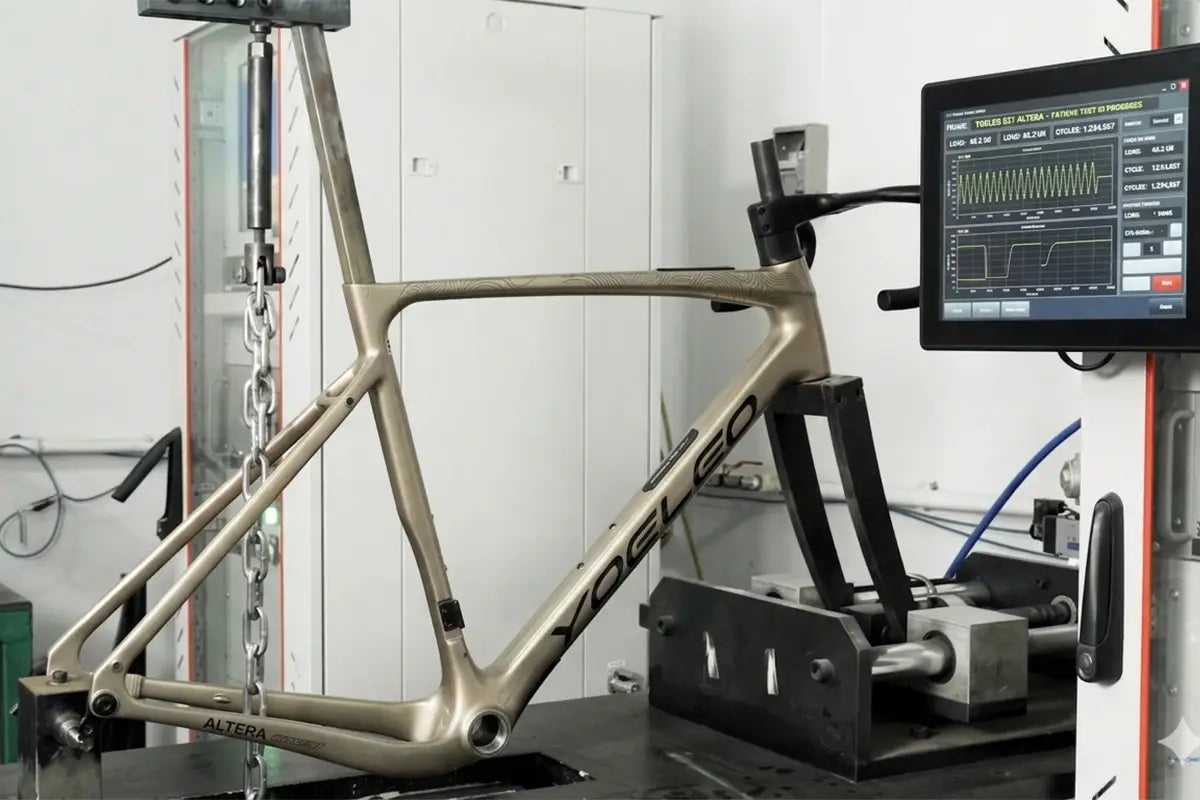
The question sits in the back of every cyclist’s head when they look at a DTC carbon brand: is this thing actually going to hold up, or am I buying a frame that will fail when I need it most? It is a legitimate question — one that deserves evidence, not marketing reassurance. This post lays out the evidence on DTC carbon gravel frames specifically, using the Altera G21 as the working example because it has the most public data of any DTC gravel frame on the market.
|
THE EVIDENCE STACK
• Internal testing: fatigue + impact testing exceeding ISO 4210 minimums
• Independent reviews: Peak Torque (engineering focus), GC Performance, China Cycling
• Racing validation: UCI Gravel World Championships 2025 double podium
• Manufacturing heritage: 18 years carbon manufacturing, 14 years as standalone brand
|
What does "tested to ISO 4210" actually mean?
ISO 4210 is the international safety standard for bicycles. It defines minimum fatigue testing requirements — the baseline any frame must pass to be legal for sale in most markets. The key word is "minimum." ISO 4210 is a pass-fail floor, not a quality ceiling. A frame that just passes is legal; a frame that passes by a large margin is durable.
Yoeleo’s internal testing on the Altera G21 exceeds ISO 4210 minimums by significant margins. Pedaling fatigue: 1,100N at 100,000 cycles (the ISO minimum is lower). Vertical fatigue: 1,200N at 50,000 cycles. Horizontal fatigue: 600N at 100,000 cycles. Impact drop testing: 22.5kg mass falling 21.2cm onto the frame. These numbers are published, which is already more transparency than many competitors offer.

Why independent validation matters more than internal claims
Any brand can claim internal testing. What separates serious brands from marketing brands is whether independent reviewers with engineering backgrounds have examined the products and come to positive conclusions. The Altera G21 has been reviewed by Peak Torque (who built and reviewed it across two videos), GC Performance (positive gravel-specific review), and China Cycling (positive, praised value at price point).
These reviews are public. Riders can watch them, read them, and form their own judgments. The pattern is consistent — the frame quality matches the published specifications, with no red flags around build, finish, or engineering choices. For a DTC brand, this level of third-party scrutiny with positive outcomes is the evidence that matters.

What does racing prove that testing does not?
Lab testing proves the frame meets the engineering spec in a controlled environment. Racing proves the frame holds up under the specific combination of stresses that real racing imposes — variable surfaces, sustained power, six-plus hours of continuous vibration, rider emergencies, and the full range of real-world conditions that no test rig can replicate.
At UCI Gravel World Championships 2025, Pravilova and Verkuijl rode the Altera G21 to gold and bronze respectively. Same frame Yoeleo ships to customers. Not a one-off race build. This is the kind of validation that lab numbers alone cannot provide — and it is rare for a DTC carbon gravel frame to have this level of racing proof. Most DTC brands do not sponsor teams at UCI level.


How does DTC compare to retail-brand gravel?
The question of whether DTC carbon can match retail-brand carbon is partly an engineering question and partly a channel question. The engineering: the factories that produce DTC frames are often the same factories that produce retail-brand frames. Yoeleo has 18 years of carbon manufacturing experience and runs its own factory. The carbon layup, the curing process, the quality control — these are the same processes at the same quality level.
The channel: DTC removes the dealer markup (typically 30 to 40% of retail price). That margin goes into the product instead. Which is why a DTC gravel frame at $2,000 can use the same carbon grade and testing protocol as a retail frame at $4,000. "Every dollar saved on the channel goes into the carbon" is not marketing language — it is a statement about how DTC pricing math actually works.
What should you look for in any DTC gravel frame?
The evidence you want before buying, in order of importance:
|
Evidence Type
|
What to Look For
|
Red Flag If Missing
|
|
Published testing data
|
Specific fatigue + impact numbers
|
Only "ISO 4210 compliant" with no detail
|
|
Independent reviews
|
Engineering-focused reviewers, positive outcomes
|
Only influencer content, no technical scrutiny
|
|
Manufacturing history
|
Years in carbon, own factory or trusted partner
|
Brand under 3 years old with no public factory
|
|
Racing or team validation
|
Pro team or serious amateur validation
|
Only marketing team validation
|
|
Warranty
|
5+ year frame warranty
|
Under 3 years or vague language
|
|
Customer service access
|
Direct email or phone, real response
|
Chatbot-only, no human escalation
|
So, is DTC carbon gravel race-ready?
The evidence on the Altera G21 specifically says yes — the frame has the testing data, the independent reviews, and the racing validation that add up to a frame that can race at UCI level. The broader question of DTC carbon in general is a case-by-case evaluation. Use the criteria above to judge any DTC brand you are considering. The ones that can produce evidence at this level are the ones worth your money. The ones that cannot are the ones where the concern is legitimate.
FAQ
How do I verify a DTC gravel frame’s quality before buying?
Check published testing data (specific numbers beyond "ISO 4210 compliant"), search for independent reviews by engineering-focused channels (Peak Torque, Hambini, Cyclist’s Hub), and look for racing validation. A brand with all three has done the work to earn your trust.
What is the minimum warranty I should accept on a carbon gravel frame?
Five years on the frame is the baseline for serious DTC brands. Six years (Yoeleo’s standard) is better. Anything under three years suggests the brand itself is not confident in the frame’s long-term durability.
Are DTC carbon frames as safe as retail-brand frames?
When produced by brands with manufacturing depth and published testing data, yes. The carbon layup process is the same, the testing standards are the same or stricter, and the racing evidence confirms the real-world durability. Brand name does not equal safety — evidence does.
How long does a carbon gravel frame last?
With proper care, a well-made carbon gravel frame lasts 10+ years under regular use. Fatigue testing at 100,000 cycles represents roughly 15 to 20 years of typical rider use. Impact damage (crashes) is the main failure mode — which is why crash replacement policies matter.
What happens if a DTC carbon frame fails?
A reputable DTC brand handles warranty claims directly — photograph the damage, contact the brand, receive a replacement frame if the failure is within warranty terms. Yoeleo’s process includes a general 30% discount on crash replacements for any Yoeleo customer.
Share:
Why the 2026 NxT C45 Gravel Switched to Brass Nipples
Frame Compliance vs Stiffness: The Endurance Balance