
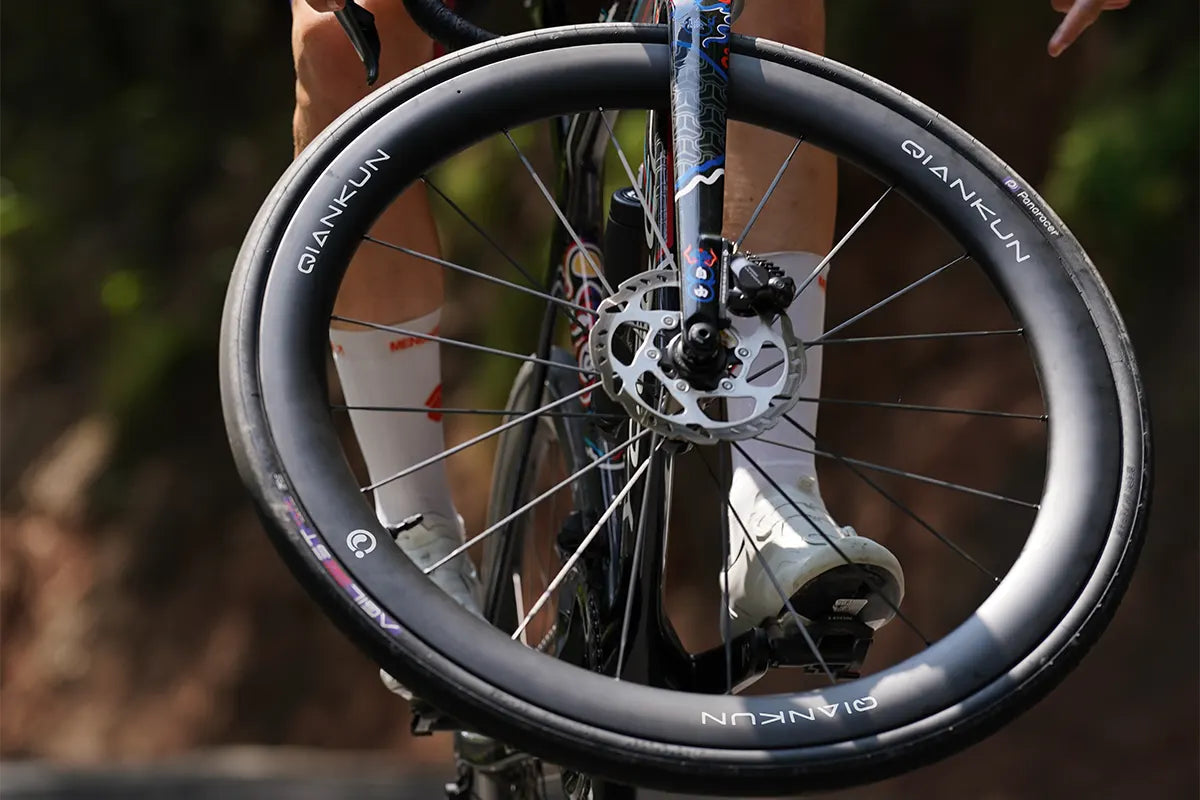
Two wheelsets, same hub, same carbon spokes, same price. The only real difference is 10 millimeters of rim depth and 100 grams — and yet that small gap changes how the wheel climbs, sprints, and behaves when a gust hits you on an exposed road. The QianKun CS50 and CS60 are built for different riders, not different price tiers. This guide shows you exactly which one matches your terrain and racing, with honest numbers instead of "go faster" slogans.

Quick Verdict for Skimmers
Choose the CS50 (50mm, 1,185g) if you climb, ride hilly terrain, or want one do-everything race wheel that stays calm in crosswinds and feels light when the road tilts up.
Choose the CS60 (60mm, 1,285g) if you race flat courses, chase fast group rides, or finish in sprints, where the deeper rim's aero edge at sustained speed is worth the extra 100g and the slightly stronger crosswind pull. Both cost $1,650, so this is purely a decision about your riding — not your wallet.
CS50 vs CS60: The Specs Side by Side
The two share a platform and differ mainly in depth, weight, and intended use. Everything else — hub, spokes, width, testing — is identical.
|
Spec
|
QianKun CS50
|
QianKun CS60
|
|
Rim depth
|
50mm
|
60mm
|
|
Wheelset weight
|
1,185g ±3%
|
1,285g ±3%
|
|
Rim weight (each)
|
385g
|
444g
|
|
External / internal width
|
32mm / 23mm
|
32mm / 23mm
|
|
Spokes
|
Carbon aero, 21F / 24R
|
Carbon aero, 21F / 24R
|
|
Hub
|
Q-Angular36 ratchet, 10° engagement
|
Q-Angular36 ratchet, 10° engagement
|
|
Rim material
|
T1000 high-modulus carbon
|
T1000 high-modulus carbon
|
|
Impact tested
|
120J (3× the 40J standard)
|
120J (3× the 40J standard)
|
|
Best for
|
Climbing, hilly racing, all-round
|
Flat racing, sprints, sustained speed
|
|
Price
|
$1,650
|
$1,650
|
What Rim Depth Actually Changes
Rim depth trades aerodynamics against weight and crosswind stability. Deeper is more aero at speed; shallower is lighter and calmer in gusts.
A deeper rim cuts drag by smoothing airflow over a larger surface, and that advantage grows with speed and with the angle the wind hits you (yaw). But depth also adds material, so the rim weighs more — and that weight sits at the rim, where it most affects acceleration and climbing. Depth also gives the wind a bigger sail to push, which is why deep wheels feel twitchier in crosswinds. The honest summary: there's no "best" depth, only the right depth for your speed, terrain, and how exposed your roads are. Our physics of yaw and crosswinds guide goes deeper here.

|
KEY INSIGHT
• At typical amateur speeds of 30–40 km/h, the aero gap between a 50mm and 60mm rim is real but small — on the order of a few watts. Crosswind behavior and climbing feel are the differences you'll actually notice most rides.
|
The QianKun CS50: Mid-Depth All-Rounder
The CS50 is the do-everything race wheel — light enough to climb well, aero enough to hold speed, and stable when the wind picks up. For most riders, it's the smarter default.
At 1,185g, the CS50 is one of the lightest 50mm carbon wheelsets you can buy, and that low rotating weight makes it feel eager on climbs and out of corners. The 50mm depth still delivers a clear aero benefit over shallow rims on the flats, but the wheel stays composed in gusts that would shove a deeper section around. If your rides mix climbs, rolling terrain, and variable wind — which describes most riders — the CS50 is the one wheel that does it all.
|
THE WIN
• The CS50 is positioned for riders who want the balance of lightness, explosive acceleration, and aero advantage in a single wheelset — climbing, KOM hunting, and breakaways included. It's the closest thing to a no-compromise all-rounder in the range.
|

The QianKun CS60: Deep-Section Speed
The CS60 is built for sustained high speed — flat races, fast group rides, and sprint finishes — where its deeper rim earns back its extra weight in aero efficiency.
At 1,285g, the CS60 is only 100g heavier than the CS50, yet it carries a meaningfully deeper 60mm profile. On flat and rolling courses held at high speed, that depth reduces drag where you spend the most energy, and the wheel rewards riders who push hard on the flats or contest sprints. The trade-off is honest: it's slightly slower to spin up on steep climbs and more affected by strong crosswinds, so it suits riders who prioritize flat-out speed over hilly versatility.
|
WATCH-OUT
• If you ride exposed coastal or ridge roads where strong side gusts are routine, a 60mm front can feel like a handful. Many riders solve this with a mixed-depth setup — a shallower front for stability, a deeper rear for aero. QianKun offers a CS50/60 mixed-depth option for exactly this.
|
Crosswinds: The Difference You'll Feel Most
Crosswind stability is where 50mm and 60mm rims diverge in everyday riding far more than raw aero numbers suggest.
A deeper rim presents more side area for the wind to push, so it transmits more steering input to your hands in a gust. Modern rim shaping reduces this, but physics still applies: a 50mm rim is inherently calmer in a crosswind than a 60mm one. Lighter riders feel this more. If you're nervous descending in wind or ride frequently exposed routes, the CS50 buys you confidence; if your races are sheltered or you're a heavier, powerful rider, the CS60's depth is easier to manage.
Which Should You Choose?
Match the wheel to your terrain, your races, and your comfort in wind. Here's the decision in one table.
|
If you...
|
Choose
|
Why
|
|
Climb and ride hilly terrain
|
Lighter, livelier uphill
|
|
|
Want one wheel for everything
|
Best all-round balance
|
|
|
Ride exposed, windy roads
|
Calmer in crosswinds
|
|
|
Race flat or rolling courses fast
|
Deeper aero at sustained speed
|
|
|
Contest sprints / fast group rides
|
Holds high speed efficiently
|
|
|
Are a heavier, powerful rider
|
Manages depth easily, rewards power
|
|
|
Want stability + aero
|
Shallow front, deep rear
|
Shared DNA: What You Get Either Way
Both wheels are the same premium race platform, so your depth choice never costs you build quality. The hardware is identical.
Both run the QianKun hub with a 36-tooth ratchet system delivering 10° engagement for an instant, snappy pickup, plus ceramic sealed bearings and tool-free freehub swaps. Both use T1000 high-modulus carbon rims laced with carbon aero spokes that are individually replaceable and individually tested to 600 KGF of pulling force — so a single damaged spoke is a swap, not a write-off. Both are tested to 120 joules of rim impact, three times the 40J industry and UCI baseline, and carry a 3-year warranty. At $1,650 each, the depth decision is about your ride, never about getting "more wheel" for more money.
|
KEY INSIGHT
|
The Verdict
The CS50 is the wheel for most riders: light, balanced, calm in wind, and quick on climbs, with enough depth to hold real aero speed. The CS60 is the specialist — choose it when your riding is fast and flat and you want every bit of sustained-speed efficiency, accepting a touch more weight and crosswind sensitivity. Same hub, same carbon spokes, same $1,650, same tested durability. Pick the depth that fits where you ride, not the bigger number.
Frequently Asked Questions
Is a 50mm or 60mm wheel better for all-around riding?
A 50mm wheel like the QianKun CS50 is better for all-around riding because it balances aerodynamics, low weight, and crosswind stability. The 60mm CS60 is better for flat, fast, sprint-focused riding where sustained-speed aero matters more than climbing and gust stability.
How much faster is a 60mm wheel than a 50mm?
At typical amateur speeds of 30–40 km/h, a 60mm rim saves only a few watts over a 50mm — a real but modest aero gain that grows at higher speeds and wind angles. For most riders, crosswind handling and climbing feel are more noticeable than the aero difference.
Are deep section wheels harder to handle in crosswinds?
Yes. A 60mm rim presents more side area than a 50mm, so it catches crosswinds more and transmits more steering input in a gust. Lighter riders and exposed, windy routes feel this most. A 50mm rim or a shallow-front mixed-depth setup is calmer.
Do the QianKun CS50 and CS60 cost the same?
Yes, both the CS50 and CS60 are priced at $1,650, and a CS50/CS60 mixed-depth option is the same price. Because they share the hub, carbon spokes, width, and 120J impact testing, your choice is about terrain and riding style, not price.
What is the weight difference between the CS50 and CS60?
Share:
C35 vs C50: NxT SL2 Climber vs All-Rounder
Deep Wheels in Crosswinds: Confidence Guide for Gusty Rides