

|
SPOKES AND RIDE FEEL IN 30 SECONDS
• Spoke material (steel vs carbon), count, cross-section (round vs bladed), and lacing pattern all affect stiffness, vibration damping, and durability.
• Fewer spokes generally means a stiffer, lighter wheel — but with less redundancy if one spoke is damaged.
• Brass nipples are heavier than alloy but more corrosion-resistant and more durable over time — the choice matters most in wet climates and after years of service.
• Individually replaceable spokes change the long-term ownership equation: a single damaged spoke means a repair, not a wheel replacement.
|
Spoke Material: Steel vs Carbon
The dominant spoke material in high-performance road wheelsets is stainless steel—typically drawn into a butted profile (thicker at the ends, thinner in the middle) that reduces weight without sacrificing ultimate tensile strength. Steel spokes flex elastically under load, returning to exactly their original length after each pedal stroke or bump. Because they use standard J-bend or straight-pull shapes, steel spokes are universally available at almost any bike shop, making them the gold standard for easy, worldwide serviceability.
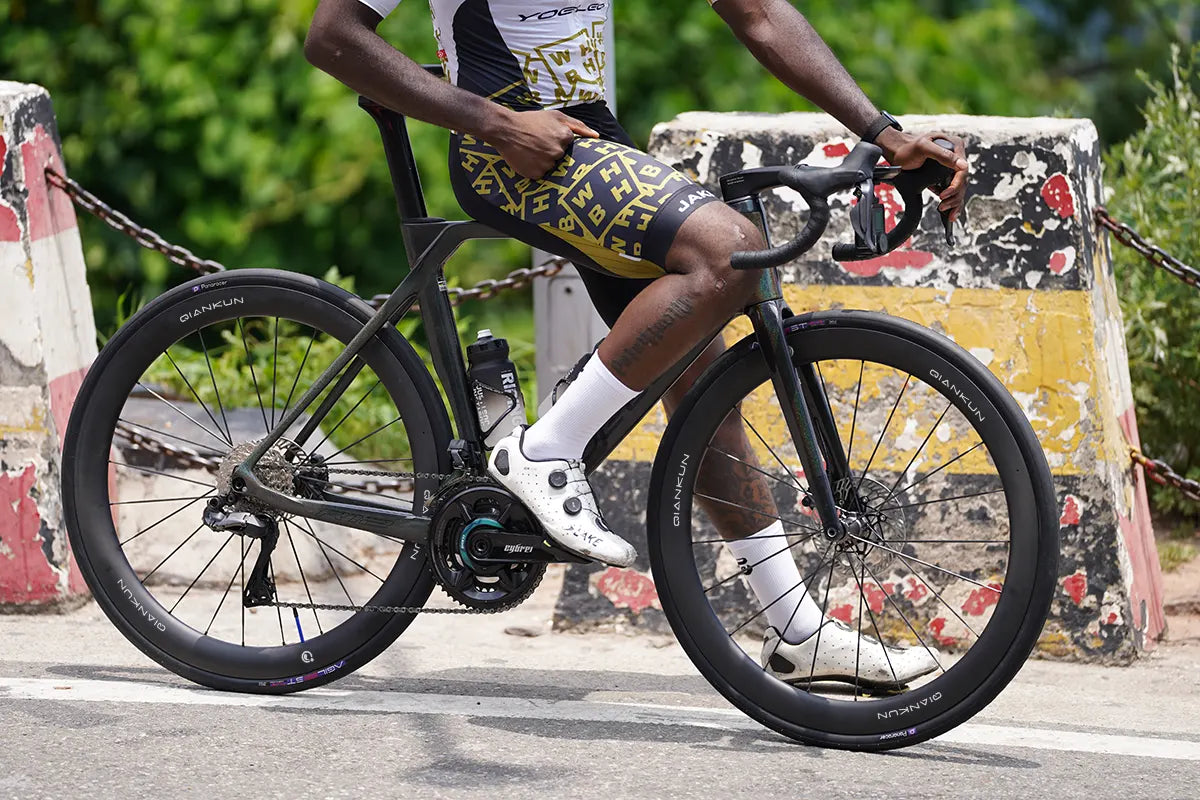
Carbon spokes, such as those featured on QianKun wheelsets, represent a leap forward in performance. They are significantly lighter and stiffer than steel, yielding near-instantaneous power transfer. However, carbon's high stiffness means it transmits more road vibration directly, and it can be more brittle under sharp lateral impacts. Furthermore, because carbon spokes are highly specialized, they require proprietary spares. While they are not as universally sourced as steel roadside, they offer an elite performance edge for racers and weight-focused riders.
Spoke Count: How Many Spokes Actually Change the Ride
Spoke count dictates how a wheel handles loads, manages weight, and survives damage. A lower spoke count (typically 20 to 24) reduces aerodynamic drag and rotational weight, creating a very responsive, lively feel during out-of-the-saddle acceleration on smooth roads.
However, from an engineering standpoint, adding more spokes actually increases lateral stiffness (resistance to side-to-side flexing during hard cornering or sprinting) because it places more structural supports closer together. A higher-count wheel (28 to 32) also distributes road forces across more points, offering a more damped, stable feel on rough terrain. Crucially, higher counts provide structural redundancy: if you break one spoke on a 32-spoke wheel, you can usually ride home; on a 20-spoke wheel, a single broken spoke will often warp the rim enough to rub against the frame
Round vs Bladed Spokes: Aerodynamics and Stiffness
Bladed (aero) spokes have an elliptical cross-section that reduces aerodynamic drag at the wheel plane — an effect that is measurable at speeds above approximately 30 km/h and becomes more significant as speed increases. Beyond aerodynamics, bladed spokes tend to be stiffer laterally than equivalent-weight round spokes, which contributes to more precise handling feel in cross-winds and during hard cornering.

Brass vs Alloy Nipples: The Decision Most Riders Overlook
Lacing Pattern: Radial vs Crossed
Spoke System Comparison Table
|
Spoke Variable
|
Performance Priority
|
Durability Priority
|
Serviceability Priority
|
|
Material
|
Carbon (light, stiff)
|
Steel bladed (elastic, tough)
|
Steel (replaceable anywhere)
|
|
Count
|
20–24 (light, fast)
|
28–32 (redundancy)
|
24–28 (balance)
|
|
Profile
|
Bladed (aero, stiff laterally)
|
Round (simpler to true)
|
Round or bladed (both ok)
|
|
Nipple
|
Alloy (lighter)
|
Brass (corrosion-resistant)
|
Brass (stays serviceable)
|
|
Lacing
|
Radial front / 2× drive rear
|
3× both sides
|
2× both sides (easier to true)
|
Yoeleo NxT SL2 and QianKun: Different Spoke Philosophies for Different Riders

|
HOW YOELEO BUILDS THE SPOKE SYSTEM
• QianKun wheelsets use individually replaceable carbon spokes — a single damaged spoke can be replaced without taking the wheel out of service for an extended period.
• QianKun and NxT SL2 both use a star ratchet freehub system — two interlocking toothed rings held under spring tension — for fast, clean engagement.
• NxT SL2 is tested to 100,000 pedaling-fatigue cycles at 1,100N — the spoke tension system is part of what must hold through each of those cycles.
• Every NxT SL2 wheelset is hand-trued before shipping, with spoke tension and lateral trueness checked on a truing stand — not solely by automated assembly.
• NxT SL2 is engineered to an internal 120J impact standard, three times the UCI minimum — the spoke bed and rim interface are part of how that margin is achieved.
|
Frequently Asked Questions
Does spoke count really affect how a wheel feels to ride?
Are carbon spokes worth it on a road wheelset?
Why do brass nipples last longer than alloy nipples?
What does 'individually replaceable spokes' mean for long-term ownership?
Unlike integrated carbon wheels where the spokes are permanently glued to the hub and rim, QianKun's design allows individual carbon spokes to be unthreaded and replaced like traditional steel spokes. If you experience a freak accident and snap a spoke, you only need to swap that single part—saving you from having to purchase a completely new wheelset.
To see a hands-on demonstration and detailed ride testing of this exact carbon spoke philosophy, watch this Review of the Yoeleo QianKun CS60 Wheelset. This video dives deep into the real-world ride quality, stiffness, and hub mechanics of the system.
Share:
Wheel Fatigue Testing Explained: What the Numbers Mean