
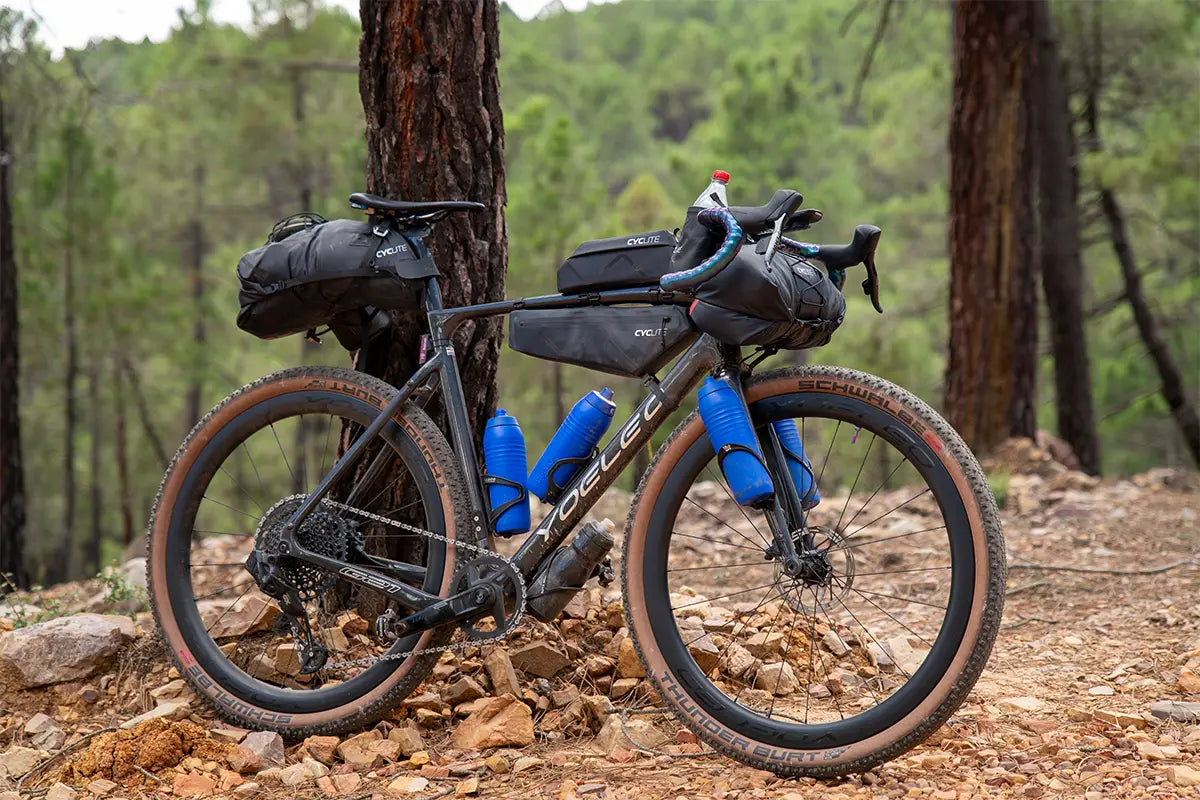
Five Days, 800 km, and a Drivetrain That's Been Through Everything
You pull into the final stop of a long bikepacking trip. The bags come off, the tires are flat, and the chain looks like it crawled out of a swamp. Sand from a coastal section. Salt from a wet morning. Dust ground into every link. The drivetrain is exhausted — and so are you.
Most riders make one of two mistakes here. They either ignore the drivetrain entirely and pay for it on the next ride, or they overreact and replace parts that have hundreds of hours of life left. Neither is right. Long-distance bikepacking demands a structured recovery process, and the difference between doing it well and doing it badly is measured in seasons of drivetrain life.
|
WHAT THIS GUIDE COVERS
• A complete post-trip drivetrain inspection in 12 steps
• How to tell if your chain, cassette, and chainrings need replacing — or just need cleaning
• The right cleaning order (most people do this backwards)
• How to protect wheels, bearings, and the rest of the bike at the same time
• A maintenance schedule for bikepacking and gravel riders going forward
|
What Actually Happens to a Drivetrain on a Long Trip
A clean drivetrain in a workshop loses about 4-5 watts to friction at typical riding speeds. A neglected drivetrain after a wet, gritty bikepacking trip can lose 15 watts or more. That's not just slow — it's expensive. Every kilometer you ride with a contaminated drivetrain accelerates wear, and replacement chains, cassettes, and chainrings add up fast.
Four enemies are working against your drivetrain on a long trip. Understanding each one tells you what your recovery process needs to address.
|
Enemy
|
What it does
|
Where it hides
|
How to remove
|
|
Grit & dust
|
Acts as a grinding paste between chain and cassette
|
Inside chain pins, between cassette cogs
|
Solvent + flush, never just a rag
|
|
Water & moisture
|
Strips lube, accelerates corrosion on steel parts
|
Inside hub bearings, under cassette
|
Dry immediately, re-lube within 24 hours
|
|
Salt
|
Eats anodizing, corrodes aluminum, kills bearings
|
Brake calipers, hub seals, frame interior
|
Fresh-water rinse before any other cleaning
|
|
Dried lube buildup
|
Traps grit, hardens into a paste that locks links
|
Outer plates, derailleur pulleys, chainrings
|
Degreaser soak + brush, repeat if needed
|

Step 1-3: Inspect Before You Clean
This is the step almost everyone skips, and it's where every smart maintenance decision begins. Before you spray anything, look at the bike. The way the dirt is distributed tells you what conditions the bike has been through and where to focus.
1. Photograph the drivetrain
Take a clear photo of the chain, cassette, chainrings, and derailleur from both sides. This becomes your baseline. After cleaning, you'll compare to find anything you missed.
2. Check the chain with a wear gauge

Use a 0.5 / 0.75 gauge. A chain that drops 0.5 is approaching replacement. A chain past 0.75 is finished and is now accelerating wear on your cassette and chainrings. On a bikepacking trip, a chain can lose 30-50% of its remaining life in a single hard week — measure it before you decide whether to clean or replace.
3. Look at the cassette and chainrings
Healthy teeth are symmetrical. Hooked, shark-finned, or asymmetric teeth mean the cassette or chainring has worn into the chain's stretched profile and will skip on a new chain. If you see this, plan to replace as a system.
|
DECISION CHECKPOINT
• Chain under 0.5 wear + clean cassette teeth → clean and re-lube, keep riding
• Chain 0.5-0.75 + clean cassette teeth → replace chain only, keep cassette
• Chain over 0.75 OR worn cassette teeth → replace chain + cassette together
• Chainring teeth shark-finned → replace as a 3-piece system (chain + cassette + chainring)
|
Step 4-7: The Right Cleaning Order
Most riders clean the chain first. That's the wrong order. Grit on the frame, fork, and wheels will end up on the chain you just cleaned. Work top-down.
4. Fresh-water rinse first (especially after coastal or wet rides)
A gentle low-pressure rinse with plain water removes salt and surface grit before it ends up dissolved in your degreaser and re-deposited on bearings. Never aim high-pressure water at hubs, bottom brackets, or headset bearings.
5. Frame, fork, and wheels
Bike wash on a soft brush. Pay attention to the underside of the bottom bracket, the seat tube collar, and the inside of the fork crown — these are mud traps. Rinse and dry with a microfiber towel.
6. Drivetrain degrease
Apply a citrus-based degreaser to the chain, cassette, chainrings, and derailleur pulleys. Let it dwell for 3-5 minutes. Use a stiff brush on each surface. Run the chain backward through a clean rag, link by link, until you stop seeing black streaks. If the rag is still black after one pass, do a second pass. Bikepacking-grade dirt almost always needs two passes.
7. Flush, dry, and inspect again
Rinse off all degreaser with clean water — degreaser left in the chain breaks down new lube. Dry the chain with compressed air or a microfiber towel, then leave the bike to fully dry before re-lubing.
Step 8-10: Re-Lube, Bolt Check, and Final Tune
8. Choose the right lube for the next ride, not the last one
Wet lube is best for ongoing wet conditions. Wax-based is best for clean, dry roads. Most bikepacking riders should default to a medium-condition lube — protective enough for surprise weather, not so heavy that it attracts grit. Apply one drop per link, run the chain through several gears, then wipe the outside thoroughly.
9. Bolt torque check
Multi-day rides loosen things. Check stem bolts, handlebar clamp, seatpost clamp, water bottle cage bolts, and especially bag mounts. Use a torque wrench — over-tightening carbon parts is a faster way to ruin a bike than dirt is.
10. Brake, shift, and bearing check
Pull both brake levers and spin each wheel — listen for rub, grinding, or rough bearing feel. Shift through every gear under load. A drivetrain that's been through a long trip almost always needs a half-turn of barrel adjustment, sometimes a new derailleur cable, and occasionally a fresh hanger alignment.
|
RIDER-FACING REMINDER
• Don't store a wet drivetrain. Even one night of moisture-on-steel creates corrosion that won't fully reverse.
• Don't lubricate a contaminated chain. New lube on old grit is worse than no lube at all.
• Don't ignore a noise. Bikepacking creak doesn't fix itself — find and fix it now, before the next trip.
|
Step 11-12: Wheels, Bearings, and the Bigger Picture
The drivetrain is only half of what gets punished on a long bikepacking trip. Wheels and frame contact points need their own check. Skip this and your next ride starts the next failure clock.
11. Wheel inspection — spoke tension and bearings
Squeeze pairs of spokes. They should feel equally tight. A spoke that's noticeably looser than its neighbors needs attention — left alone, it accelerates rim and hub wear. Spin each wheel and listen for hub bearing grit. If the bearings sound rough, schedule a service before the next trip.
On wheelsets with individually replaceable spokes — like the QianKun range — a single damaged or loosened spoke is a 10-minute fix at your local shop, not a whole-wheel replacement. This is a design choice that pays back specifically on long-distance and bikepacking use cases.
12. Frame contact points
Check bottom bracket for play. Check headset for notchiness. Inspect the down tube for new chips or strikes (especially if you've been on gravel). Run a finger along the chainstay under the chainring — a worn-through paint area means the chain has been slapping there under load, and a chainstay protector is overdue.
How Yoeleo Builds Bikepacking-Ready Bikes That Recover Better
Recovery is easier when the bike was designed to take abuse in the first place. Yoeleo designs framesets, wheelsets, and handlebars for cyclists who use their bikes — not just polish them. A few specific design choices make a measurable difference on long trips.
Altera G21 / G21 DB gravel frameset

Built for: multi-day gravel, bikepacking, mixed-surface adventure.
Why it recovers well: the Altera G21 was raced to a 1st and 3rd place finish at the UCI Gravel World Championships — the same frame is built to handle the impact and fatigue of multi-day terrain. Bottom bracket and chainstay are laid up with bikepacking abuse in mind.
Weight: approximately 1,100 g, sized for full bag mounting and load capacity.
NxT SL2 and QianKun wheelsets
Why durability matters more than weight on a bikepacking wheel: you're not racing — you're surviving. Yoeleo's internal testing standard for these wheels is 3× the UCI minimum impact energy. Tested to 100,000 pedaling fatigue cycles at 1,100 N. The wheels survive what your trip throws at them.
QianKun individually replaceable spokes: a feature designed specifically for long-distance riders. A broken spoke on a multi-day trip is no longer a wheel-replacement event — it's a single-spoke service. This is the kind of engineering we build because we ride too.
H21 and H25 one-piece handlebars
Why a one-piece handlebar matters on bikepacking: fewer parts to creak, fewer interfaces to seize. T700 ProMoldCore one-piece construction means there's nothing to loosen and nothing to overtighten.
|
WHAT GOOD ENGINEERING LOOKS LIKE ON A LONG TRIP
• Frame survives impact loads without delamination
• Wheelset takes potholes, train tracks, and gravel without truing every 200 km
• Individually replaceable spokes turn a trip-ending mechanical into a 10-minute fix
• Bottom bracket and headset bearings survive water and grit between services
|
Your New Maintenance Schedule
Recovery isn't a one-time thing. A bikepacking-ready drivetrain is built on a maintenance rhythm. Use this schedule going forward.
|
Frequency
|
Action
|
Time needed
|
Why
|
|
Every ride
|
Quick chain wipe, glance at tires
|
2 minutes
|
Catches problems before they grow
|
|
Every 200-300 km
|
Degrease + re-lube chain, wipe drivetrain
|
20 minutes
|
Keeps friction low, prevents wear
|
|
Every 1,500 km
|
Full drivetrain clean, chain wear check, cable tension check
|
1 hour
|
Catches replacement-window components
|
|
Every 5,000 km
|
Bearing service, hanger alignment, full bolt re-torque
|
2-3 hours
|
Resets the bike for another season
|
|
After every bikepacking trip
|
Full 12-step recovery process above
|
2-3 hours
|
Resets the bike for whatever's next
|
Frequently Asked Questions
Do I need to replace my chain after every long bikepacking trip?
Not automatically. Measure the chain with a 0.5/0.75 wear gauge first. A chain under 0.5 wear can be cleaned and ridden. Past 0.75, replace it before it accelerates cassette wear.
Can I just use water and a brush to clean a contaminated drivetrain?
Not effectively. Bikepacking-grade contamination — embedded grit, dried lube, salt — needs degreaser to break down. Water alone leaves the abrasive paste in place. Always degrease, then rinse.
How long should a chain last on a gravel/bikepacking bike?
Typically 2,500-4,000 km depending on conditions, lube discipline, and rider weight. Wet, gritty conditions can cut chain life in half. Measure with a wear gauge — distance is a rough guide, not a rule.
My chain skips after replacement — what happened?
The cassette wore into the old chain's stretched profile. A new chain doesn't match the worn teeth, so it skips under load. Replace chain and cassette as a system going forward.
Should I service hub bearings after every bikepacking trip?
Not after every trip — service them when they sound or feel rough, typically every 5,000-8,000 km. After a particularly wet trip with high-pressure water exposure, plan an earlier service.
How does Yoeleo's wheelset design help with long-distance recovery?
Two specific design choices. First, our wheelsets are tested to 3× the UCI minimum impact energy and 100,000 pedaling fatigue cycles at 1,100 N — they're built to survive what bikepacking throws at them. Second, the QianKun range uses individually replaceable spokes, so a single damaged spoke is a quick service, not a wheel replacement.
Where to Go From Here
|
NEXT STEPS
• Already on a Yoeleo Altera G21 → our recommended bikepacking maintenance schedule is above
• Building a bikepacking-ready bike → explore the Altera G21 / G21 DB frameset
• Want a handlebar that won't creak after 1,000 km → explore H21 and H25 one-piece handlebars
|
Share:
Old Bike Upgrade Roadmap: Where to Spend First
How Light Should a Bike Really Be? The Truth About Weight, Performance & Buying Smart