
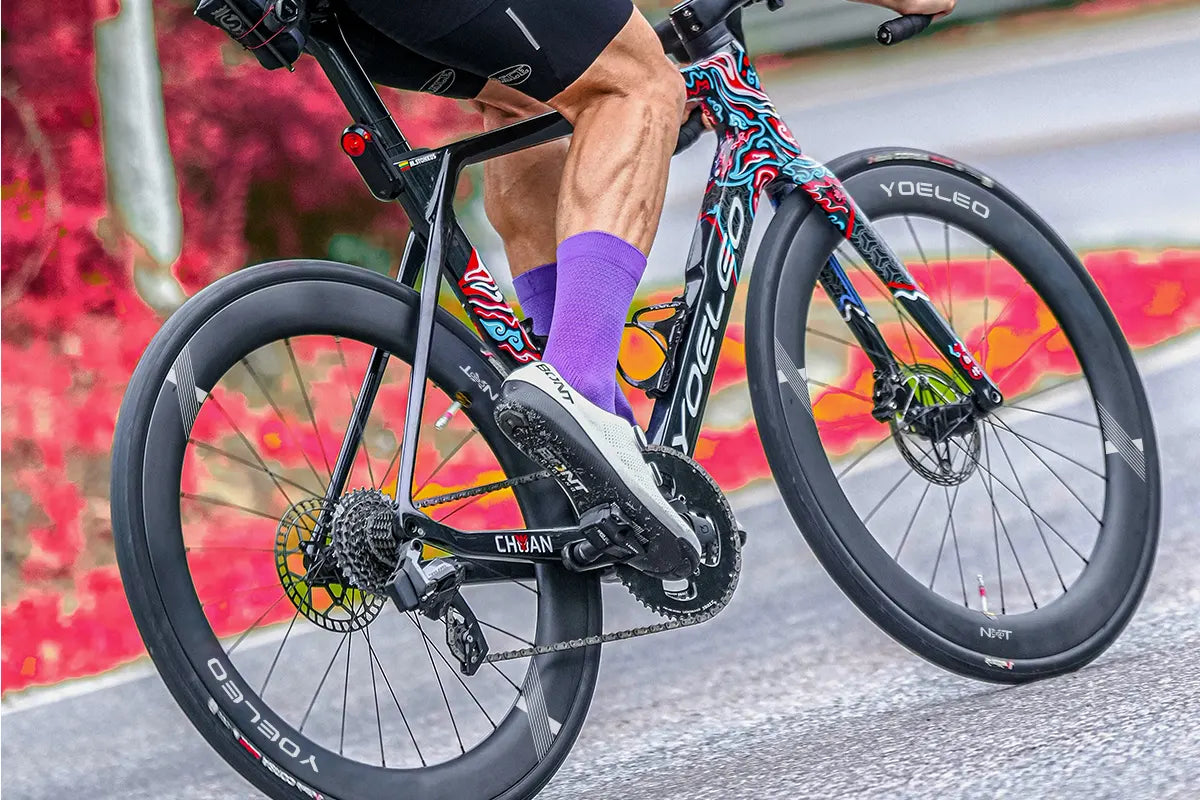
Every rider who has ever been nudged sideways by a gust on a long exposed section has had the same thought: I should have bought shallower wheels. That thought gets reinforced by forum posts, by the nervous-sounding crosswind warnings in wheel reviews, and by a general cycling culture that treats deep rims in wind as a known hazard to be avoided by the cautious. The result is that most riders buy shallower wheels than they need — and leave measurable time and energy savings on the table across every flat ride they do for the life of those wheels.

The physics of deep rims in crosswinds are genuinely interesting, and they are also more favourable to the rider than the popular narrative suggests. Modern wheel design has shifted the crosswind equation substantially over the past decade. Understanding what is actually happening when a gust hits — and what is not — gives you a framework for choosing depth confidently and for handling windy conditions without the anxiety that comes from not understanding the mechanics.
|
DEEP WHEELS IN CROSSWINDS IN 30 SECONDS
• The crosswind problem with deep wheels is real but widely overstated — modern toroidal and wide rim profiles produce far more manageable crosswind behaviour than legacy deep-section designs.
• At the yaw angles most riders experience (0°–15°), a deeper rim often provides more aerodynamic stability than a shallower one — the steering force is more predictable, not less.
• The gusts you feel are typically brief excursions to high yaw angles, not sustained crosswinds — and rider handling technique during those gusts determines the experience more than rim depth.
• Front wheel depth matters more than rear for crosswind handling. Running a shallower front than rear is the practical professional racing approach.
|
What Yaw Angle Actually Means — and Why It Is the Key Variable
Yaw angle is the apparent angle of the wind relative to your direction of travel. When you ride directly into a headwind, yaw angle is zero. When the wind comes from directly beside you, yaw angle is 90°. In practice, cyclists rarely experience sustained yaw above 15–20° — the combination of your forward speed and the wind speed creates an apparent wind that is almost always substantially forward of a true 90° crosswind.
At yaw angles of 0°–15°, deeper rims generate progressively lower aerodynamic drag than shallower rims — they are doing exactly what they are designed to do. The crosswind handling concern applies to higher yaw excursions, typically above 15–20°, where the rim presents enough lateral surface to generate meaningful steering force. Wind tunnel testing documented by independent analysis, including data published by Hambini, places the critical yaw range for modern 60mm rims at approximately 15°–25°, depending on the rim profile.
How Modern Rim Profiles Changed the Crosswind Equation
A narrow, V-section 60mm rim from 2012 behaves very differently in crosswinds than a wide, toroidal 60mm rim from 2024. The engineering change is the rim’s width-to-depth ratio and the curvature of its transition from the tyre bed to the rim sidewall.
Wider rims — the NxT SL2 range uses a 23mm internal width and 32mm external width — allow broader tyre profiles that create a smooth aerodynamic transition from tyre to rim. This reduces the abruptness of the lateral force change when a gust arrives, making the steering input more gradual and more manageable. Aerodynamic testing data summarised by BikeRadar and by Cyclist’s Hub over the past three years consistently shows that wide-profile modern deep rims have narrowed the crosswind handling gap to their shallower counterparts substantially.
What a Gust Actually Does to the Bike — and Your Correct Response
When a crosswind gust arrives, it generates a lateral aerodynamic force on the rim that tries to push the front of the bike away from the wind. The bike naturally wants to steer slightly into the wind as a result — which, counter-intuitively, is self-correcting behaviour. A gust does not blow the bike sideways; it pushes the front wheel in a direction that your weight and steering geometry can work with.

The mistake most riders make when a gust hits is to overcorrect — tensing the arms and fighting the steering input with opposing pressure. This makes the handling feel worse, not better. The correct technique is relaxed arms, slightly increased grip pressure rather than locked elbows, and allowing the bike to track naturally through the steering correction. Skilled riders develop this instinctively; riders who approach deep wheels nervously tense up, which amplifies the sensation of instability.
-
Relax your elbows — rigid arms transfer gust-induced forces directly to your balance point; bent elbows act as suspension.
-
Look ahead, not at the wheel — visual fixation on the wheel during a gust reinforces the sensation of instability.
-
Reduce your speed marginally before sustained exposed sections, not after a gust hits.
-
In a group, maintain your line — a predictable trajectory is safer in gusty conditions than constant micro-corrections.
-
Consider moving your hands to the drops in sustained crosswind sections — a lower grip gives you more leverage and a more stable contact point.
Front vs Rear: Why Mixed Depth Is the Professional Standard
Professional riders and team mechanics manage crosswind sensitivity by running a shallower wheel on the front than the rear. The front wheel generates more crosswind handling force than the rear — the front tyre steers the bike; the rear tyre follows. A 50mm front and 60mm rear combination captures nearly all the aerodynamic benefit of a full 60mm pair (the rear contributes less to total frontal drag) while substantially reducing the steering sensitivity in gusty conditions.
This is not a compromise for nervous riders — it is the systematic approach used in professional road racing specifically because it maximises aerodynamic performance while managing the handling variable. For most riders, a front 35 or 50 paired with a rear 60 is a more practical choice than a matched 60mm pair on exposed routes.
When Deep Wheels in Wind Become Genuinely Difficult
There are conditions where deep rims become meaningfully harder to manage — not because of the wheel design, but because of the conditions’ severity. Sustained crosswinds above approximately 50 kph that push measured yaw above 20° for extended periods create handling demands that go beyond technique. Unpredictable, turbulent wind in urban environments or behind lorries creates rapid yaw excursions that are harder to anticipate than sustained open-terrain crosswinds.
In genuinely severe wind conditions, the right tool is shallower wheels — not because deep rims are inherently unstable, but because at extreme yaw angles the aerodynamic forces exceed what relaxed handling technique can comfortably manage. A 35mm wheel in a 70 kph sustained crosswind is a better practical choice than a 60mm wheel. The point is that the threshold for genuinely difficult is well above what most recreational riders encounter on most rides.
|
Wind Condition
|
Yaw Angle Estimate
|
Recommended Approach
|
|
Light variable wind, urban riding
|
0°–8°
|
Any depth; no crosswind handling concern
|
|
Moderate coastal or open-terrain wind
|
8°–15°
|
50–60mm with relaxed technique; normal riding
|
|
Strong sustained open crosswind
|
15°–20°
|
50mm or mixed 50F/60R; attentive technique, relaxed grip
|
|
Very strong gusts on exposed cols or coastal roads
|
20°–25°
|
35–50mm; reduce speed on fully exposed sections
|
|
Extreme sustained crosswind above 50 kph
|
25°+
|
35mm; this is the only condition where depth is genuinely limiting
|

Building Crosswind Confidence on Deep Wheels
Confidence in gusty conditions is a skill, and it compounds with exposure. Riders who avoid deep wheels to avoid crosswinds never develop the technique that makes deep wheels manageable, which reinforces the avoidance. A more useful approach is to begin building crosswind experience on moderate 50mm wheels — which have much less crosswind sensitivity than 60mm but still require technique — before moving to 60mm on fully exposed routes.
Why the NxT SL2 and QianKun Profiles Handle Crosswinds Better Than Their Depth Suggests
The crosswind performance of a wheel is not determined by depth alone. Rim profile, internal and external width, and the tyre-to-rim transition shape all influence how lateral force builds as yaw angle increases. The NxT SL2 C50 and C60 use a wide external profile — 32mm — and a smooth toroidal transition that reduces the abruptness of lateral force change in gusts. Independent analysis including Hambini’s wheelset testing has documented how this rim geometry compares favourably in crosswind behaviour relative to narrower-profile rims of equivalent depth.
The QianKun CS50 and CS60 pair the same rim profile approach with carbon aero spokes — a reduction in rotational mass that also reduces the spoke’s contribution to lateral aerodynamic force. Both are engineered to a 120J internal impact standard, three times the UCI minimum, and both use a star ratchet freehub system with individually replaceable carbon spokes, so field damage to a spoke does not mean a wheel replacement.
|
HOW YOELEO’S NXT SL2 AND QIANKUN MANAGE CROSSWINDS
• 32mm external width on NxT SL2 creates the wide toroidal profile that modern rim design uses to reduce abrupt lateral force build-up in crosswinds
• Carbon aero spokes on QianKun CS50/CS60 reduce spoke lateral surface and rotational mass — less wheel component contributing to crosswind force
• Engineered to an internal 120J impact standard (3× the UCI minimum) — the same manufacturing rigour that makes them strong makes the rim profile consistent and predictable
• Star ratchet freehub and individually replaceable QianKun spokes — field-serviceable, DTC-direct for parts, no need to return the whole wheel
• Hand-trued before shipping on NxT SL2 means consistent spoke tension — properly tensioned spokes are stiffer laterally and track straighter in crosswinds
|
Frequently Asked Questions
Are deep carbon wheels dangerous in crosswinds?
Modern deep carbon wheels with wide toroidal profiles are well-suited to the yaw angles most recreational cyclists experience — typically 0°–15° in normal riding conditions. Sustained crosswinds above approximately 50 kph with yaw angles exceeding 20° create genuinely difficult handling conditions, but this threshold is well above what most rides expose you to.
What is yaw angle in cycling aerodynamics?
Yaw angle is the angle between your direction of travel and the apparent wind direction. Because your forward speed contributes to the apparent wind, a true sidewind rarely produces a 90° yaw in cycling — most real-world yaw falls between 0° and 15°. At these angles, deeper rims are more aerodynamically efficient than shallower ones.
Should I run shallower wheels on the front than rear in wind?
Yes — this is the approach used in professional road racing. The front wheel steering geometry means it generates more lateral handling force in crosswinds than the rear. A front wheel that is one depth shallower than the rear — for example, 50mm front and 60mm rear — captures most of the aerodynamic benefit of the deeper rear while reducing crosswind steering sensitivity.
How do I improve my handling on deep wheels in crosswinds?
Relax your elbows rather than gripping rigidly — this lets the bike track naturally through the gust rather than transferring all the lateral force directly to your hands. Look ahead rather than down at the wheel, and allow the bike to make small self-correcting steering inputs without fighting them. Reduced speed on fully exposed sections before the gust arrives is more effective than reacting after it hits.
Share:
50mm vs 60mm Wheels: QianKun CS50 vs CS60
Wheel Depth for Rider Weight & Power: A Simple Selector