
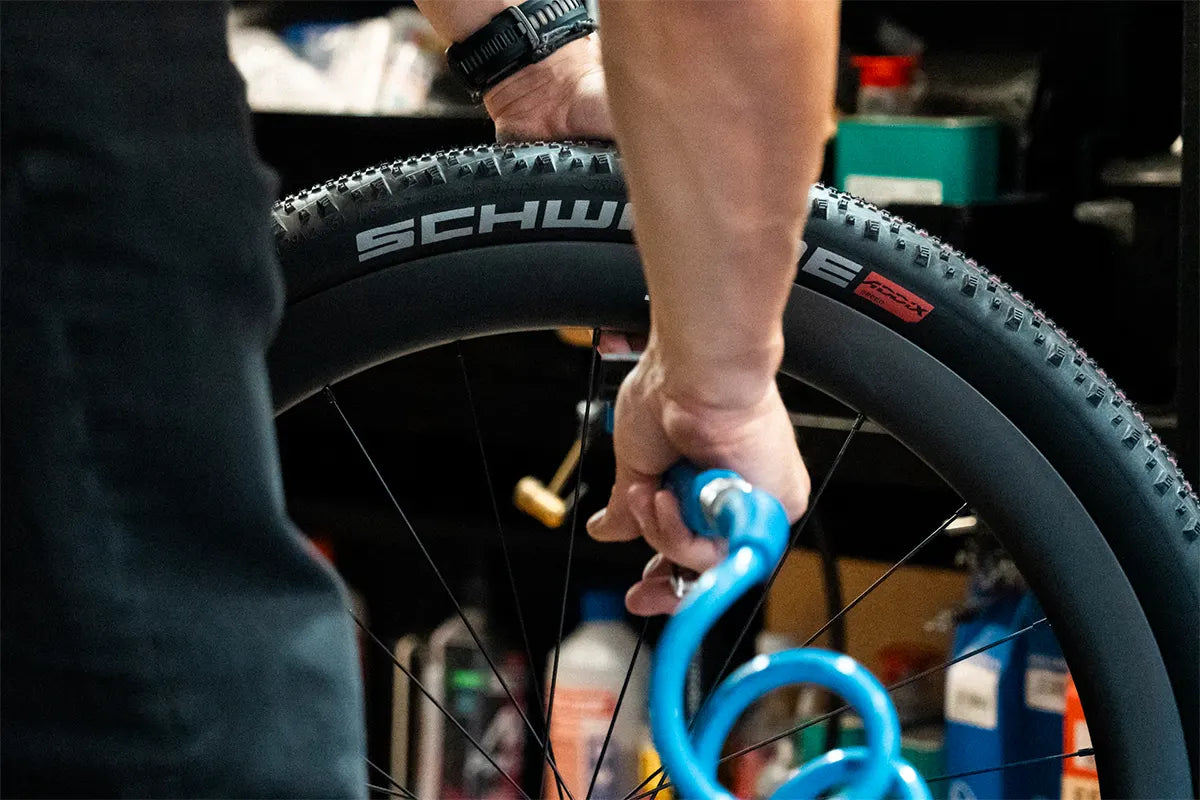
You set aside an hour for tubeless setup. Two hours later, the tyre has not seated, the sealant is everywhere, and the compressor is running out of patience. Tubeless is one of cycling's most worthwhile upgrades — lower rolling resistance, fewer punctures, genuinely lower pressure without pinch flats — but it has a steep learning curve that nobody warns you about at the point of purchase.

The three failures that derail most tubeless setups are not random bad luck. They are systematic problems with identifiable causes and specific fixes. Understanding why each failure happens makes the solution obvious — and makes the next setup take thirty minutes instead of three hours.
|
TUBELESS PROBLEMS IN 30 SECONDS
• Tyre won't seat: the bead cannot form an air seal against the rim bed because there is insufficient volume or speed of air flow — fix with a floor pump blast, a tubeless inflator, or a compressor at the valve core removed.
• Burping at low pressure: the bead is not fully locked into the bead shelf — fix by seating the tyre at higher pressure first, then bringing it down to riding pressure after the bead audibly snaps into place.
• Sealant not sealing: the puncture is larger than the sealant's particle size can bridge, the sealant has dried out, or the tyre is not spinning to distribute it — fix by adding fresh sealant and riding or rotating the wheel.
• Tape and valve integrity are the most overlooked causes of persistent failures — verify both before blaming the tyre or the rim.
|
Failure 1: The Tyre Won't Seat
A tubeless tyre seats when its beads press against the rim's bead shelves with enough force to form an air seal. That sealing force comes from tyre pressure. The problem is that air has to get inside before there is pressure — and until the beads are nearly seated, air escapes as fast as it enters.

The fix is air volume and speed. A standard floor pump delivers low volume at moderate pressure; it works on some tight tyre-and-rim combinations, but fails on loose or brand-new tyres. The correct approach, in order of escalation:
-
Remove the valve core before inflating. This allows far higher air flow rates through the valve, dramatically increasing seating success with a standard pump.
-
Pre-seat the tyre by hand before inflating — push the bead as deep into the rim channel as possible on one side, ensuring the other side is seated high on the bead shelf.
-
Use a tubeless inflator (a large-volume chamber that releases air quickly) if a pump fails. These are available from Lezyne, Topeak, and Bontrager for USD 40–80 and solve the vast majority of difficult-seating problems.
-
Use a compressor at low volume setting if available. Do not exceed the tyre's maximum pressure rating — the goal is to seat the bead, not stress the casing.
-
Apply soapy water or tyre mounting fluid to the bead and rim interface — this lubricates the seating path and allows the bead to slide into position with less air volume.
Failure 2: Burping at Low Pressure
Burping is the sudden, brief escape of sealant and air when a tyre's bead temporarily lifts away from the rim bead shelf under lateral cornering load. It is the most common riding complaint after an otherwise successful tubeless setup — and it is almost always a setup error, not a tyre or rim defect.
The most common cause is a bead that seated at the bottom of the rim channel rather than snapping up onto the bead shelf. This happens when the tyre is inflated slowly from low pressure, or when soapy water prevents the bead from locking in the final step. The fix is to re-seat at higher pressure first.
-
Inflate to the tyre's maximum rated pressure immediately after seating — even if you intend to ride at 40 psi, seat at 80 psi. This locks the bead into the shelf.
-
Listen for the characteristic double pop (one per bead) as the tyre snaps up. If you did not hear it, the bead has not locked.
-
Deflate to riding pressure only after the bead has audibly seated. Never inflate slowly to riding pressure and call it done.
-
If burping persists after correct seating, check tyre-to-rim compatibility — a tyre with a significantly loose bead diameter relative to the rim will always burp under lateral load regardless of setup technique.
|
HOOKLESS RIM PRESSURE LIMITS
• Hookless carbon rims (including ETRTO-compliant tubeless-ready designs) have maximum tyre pressure limits — typically 72.5 psi / 5 bar for road tyres on hookless rims. Never exceed the rim manufacturer's stated maximum. The hookless bead shelf design requires tyre pressures to remain below this threshold to maintain bead retention under load. Check both the rim's rated maximum AND the tyre's hookless compatibility before inflating.
|
Failure 3: Sealant Won't Seal
Tubeless sealant works by flowing into a puncture under pressure, where latex particles and fibres accumulate and cure. It is effective for punctures up to roughly 4–6mm in diameter depending on sealant brand and particle size. Outside that range, or when sealant has degraded, it will not seal — and the rider will not always know which situation they are in.
|
Symptom
|
Likely Cause
|
Fix
|
|
Sealant bubbles but does not seal
|
Puncture is within sealant range but not spinning — sealant pooling at bottom
|
Rotate wheel to bring puncture to 6 o'clock; spin the wheel to distribute sealant
|
|
Sealant seals briefly then re-opens
|
Thorn or debris still embedded in tyre
|
Remove debris, allow sealant to flow, plug with a tyre plug if needed
|
|
No sealant emerges at puncture site
|
Sealant has dried — latex dries out over 3–6 months depending on conditions
|
Add fresh sealant via valve (remove core), re-inflate
|
|
Large cut or sidewall tear — sealant floods out
|
Puncture exceeds sealant capacity
|
Boot from inside, insert inner tube, or use a plug kit designed for large cuts
|
|
Continuous slow leak at valve or tape
|
Valve core loose or tape compromised
|
Tighten valve core (finger-tight plus a quarter turn); re-tape if required
|
Tape and Valve: The Two Overlooked Variables
Experienced tubeless mechanics know that the majority of persistent setup problems trace back to rim tape and valve quality, not to the tyre or the rim. Both are inexpensive components that get treated as afterthoughts and cause disproportionate frustration.

Rim tape must span the full internal width of the rim bed and overlap by at least 50mm at the valve hole. A single layer is often sufficient on a rim with a smooth, well-finished channel; some rims benefit from a second layer for additional sealing at the spoke nipple holes. Use tape rated for tubeless — standard cloth handlebar tape, electrical tape, and other substitutes will not hold sealant pressure over time.
-
Press tape firmly and consistently into the rim channel with a rag or tyre lever. Air pockets under the tape become leak paths.
-
The valve hole punch should be clean and centred — a ragged hole allows air to track between the tape layers.
-
Tubeless valves with a removable core allow sealant injection and airflow adjustment. Use a valve that is correctly sized for the rim hole diameter — a loose valve will always leak.
-
Valve locknut should seat against the rim bed firmly — use the supplied rubber gasket, and tighten the locknut by hand plus a quarter turn. Over-tightening deforms the gasket.
Sealant Volume and Refresh Intervals
Most tyre manufacturers recommend 30–60 ml of sealant for a road tyre, 60–90 ml for a gravel or MTB tyre. The higher end of that range is appropriate for the first setup — sealant coats the inside of the tyre casing on the first inflation, consuming some of the initial volume. Check sealant level every 2–3 months by removing the valve core and probing with a wire; dried latex on the wire indicates the sealant has partially cured and a top-up is due.
Wheelsets Designed for Tubeless That Works
The experience described above — the compressor, the soap water, the re-taping — is mostly a setup problem, not an equipment problem. But the rim design does matter. ETRTO-compliant hookless rims with a tight bead-seat diameter tolerance seat tyres more reliably and hold them more securely at low pressure than older designs with looser tolerances.
The NxT SL2 series and QianKun wheelsets are tubeless-ready hookless designs, engineered to current ETRTO standards. The NxT SL2 is built to an internal 120J impact standard, three times the UCI minimum, and tested to 100,000 pedaling-fatigue cycles at 1,100N — meaning the rim structure that forms the bead shelf is designed to maintain dimensional accuracy under load, not just at rest. QianKun wheels bring individually replaceable carbon spokes, so a mechanical issue with the spoke system does not compromise the rim's tubeless integrity. For riders setting up tubeless for the first time or troubleshooting a persistent failure, starting with a rim that is built to tight dimensional tolerances removes one variable from an already complex equation.
|
HOW YOELEO BUILDS FOR TUBELESS RELIABILITY
• ETRTO-compliant hookless bead seats on NxT SL2 and QianKun — tight bead diameter tolerances improve seating success and burp resistance
• NxT SL2 engineered to an internal 120J impact standard, three times the UCI minimum — rim structure maintains accuracy under load
• Tested to 100,000 pedaling-fatigue cycles at 1,100N — the rim bed and bead shelf geometry is tested for sustained repeated load
• QianKun carbon spokes are individually replaceable — wheel damage does not compromise the rim's tubeless-ready structure
• Hand-trued NxT SL2 before shipping — rim bed runout is minimised, making tape application and bead seating more consistent
|
Frequently Asked Questions
Why does my tubeless tyre keep burping in corners?
Burping happens when the tyre bead briefly lifts off the bead shelf under lateral cornering force. The most common cause is a bead that did not fully snap into the bead shelf during setup — inflate to the tyre's maximum rated pressure immediately after seating to lock the bead in place, then reduce to riding pressure. Also verify that your riding pressure is not below the minimum for your weight and tyre volume.
How much tubeless sealant should I use?
For road tyres, 30–60 ml is the standard range; start at the higher end for a new setup as the tyre casing absorbs some sealant on first inflation. Gravel and MTB tyres typically need 60–90 ml. Check sealant level every 2–3 months and top up whenever the probing wire comes out dry.
Can I use any tyre on a hookless tubeless rim?
No. Hookless rims require ETRTO-approved tubeless-compatible tyres. Check the tyre manufacturer's hookless compatibility list before mounting. Maximum tyre pressure on a hookless rim is typically 72.5 psi / 5 bar — exceeding this can cause bead failure. Clincher-only tyres and open tubular tyres are not compatible with hookless rims.
Why won't my tubeless tyre seat with a floor pump?
A standard floor pump delivers insufficient air volume and speed to push the bead past the rim channel into the bead shelf position. Remove the valve core to maximise air flow, or use a tubeless inflator (a large-volume chamber that releases air in a fast burst). Soapy water on the bead helps the bead slide into the seated position with less air volume required.
Share:
Star Ratchet Freehub Service: Clean & Regrease at Home
Tire Pressure by Rider Weight Chart: Road & Gravel