
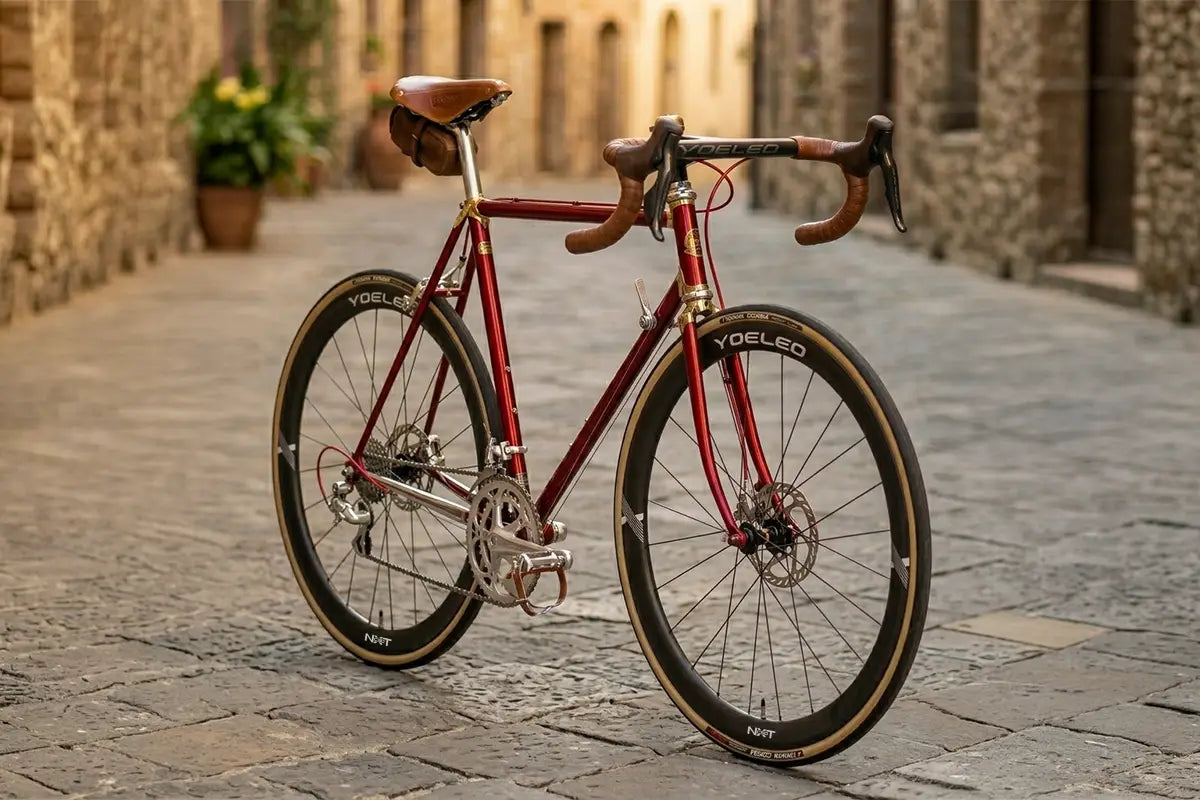
Quick Answer
If your bike is more than four years old and you want to feel faster without buying a new one, spend in this order: wheels first, cockpit second, drivetrain only if shifting is failing you, and frameset last. The reason is not marketing — it is physics, fit, and wallet compounding. This guide walks the four tiers using the same logic Yoeleo's engineering team uses when riders email asking which upgrade to make first.
The $4,000 Mistake
Picture three riders, each with a 2019 starter carbon road bike, each with $4,000 to spend, each chasing the same goal: feel faster on the same Saturday loop.
Rider A buys a new top-tier groupset. Two months later he is shifting cleaner — and dropping the same Strava times. Rider B buys a new frameset and keeps his old wheels, bar, stem and groupset. Two months later his bike looks new — and his average speed has moved by 0.4 km/h. Rider C spends most of the money on wheels and a one-piece cockpit, leaves the rest alone, and Saturday-by-Saturday becomes the rider who used to drop him.
Rider C did not get lucky. He upgraded in the order that respects what actually affects a bicycle's speed.
|
WHY ORDER MATTERS
• Every dollar moves a different lever — aero, weight, stiffness, fit, drivetrain efficiency
• Some levers compound (wheels improve aero, weight, stiffness, look at once); others do not (paint is look only)
• Spend first on the levers that touch the most physics
|
Before You Spend a Cent
Most upgrade regret starts before the credit card comes out. Three honest questions filter out the wrong upgrades fast.
1. Does the bike still fit?
Fit beats every component upgrade in the catalog. A bike you cannot ride comfortably for three hours will never feel fast, regardless of what is bolted to it.
If your reach, stack or saddle height is off — or your shoulders ache after 90 minutes — fix that before you spend money on speed. A fit session and a stem swap costs less than a single carbon part, and it unlocks every other upgrade.
2. Is anything you own about to break?
Sketchy bearings, a fading bottom bracket, or a frayed cable will undermine every new part you bolt to the bike.
Replace consumables first. A new chain, fresh bar tape, fresh tires, a service of the hubs and BB. This is the simplest reset you can buy and it makes whatever comes next feel honest.
3. Are you actually riding it?
If the bike sits four weekends out of five, the answer is not a new wheelset. It is a riding goal, not a parts list.
We will say the unpopular thing: if you are not riding consistently, the upgrade you need first is a Saturday calendar. Once the riding is real, the gains from upgrades are real too.
The Yoeleo Upgrade Hierarchy
Once those three questions are answered, here is the order we recommend — taught to us by a decade of building wheels, cockpits and framesets at the same factory tier as several of the leading European brands.
|
Tier
|
Upgrade
|
Why
|
Yoeleo Solution
|
|
Tier 1
|
Wheelset
|
Aero + rotational weight + stiffness — three physics levers in one part
|
NxT SL2 C35/C50/C60/C88 or QianKun for value
|
|
Tier 2
|
Cockpit
|
Aero, fit, cleaner cockpit, weight at the front
|
H9, H21, H25 one-piece
|
|
Tier 3
|
Drivetrain
|
Only if shifting feels worse than the rider
|
Chain/cassette refresh first; groupset step-up second
|
|
Tier 4
|
Frameset
|
The new-bike feeling, biggest commitment
|
R11 aero, R12 climber, Altera G21 gravel
|
|
THE 60/30/10 SPENDING SPLIT
• 60% of your upgrade spend into Tier 1 — wheels earn the largest single speed jump
• 30% into Tier 2 — cockpit and fit, the second-largest jump and the most personal
• 10% reserve for the small things — bar tape, tires, cables, bearing service
• Drivetrain and frameset are separate decisions, not part of the same wallet
|
Tier 1 — Wheels: The Biggest Single Jump

A wheelset upgrade is the only single component that improves aerodynamics, rotational weight and stiffness at the same time. That is why it sits at the top of every honest upgrade roadmap.
What 'good wheels' actually means
Three things matter, and the marketing in this category often ignores all three.
First, depth and shape. A rim's depth, width and shape determine how it behaves in still air and at yaw. Modern road wheels live in the 35–60 mm depth band for all-around use, with 80+ mm reserved for flat time trials and tailwind days.
Second, weight at the rim. Rotational mass at the rim affects acceleration far more than the same grams at the hub. Wheels engineered like the NxT SL2 series prioritize keeping mass in the laminate where it serves structure, not in the rim wall.
Third, hub and lacing — the silent killer of upgrade joy. Yoeleo's SAT and QianKun hubs use a star ratchet engagement system: two interlocking toothed rings held by a spring, with fewer wear points than a traditional design and a clean engagement feel year after year.
How depth changes the ride
A 35 mm rim is light and stable in crosswinds. A 50 mm rim is the best all-rounder for most riders. A 60 mm rim trades some crosswind manners for measurable aero gains. An 88 mm rim belongs on flat days and tailwinds, not on a first wheelset.
|
Depth
|
Best For
|
Tradeoff
|
Yoeleo Match
|
|
35 mm
|
Climbing, light riders, gusty regions
|
Less aero benefit on flats
|
|
|
50 mm
|
All-around, all-day, all-terrain road
|
Slightly heavier than 35
|
|
|
60 mm
|
Rolling terrain, faster group rides
|
Noticeable crosswind handling
|
|
|
88 mm
|
Flat TT, triathlon, tailwind days
|
Not a first-wheelset choice
|
The standard behind the numbers
Yoeleo's internal wheelset standard is 3× the UCI minimum impact threshold — 120 J across the NxT SL2 line and QianKun. The D8 NxT carries an 80 J standard, double the UCI minimum.
We talk about this not to flex spec sheets but because riders ask 'is it safe?' more than any other question. Every NxT SL2 rim is engineered for 100,000 pedaling fatigue cycles at 1,100 N. That is not a sticker — it is the floor we ship from.
The value tier without compromise
The QianKun line carries the same 120 J impact standard as NxT SL2, with individually replaceable spokes that turn a roadside surprise into a 15-minute fix.
Most riders do not need to spend top-tier money to step out of the OEM wheel trap. The QianKun line was designed for the rider who knows what they want from a wheel: engineering value, accessible premium, and parts that you can replace without buying a new pair. Each spoke is replaceable individually — a feature most other wheels at this tier do not offer.
|
WHAT YOU FEEL ON THE FIRST RIDE
• Acceleration out of stops — lighter at the rim, less effort to spin up
• Crosswind manners — modern rim shapes reduce yaw twitch
• Power transfer — stiffer hub-spoke-rim system loses less of what you put in
• Confidence — a wheelset designed and tested to 3× UCI minimum
|
Tier 2 — Cockpit: The Second-Biggest Jump
A modern one-piece carbon cockpit pulls aero gains, weight savings and a cleaner front end into a single upgrade — but only if the size and reach match the rider.
One-piece vs two-piece
A traditional stem and bar combination is endlessly adjustable — and aerodynamically average. A one-piece cockpit removes the spacer stack at the stem clamp and a noticeable amount of frontal area. For riders whose fit numbers are stable and well known, this is a real upgrade.
Yoeleo's H-series — H9, H21, H25 — are T700 carbon with ProMoldCore one-piece construction. The cockpit lays inside the frame as a single carbon shape, which is faster than two pieces and quieter on a wet ride.

Fit before flash
Order cockpit size last in the conversation, after you have nailed reach, drop and bar width. Anything else turns an upgrade into a fitting problem.
We see returns when a rider buys an aesthetic spec — say a one-piece with 80 mm reach and 38 cm drops to match a stem they used to run — without realizing their old bar had different shape geometry. Use the fit you already trust. Adapt the part to the rider, never the other way.
When to skip the one-piece
If you are still searching for your reach, drop and width — keep a traditional stem and bar. The cost of changing a 100 mm stem to a 90 mm stem is small. The cost of replacing a one-piece is not. Use one-piece carbon when the geometry is locked.
Tier 3 — Drivetrain: When (and When Not) to Upgrade
Drivetrain upgrades feel exciting and rarely move the clock. Upgrade only when shifting fails the rider — not because a new generation exists.
A 12-speed groupset does not move you faster than an 11-speed groupset on the same Saturday loop. What it can do is shift cleaner under load, weigh slightly less, and outlast a worn-out cable system. Those are real benefits — just not speed benefits.
Our recommendation: replace your chain twice a year, your cassette once, and re-cable annually. If shifting still feels worse than you are, then look at a drivetrain step-up. Until then, the dollars belong elsewhere.
Tier 4 — Frameset: The Biggest Commitment
A new frameset is the largest single move on the roadmap. Save it for when the existing frame is genuinely holding you back — geometry, fit, stiffness, or simply the wrong category for how you ride now.

When a new frame actually makes sense
Three scenarios. First, the frame no longer fits. Riders change, bodies change, goals change. A frame chosen for 'just getting into cycling' four years ago may be slack and tall — perfect then, slow now.
Second, the discipline changed. If you ride gravel three out of four weekends, you are riding a road frame off-tarmac, and that is not the frame's fault — it is the wrong tool. A frame like the Altera G21 was designed for the gravel rider, with the geometry, clearances and mounts to match.
Third, the frame is worn out or the warranty has expired and you trust the rest of your kit. A new frame is the right move.
The three Yoeleo framesets
|
Frame
|
Best For
|
Frame Weight
|
Notes
|
|
Aero road, group rides, fast Saturdays
|
~1,050 g
|
All-around road platform, disc and rim brake
|
|
|
Climbing, mountainous terrain
|
~900 g
|
Engineered for elevation gain
|
|
|
Gravel, mixed-surface, adventure
|
~1,100 g
|
2025 UCI Gravel Worlds podium platform
|
|
RACE-PROVEN, NOT JUST SPEC-SHEET
• The Altera G21 took 1st and 3rd at the 2025 UCI Gravel World Championships (Pravilova and Verkuijl)
• Peak Torque self-purchased his G21 and tested it the way an unpaid reviewer does
• Hambini's review of Yoeleo wheels concluded the engineering 'made Western brands look stupid'
• Cyclist's Hub has published nine independent reviews across the Yoeleo range
|
4. Mistakes to Avoid
Mistake 1 — Buying for looks
Black-on-black, glossy or matte, exotic decals. None of it makes the bike faster. Buy the part that earns the largest speed jump first; let aesthetics be the tiebreaker between equivalent choices.
Mistake 2 — Skipping the fit
Buying a one-piece cockpit before nailing fit is the most expensive mistake in this category. The same is true for saddle and stem changes. The fit is the speed.
Mistake 3 — Confusing 'new generation' with 'better for me'
A new groupset generation rarely matters in the first three years for most riders. A new wheelset almost always does. Choose by what moves the clock, not what moves the marketing cycle.
Mistake 4 — Buying value twice
The most efficient upgrade is the one you do not have to redo. Buy the wheelset that lasts five seasons the first time. The cheap-now-real-later approach almost always ends with two pairs of money spent.
The Roadmap in One Decision Table
|
Your Goal
|
First Upgrade
|
Yoeleo Match
|
Budget Share
|
|
Faster on flat group rides
|
50 mm wheelset
|
60%
|
|
|
Faster on climbs
|
Lighter wheels + lighter cockpit
|
60% + 30%
|
|
|
More confidence on gravel
|
Gravel-specific frameset
|
Tier 4 swap
|
|
|
Best value step up
|
Engineered value wheels
|
60%
|
|
|
Big aero target
|
Deep rim + one-piece
|
60% + 30%
|
The Old Bike Upgrade FAQ
How much faster will new wheels actually make me?
A meaningful wheelset upgrade — moving from an OEM training wheel to an engineered carbon set in the 50 mm depth range — is typically worth 0.8 to 1.5 km/h on the same loop for the same effort, depending on terrain and rider. Tested independently by Cyclist's Hub, Yoeleo's NxT SL2 sits at the top end of that range for its price point.
Are carbon wheels safe for daily riding?
Modern engineered carbon wheels are safe when designed and tested to a real standard. Yoeleo's internal standard for the NxT SL2 and QianKun lines is 3× the UCI minimum impact threshold, and every rim is engineered for 100,000 pedaling fatigue cycles at 1,100 N. The result is a wheel designed to outlast the bike it goes on.
Should I upgrade my old bike or buy a new one?
If the frame fits and the discipline is right, upgrading wheels and cockpit will get you 70 to 80 percent of the way to a new-bike feel at roughly a third of the cost. Buy a new frameset only when the existing frame does not fit, is not the right category, or is genuinely worn out.
How long does a custom-paint Yoeleo build take?
Custom paint is craft time, not delay — every paint scheme is hand-finished and inspected before it ships. Plan for roughly 50 days from order to delivery for custom-painted framesets. Stock-color builds ship faster.
What's the difference between NxT SL2 and QianKun wheels?
Both carry the same 120 J impact standard — 3× the UCI minimum. The NxT SL2 is the engineered top of the wheel range with the latest rim shapes. QianKun is the value tier with individually replaceable spokes, designed for riders who want premium engineering without the top-tier price.
Next Step
If you are ready to map your own upgrade path, the most useful step is to look at the wheelsets first — that is where 60 percent of upgrade dollars should land. Then size your cockpit to your existing fit, and let everything else wait its turn.
Share:
7 Cycling Myths Keeping Beginners Slow | Yoeleo
Drivetrain Maintenance After Bikepacking A Recovery & Care Guide for Long-Distance Riders