
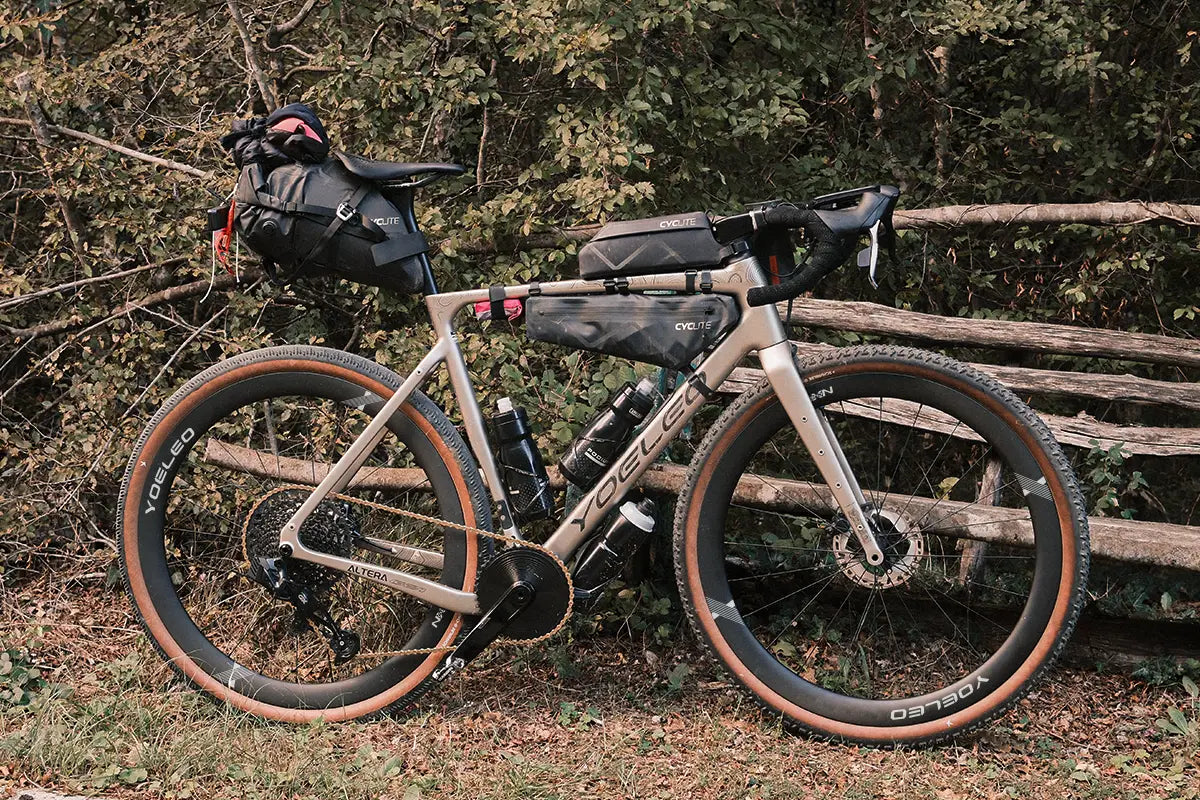
A decade ago, the choice was simple: road bike or mountain bike. Today, most enthusiasts ride something in between — a route that starts on tarmac, crosses fire roads, hits packed dirt, and finishes on broken pavement. The bike industry has answered with framesets that clear ever-wider rubber: 40, 45, 50, even 53 mm. But more clearance is not automatically better. Wide tires roll slower on tarmac, take longer to accelerate, and feel ponderous on smooth roads.
The real question is not 'how wide can I go?' It is 'what is the right clearance for the terrain mix I actually ride?' This guide walks through the wide-versus-fast tradeoff with real-world data, then maps each width range to the riders, routes, and Yoeleo platforms it serves best.
Quick Verdict — How Much Clearance Do You Actually Need?
If you ride 80 percent tarmac and 20 percent light dirt, the R11 or R12 with 32 mm clearance covers you. If you ride a true mix of road and gravel, the Altera G21's 53 mm clearance gives you headroom from 38 mm fast gravel up to 50 mm bikepacking rubber. The sweet spot for 2026 mixed-terrain riding sits at 40–45 mm — wide enough for control on loose surfaces, narrow enough to stay efficient on the tarmac transitions.

The Modern Clearance Landscape (32 mm to 53 mm)
Tire clearance has expanded in lockstep with the rise of mixed-terrain riding. The chart below shows where each width range fits in today's category map and which platforms are designed for them.
|
Tire Width
|
Surface Target
|
Typical Use
|
Yoeleo Platform
|
|
28–32 mm
|
Tarmac, smooth roads
|
All-road, fast group rides
|
|
|
35–38 mm
|
Hard-pack dirt, light gravel
|
Fast gravel races, gravel commute
|
|
|
40–45 mm
|
True mixed terrain
|
Long gravel events, mixed adventure
|
|
|
45–50 mm
|
Loose gravel, broken doubletrack
|
All-day gravel, mixed bikepacking
|
|
|
50–53 mm
|
Rough gravel, light singletrack, loaded bikepacking
|
Bikepacking, rugged adventure
|
Altera G21 (the platform ceiling)
|

The Wide-vs-Fast Tradeoff, Explained
Wider tires are not slower on every surface — they are slower on some surfaces, and faster on others. The crossover point is governed by surface roughness and the rolling-resistance model. Here is how each variable behaves as you go wider.
What Gets Better as Tires Get Wider
-
Grip — larger contact patch, especially under load and at low pressure
-
Comfort — more casing volume to absorb chatter and big hits
-
Puncture resistance — supple casings at low pressure deform around debris rather than cutting
-
Confidence on loose surfaces — the tire floats over gravel scatter instead of digging in
-
Capability — a 50 mm tire opens routes a 35 mm tire cannot ride safely
What Gets Worse as Tires Get Wider
-
Aerodynamics — bigger frontal area; matters most at sustained 30+ kph on tarmac
-
Rotational weight — slower acceleration and slower steering response
-
Tarmac efficiency — at the same pressure, narrower tubeless casings roll faster on smooth surfaces
-
Ponderous feel — heavy treads feel sluggish on smooth roads and at the start of climbs
|
THE TRADEOFF IN ONE LINE
• Wider tires win on the rough; narrower tires win on the smooth. The right width is the one that matches your average surface, not your roughest section.
• The rim, frame, and pressure choices have to support the width. A wide tire on a narrow rim or over-inflated runs slower than a correctly-sized narrower tire.
|
Tire Width vs Surface — A Decision Matrix
Use this matrix as a starting point. Match the row that best describes your typical route mix, not your once-a-year adventure ride.
|
Your Route Mix
|
Recommended Width
|
Why It Wins
|
|
90% tarmac, 10% smooth dirt
|
30–32 mm road
|
Fastest on the dominant surface; tarmac efficiency matters most
|
|
60% tarmac, 40% hard-pack dirt
|
35–38 mm gravel
|
Bridges both surfaces without giving up much on either
|
|
50% road, 50% mixed gravel
|
40–43 mm gravel
|
Modern all-rounder — efficient on tarmac, stable on gravel
|
|
30% road, 70% loose gravel
|
45–47 mm gravel
|
Grip and float matter more than tarmac speed here
|
|
Bikepacking + loaded gravel
|
48–53 mm gravel
|
Volume and impact margin protect you and the load
|
Why Frame Clearance Sets the Real Ceiling
Wheels can be swapped. The frame is permanent. The largest tire that fits the frame is the absolute ceiling on what the bike can ever do, which is why clearance is the most important spec in any mixed-terrain frameset choice. A frame with 38 mm clearance will never be a true bikepacking platform, no matter what wheel you bolt to it.
This is where the Altera G21 changes the conversation. The frame and fork together clear 700×53 mm rubber — the highest single-tire clearance in our lineup and one of the widest in the modern gravel category. That ceiling means you can run fast 38 mm gravel rubber for a race weekend, swap to 45 mm for an all-day mixed route, and mount 50 mm for a loaded bikepacking trip — all on the same frameset. Same chainstays, same fork, same handling character; different shoes for the day.
|
CLEARANCE IS PERMANENT
• The largest tire your frame clears is the largest tire you will ever be able to use on that bike. Plan up, not down.
• Altera G21 ceiling: 700×53 mm with single chainring (1x); 50–34T double-chainring compatible.
• If you might ever bikepack, ride loose gravel, or want a single-bike answer to mixed surfaces, oversize the clearance.
|
Rim Internal Width — The Other Half of the System
Tire width is only half the equation. The internal width of the rim sets the inflated profile of the tire and, with it, the airflow shape, the contact patch, and the pressure stability. Two tires of the same nominal width can sit and ride completely differently depending on which rim they are mounted to.
SAT C45 DB Pro NxT Gravel — Built for 40–50 mm Rubber
The C45 Gravel wheelset uses a 27 mm internal width and 34.3 mm external — wider than our road NxT SL2 hoops by design. That extra internal width is what lets a 40–50 mm gravel tire sit in its ideal shape instead of bulging or pinching. Reinforced 3.65 mm sidewalls give the rim the impact margin gravel demands, and the full wheel system is tested to 120 J of rim impact (3× the UCI minimum) with hub torque cycled to 230 Nm × 52,000 cycles. Hookless tubeless, no rim tape required.
Optimal tire range: 40–50 mm gravel rubber.
Compatible range: 38–53 mm — the widest 53 mm tires sit slightly above the airfoil sweet spot but ride and seal cleanly.
Why it pairs with the G21: The G21's 53 mm frame ceiling and the C45 Gravel's 27 mm internal are designed as a system.
NxT SL2 Road Wheelsets — Built for 28–32 mm All-Road
For riders mixing tarmac with the occasional smooth dirt section, the road-spec NxT SL2 wheelsets (C35, C50, C60) carry a 23 mm internal width and 32 mm external — the modern road profile, optimized for 28–30 mm rubber. Up to 32 mm fits the rim and clears the R11 or R12 frame, so an all-road setup with the right tire choice handles unsealed connector roads and smooth gravel without giving up tarmac speed.
Optimal tire range: 28–30 mm road or fast all-road.
Compatible range: 25–32 mm.
When to choose this over a gravel-specific build: Your route mix is 80 percent tarmac or you only see dirt rarely.
Building the Right Combo for Your Mix
The All-Road Setup — R11 or R12 + NxT SL2
Best for riders whose mixed terrain is mostly road with occasional unsealed sections. The R11 or R12 with the C50 NxT SL2 on 30–32 mm tubeless rubber is fast on tarmac, comfortable on broken roads, and capable on smooth fire roads. The 32 mm frame ceiling is the limit — if your dirt sections turn loose or rough, this is the wrong platform.
The Mainstream Mixed Setup — Altera G21 + C45 Gravel on 40–45 mm
Best for the largest group of mixed-terrain riders. The Altera G21 with the C45 Gravel on a 42 mm tubeless gravel tire handles 95 percent of mixed routes well. Tarmac transitions feel sharp, fast gravel descents stay composed, and the frameset's long wheelbase and integrated storage make it equally happy on a 5-hour adventure ride or a gravel race start line. This is the build that won the 2025 UCI Gravel World Championships women's category and took 3rd in the men's race.
The Adventure & Bikepacking Setup — Altera G21 + C45 Gravel on 47–50 mm
Best for loaded touring, sustained loose gravel, and rugged adventure routes. The same G21 frame and C45 Gravel wheels host 47–50 mm rubber for a setup that prioritizes float, comfort, and impact margin over outright speed. The Altera G21 fork with mounting holes carries front panniers; integrated top-tube and down-tube storage compartments swallow tools and snacks without external bags. The 53 mm clearance ceiling means you can step up further when the route demands it.

|
WHY THE G21 CEILING MATTERS
• 53 mm is real, usable clearance — not theoretical. The frame and fork are designed around the wider rubber, with deliberate margin for mud and tire growth.
• Universal Derailleur Hanger (UDH) compatibility means modern wide-range gravel drivetrains fit cleanly without proprietary parts.
• T-47 inboard bottom bracket and mould-integrated alloy sleeves keep the bottom bracket area stiff and serviceable under bikepacking load.
|
Recommendations by Rider Type
The Fast All-Rounder
You ride: Mostly tarmac group rides, fast gravel sections, occasional rough chipseal.
Frame: R12 aero road frameset (32 mm clearance, BB386, ProRoute internal cable routing).
Wheels: SAT C50 NxT SL2 (23 mm internal, 50 mm depth).
Tire: 30 mm tubeless road.
The Mixed-Terrain Daily Driver
You ride: Equal parts tarmac and gravel, 3–5 hour routes, sometimes timed gravel events.
Frame: Altera G21 (53 mm clearance, T-47 BB, UDH, integrated in-frame storage).
Tire: 42 mm tubeless gravel — a fast file tread or light knob.
The Long-Form Adventurer
You ride: Multi-day bikepacking, loaded mixed-surface routes, rugged adventure rides.
Frame: Altera G21 with fork-mounting fork option (front pannier mounts).
Tire: 47–50 mm tubeless gravel with reinforced casing.
The Racer Who Also Adventures
You ride: Gravel races on the weekend; long mixed-terrain rides midweek.
Frame: Altera G21 — the same frame that took 1st and 3rd at the 2025 UCI Gravel Worlds.
Wheels: SAT C45 NxT SL2 Gravel (race day) — same wheels handle 38 mm fast rubber and 47 mm adventure rubber.
Tire: 38–40 mm for racing, 45–47 mm for adventure days.

The Verdict — Wide vs Fast Is the Wrong Frame
Wide is not slow. Fast is not narrow. Both can be true at the same time depending on the surface, the rim, the pressure, and the rider. The honest answer is to choose the frame with enough clearance to cover everything you might ride, then pick the wheel and tire combination that matches your typical week — not your most demanding day.
For most riders solving the mixed-terrain question in 2026, that means the Altera G21 platform: a 53 mm clearance ceiling, a frame proven at the highest level of competitive gravel, and a wheel ecosystem (C45 NxT Gravel) engineered for the 40–50 mm tire range where modern mixed terrain actually lives. For riders whose mix tilts heavily toward sealed roads, the R11 or R12 with the NxT SL2 platform delivers all-road capability without the gravel-specific compromises.
Buy the clearance you might need. Run the width your week actually rewards.
Frequently Asked Questions
What tire clearance is best for mixed terrain riding?
For a true mix of road and gravel, 40–45 mm is the modern sweet spot — wide enough for control on loose surfaces, narrow enough to stay efficient on tarmac transitions. Frames with 50–53 mm clearance give you the headroom to go wider for bikepacking or rougher routes without buying a second bike.
How wide a tire does the Altera G21 clear?
Up to 700×53 mm with a 1× drivetrain (single chainring up to 42T standard, 44T with the wide-spindle option). Double-chainring compatible up to 50–34T. The clearance is real and usable, with deliberate margin for tire growth and mud.
Can I use one set of wheels for road and gravel?
Yes, with caveats. The road-spec NxT SL2 wheelsets (23 mm internal) handle 28–32 mm tires for fast all-road use. The C45 NxT Gravel wheelset (27 mm internal) is engineered for 40–50 mm gravel rubber. A single wheelset cannot cover both ends well — choose the wheel that matches the surface where you spend most of your time.
Are wider gravel tires always faster on gravel?
On rough or loose gravel, yes — the impedance and grip gains outweigh the rolling-resistance penalty. On smooth hard-pack and tarmac transitions, narrower fast-rolling gravel tires (38–42 mm) can be quicker. Match the tire to the surface that defines your ride, not the one that scares you most.
What is the difference between gravel and road tubeless setup?
Gravel tubeless setups use wider rims, lower pressures, and casings designed for impact resistance and puncture protection. The 27 mm internal width on the C45 NxT Gravel wheelset is engineered for 40–50 mm rubber at gravel pressures, with reinforced 3.65 mm rim sidewalls. Road tubeless (NxT SL2 road) uses a 23 mm internal width for 28–32 mm rubber at higher pressures.
Share:
“Beyond Boundaries: Tony's Transformation with Yoeleo Bikes in Australia - A Tale of Perseverance and Passion"
Race Morning: The Night-Before Checklist That Prevents DNFs