
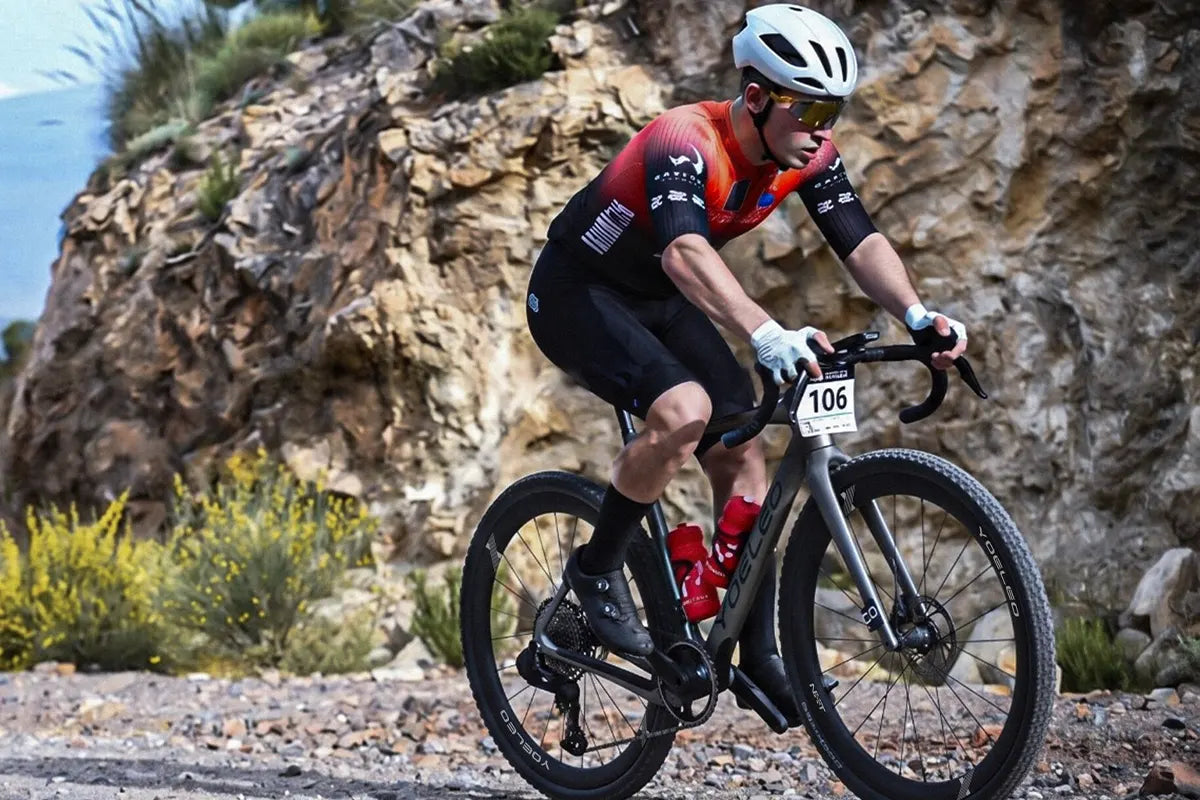
You registered for your first gravel race at 11pm on a Tuesday, riding the wave of post-ride confidence. By Thursday morning, the doubt arrived. How do you train for something that is part road race, part trail run, part endurance event, and entirely unpredictable? What tires? What pressure? What do you actually eat at kilometre 80 of a race you have never done before?

The good news: gravel racing is more forgiving than road racing for first-timers, and six weeks of focused preparation is enough to arrive ready — not just physically, but with a bike that is dialled, a nutrition plan that works, and a race-day routine that removes the avoidable surprises. This guide gives you the framework, week by week.
|
FIRST GRAVEL RACE IN 30 SECONDS
• Six weeks is enough time to prepare for most first gravel events if you have a base of regular riding
• Tire choice and pressure are the most race-defining bike decisions — get these right in training, not on race morning
• Nutrition starts at the start line, not when you feel hungry — practise your plan in training
• The bike check (week 5) matters: a mechanical on race day is more common than a fitness failure for first-timers
|
Week 1–2: Build Your Aerobic Foundation and Dial the Bike
The first two weeks are not about peak fitness — they are about consistency and removing unknowns. Ride four to five days at moderate effort, mixing road and gravel surfaces so your body adapts to the postural and core demands of gravel riding. Gravel riding recruits stabiliser muscles that road cycling does not — lower back, hip flexors, and upper body — and those muscles need time to adapt before race intensity arrives.
While you are riding, audit your bike. Confirm your drivetrain is clean, your cables or electronic system is functioning correctly, and your tires have no embedded debris or sidewall cracking from the previous season. A drivetrain service and fresh bar tape are worth doing in week 1 so any issues surface before they matter.
Week 3: Introduce Intensity and Test Your Nutrition
Week 3 is where training quality starts to matter. Add one interval session per week — not race-pace efforts, but sustained moderate-to-hard work that mimics the variable intensity of gravel racing: 20-minute efforts at a pace you could hold but not hold a conversation, on terrain that mixes gradients. Gravel races rarely let you settle into a steady-state rhythm for long.
Test your nutrition strategy in a long ride this week. Aim for 60–90g of carbohydrate per hour during efforts over two hours, starting from the first 30 minutes — not when you feel tired. Sports nutrition research (published in journals including the International Journal of Sport Nutrition) consistently shows that athletes who under-fuel in the first half of endurance events perform significantly worse in the second half, regardless of fitness. Practise eating on the bike if you do not already do it habitually.
Week 4: Tire Setup and Pressure Testing
Tire choice is the most race-defining equipment decision for a gravel event — more impactful than frame weight, wheel depth, or groupset. The right choice depends on your specific event's surface: hard-packed gravel or compressed dirt suits a low-profile tread pattern in the 38–42mm range; loose or rocky terrain demands more volume and a moderate knob height, typically 40–45mm or wider.
Test your chosen tire at several pressures on the kind of surface your event will cover. Start high, reduce by 3–5 psi per ride, and note where grip, comfort, and rolling speed feel optimal. Most riders in the 65–80kg range find their gravel sweet spot between 28 and 40 psi on a 40mm tubeless tire. Document the pressure that works and use it on race day — do not experiment on the morning of the event.
Week 5: The Bike Check — Every Component
|
Component
|
What to Check
|
Action if Issue Found
|
|
Tires
|
Sidewall integrity, tread depth, sealant life
|
Replace tires or top up sealant 5–7 days before race
|
|
Drivetrain
|
Chain wear, cassette wear, jockey wheels
|
New chain if stretch is measurable; clean and lube all components
|
|
Brakes
|
Pad depth, rotor condition, hydraulic fluid level
|
Replace pads if under 2mm; bleed hydraulics if lever feels soft
|
|
Wheels
|
Spoke tension, lateral and radial trueness
|
True if any wobble; check quick-release or axle torque spec
|
|
Cockpit
|
Bar tape, stem bolt torque, headset play
|
Re-tape if worn; torque stem and headset bolts to spec
|
|
Tubeless system
|
Sealant volume, valve function, rim seal
|
Inject fresh sealant; test valve rotation; reseat tire if needed
|
|
Electronics
|
Battery charge (Di2 / GPS / power meter)
|
Full charge 24 hours before race; spare batteries for GPS
|
Week 6: Taper, Race Logistics, and the Day-Before Routine
Week 6 is for tapering and removing logistical stress. Reduce volume by 30–40% while maintaining some intensity — two shorter rides with brief efforts at race pace, nothing longer. Your fitness is built; the goal now is arriving fresh rather than arriving fit.

Pack your race kit the night before using a checklist, not memory. The list below covers the categories most first-timers forget to verify until race morning:
-
Helmet (check retention system and strap)
-
Shoes and cleats (check cleat bolt torque)
-
Cycling kit — jersey, bibs, base layer appropriate to forecast temperature
-
Gloves (gravel vibration makes these more important than on road)
-
Hydration — bottles or pack; confirm capacity matches the event's feed station spacing
-
Nutrition — enough for the full race duration plus 20% buffer
-
Flat kit — tubeless plug kit, CO2 or pump, spare valve core
-
Bike computer charged and race course loaded
-
Emergency layer (gilet or light jacket for starts in cold or changeable weather)
-
Race number (if issued pre-event) and confirmation email
Race-Day Fundamentals: The First 20 Minutes
The first 20 minutes of a gravel race are where most first-timers make the mistakes that cost them the second half of the event: going out too hard on the neutral rollout, choosing an impossible position in the bunch, burning matches before the terrain dictates it. Gravel racing rewards patience in the opening section more than most other formats.
Start your nutrition from kilometre one — a gel or real food at the 30-minute mark before your body registers any need. Ride within yourself through the first third of the race; the terrain will provide enough intensity without you adding to it. Save your hardest efforts for where the race course demands them: technical sections, short punchy climbs, and the final 15–20% of the event where fitness gaps widen.
The Right Gravel Frame for Your First Race — and Every Race After
At the 2025 UCI Gravel World Championships, Pravilova took gold and Verkuijl took bronze — both on the Altera G21. That performance at the highest level of gravel racing validates the frame's engineering under race conditions, but the G21 was designed as much for first-time racers as for podium contenders: 53mm tire clearance for race-day tire flexibility, integrated in-frame storage for nutrition and tools, and a 27.2mm Pro-Flex seatpost that absorbs the fatigue of sustained gravel riding across a multi-hour event.

The Altera G21 is internally tested beyond ISO 4210 standards, UCI-approved, and independently reviewed by Peak Torque (self-purchased), Hambini, and Cyclist's Hub. Yoeleo's DTC model means the engineering investment goes into the frame rather than into retail margins — giving first-time gravel racers access to race-level equipment without the premium-brand price premium.
|
HOW YOELEO SETS YOU UP FOR YOUR FIRST GRAVEL RACE
• Altera G21: 53mm tire clearance handles race-day tire decisions confidently — 38mm fast slick to 50mm volume knobbly without a wheel change
• Integrated top-tube and down-tube storage removes the need for a frame bag on shorter events; Pro-Flex seatpost reduces fatigue over long gravel hours
• NxT SL2 C35 and C45 Gravel wheelsets engineered to 120J internal impact standard (3x UCI minimum) — built for the rim impacts gravel terrain delivers
• UCI Gravel World Championship double podium in 2025 — Pravilova gold, Verkuijl bronze, both on G21 — the strongest race-condition proof in this category
• Independent validation from Peak Torque (self-purchased G21 review) and Cyclist's Hub confirms performance claims hold up under real-world scrutiny
|
Frequently Asked Questions
How many weeks do I need to prepare for a first gravel race?
Six weeks of structured preparation is sufficient for most first gravel events if you have an existing base of regular riding. The priorities are: bike audit, tire and pressure testing, one weekly intensity session, and a nutrition plan practised in training rather than improvised on race day.
What tire pressure should I use for a gravel race?
Pressure depends on tire width, rider weight, and surface. Most riders (65–80kg) on a 40mm tubeless gravel tire find 28–40 psi works well on packed gravel or compressed dirt. Test your specific tire on your event's surface type in training — do not guess on race morning.
Should I use tubeless tires for a gravel race?
Yes. Tubeless tires allow lower pressures for better grip and comfort, resist pinch flats that are common on technical gravel surfaces, and self-seal small punctures. Set up tubeless at least a week before your event to confirm the seal is solid and sealant is distributed evenly.
What do I eat during a long gravel race?
Target 60–90g of carbohydrate per hour for efforts over two hours. Begin eating from the first 30 minutes — not when you feel hungry. Practise your nutrition plan on long training rides before the event. Carry more than you expect to need and use feed stations where available to resupply.
Share:
Carbon Bike Torque Specs: The 10-Minute Habit Guide
Road Bike Comfort on Long Rides: 5 Setup Changes