
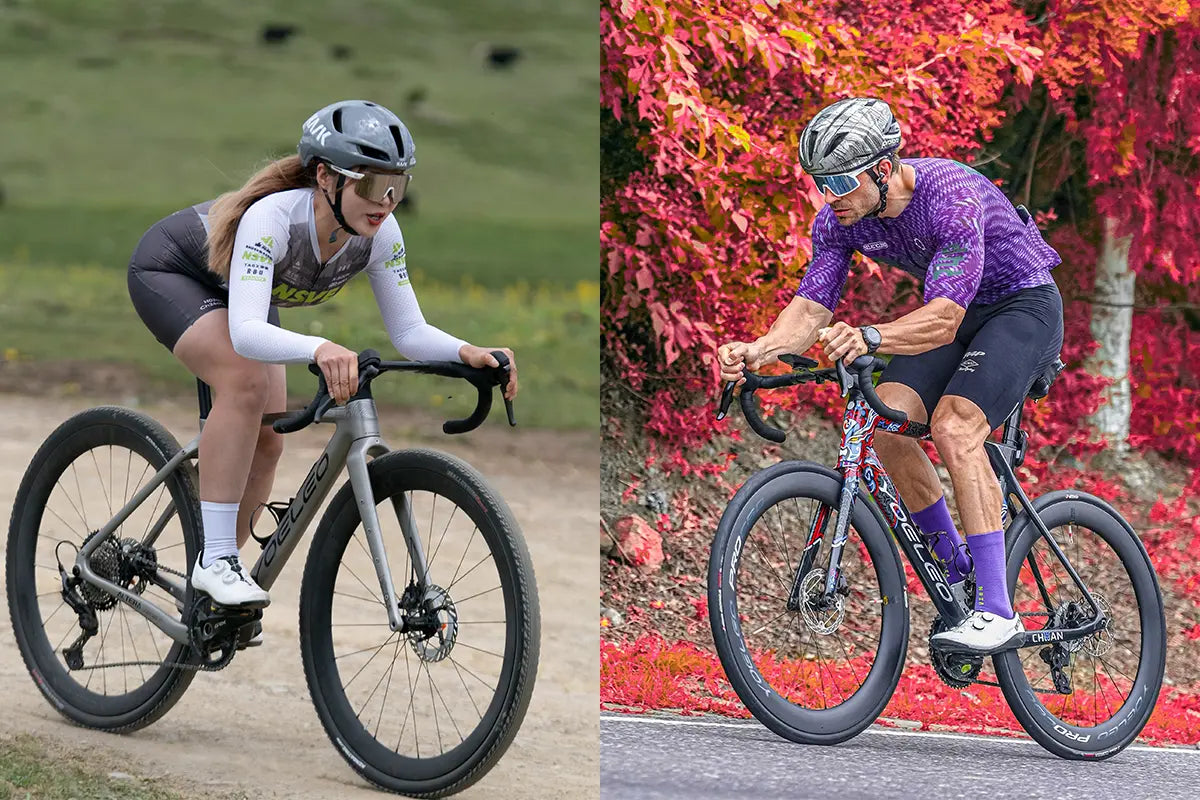
You're not wrong to be skeptical. The lines between road, all-road, and gravel have blurred dramatically in the last five years. Riders on forums regularly report that their endurance road bike handles 90% of what a gravel bike does. Others have been caught in analysis paralysis, comparing a top-end all-road against a gravel frame and genuinely unable to decide.
This guide cuts through the confusion. We'll walk through the geometry that separates these categories, explain how tire clearance plays into real-world riding, and help you honestly evaluate whether you need one bike or two.
|
QUICK VERDICT
• Mixed terrain (roads + gravel regularly): Gravel bike. G21. More versatile, capable, stable.
• If you must choose one: Gravel bike. It handles more terrains adequately than a road bike.
• Most riders genuinely only need one bike. Choose based on your actual terrain split.
|
The Core Geometry Differences
|
Geometry Metric
|
Road Bike (R11/R12)
|
Gravel Bike (G21)
|
Real-World Impact
|
|
Head Tube Angle
|
72–73.5°
|
70.5–72°
|
Steeper = quicker steering; Slacker = planted, stable
|
|
Chainstay Length
|
400–410mm
|
415–425mm
|
Shorter = snappy accel; Longer = better rear traction
|
|
Stack Height
|
Lower (relative)
|
Higher
|
Lower = aggressive; Higher = upright, control-focused
|
|
Trail
|
~55–60mm
|
~60–65mm+
|
Less trail = responsive; More trail = damps vibration
|
|
BB Drop
|
Minimal
|
Moderate
|
Less drop = cornering; More drop = stability on rough
|
|
Tire Clearance
|
Up to 32mm
|
Up to 53mm (1x)
|
32mm = light gravel only; 53mm = technical terrain
|
|
BB Standard
|
BB86 / BB386
|
T-47 threaded
|
Threaded = easier maintenance, less creak
|
A 2024 survey from the Bicycle Product Suppliers Association found that 68% of cyclists shopping for a frameset cited versatility as a primary concern, yet only 31% accurately understood how geometry affects handling on different surfaces. The confusion is real, and it costs riders money on frames that don't match their actual use case.
Tire Clearance: The Defining Spec
Road Bike Tire Clearance
Gravel Bike Tire Clearance
Handling Feel: How Geometry Translates to the Road
Road Geometry in Action
Gravel Geometry in Action

The Versatility Question: Can One Bike Do Both?
When a Road Bike Is the Right Choice
-
You're primarily a pavement rider. Group rides, centuries, training on established routes.
-
You value speed and efficiency. Road geometry is optimized for power transfer and aerodynamics.
-
You want the lightest build. The R11 at 890g raw is among the lightest frames available.
-
Your budget is tighter. Road framesets offer more component options at the same price point.
-
You already own a road bike and aren't doing regular off-road riding.
|
R11 FRAMESET
• Toray T1000 carbon · 890g raw (49cm) · Climbing/race focus
• Up to 32mm tires · BB86 · Disc brake · UCI Approved
• H9 integrated handlebar · Mechanical + Di2 compatible
|
|
R12 FRAMESET
• Toray T800 carbon · 950g (50cm) · Aero all-rounder
• Up to 32mm tires · BB386 · ProRoute cable routing · Disc brake · UCI Approved
• Recommended wheelset: SAT C50 DB PRO NxT SL2 (1,330g, 50mm, $999)
|

When a Gravel Bike Is the Right Choice
-
You want to ride anywhere. Turn onto dirt roads without anxiety. Exploration is core to why you ride.
-
You're entering gravel events. The 2025 UCI Gravel World Championship saw the G21 on the podium: women's win + men's 3rd.
-
You commute on mixed surfaces. Bike paths, gravel shortcuts, railroad trails.
-
You value durability and self-sufficiency. T-47 threaded BB, UDH hanger, in-frame storage.
-
You want dropper post capability. The G21's 27.2mm seatpost is dropper-compatible.
-
You ride year-round in harsh conditions. Wider tires, stable geometry handle mud, snow, and debris.
|
ALTERA G21 FRAMESET
• Toray T800 carbon · 980g ±50g (49cm) · Gravel/Adventure
• Up to 700×53mm tires (1x) · T-47 BB · Universal Derailleur Hanger
• Fork with pannier holes option · Integrated in-frame storage
• 27.2mm Pro-Flex seatpost (dropper compatible) · ProRoute · UCI Approved
• 2025 UCI Gravel World Championship: women's win + men's 3rd place
• Recommended wheelset: SAT C45 DB Pro NxT Gravel (1,380g, 45mm, 27mm internal, $999)
|


The 'One Bike' Scenario: Making Either Work
If You Choose Road
If You Choose Gravel
Real-World Decision Scenarios
|
Scenario
|
Terrain Split
|
Best Choice
|
Why
|
|
Local Road Rider
|
99% pavement
|
Road (R11/R12)
|
Efficiency + handling advantages matter
|
|
Mixed Commuter
|
50/50 pave/gravel
|
Gravel (G21)
|
Can't fit necessary tire sizes on road
|
|
Event Racer (both)
|
80% road / 20% gravel
|
Road + rent gravel
|
Geometry trade-off not worth it for both
|
|
Adventure / Bikepacking
|
40% road / 60% gravel
|
Gravel (G21)
|
Weight capacity, tire options, stability
|
|
Year-Round All-Weather
|
70% road / 30% mixed
|
Gravel (G21)
|
Wider tires, stability in rain/mud/snow
|
FAQ: Road vs. Gravel Choice
Q: Can I use a road bike for gravel?
A: Yes, for light gravel riding. A road bike with 32mm tires can handle dirt roads and hardpack. It struggles with washboard, rocks, and technical terrain. Not suitable for serious gravel racing.
Q: Can I use a gravel bike for road racing?
A: Not competitively. The slack geometry (lower HTA, longer chainstay) makes a gravel bike 2–3 seconds per kilometer slower on pavement than a purpose-built road bike. In competition, this matters.
Q: How much slower is a gravel bike on pavement?
A: Approximately 2–3 seconds per kilometer on flat terrain. Over a 40 km road race, that's 1.5–2 minutes. For recreational riding, it's imperceptible.
Q: Should I buy a road bike if I ride 80% pavement?
A: Yes. The efficiency advantage is meaningful for this use case. If your occasional gravel riding is light (dirt roads), a road bike with 32mm tires works adequately.
Q: What if I can only afford one bike?
A: Buy a gravel bike. It's more versatile. A gravel bike with 32mm slick tires handles pavement reasonably well. A road bike cannot safely handle serious gravel.
Q: Is a gravel bike heavier?
A: Marginally. A gravel bike frame is typically 80–120 grams heavier than a road frame due to more robust construction. Over the whole bike, the difference is 300–400 grams. On pavement, this is imperceptible.
Q: Can I swap tires between road and gravel riding?
A: No. A road bike's maximum clearance is typically 32mm. A gravel bike can fit 45–53mm. You can't fit gravel tires on a road bike. You can fit road tires on a gravel bike (32mm slicks).
Q: Does frame material affect road vs. gravel choice?
A: Not significantly. Both road and gravel bikes use similar materials (carbon, aluminum, titanium, steel). The geometry is what matters, not the material.
Share:
Carbon Frame Care: The Complete Guide to Storage, Transport, and Long-Term Maintenance
How to Size a Road Bike When Buying Online