
The case for buying two bikes rests on an assumption that dissolves under scrutiny: that a gravel frame cannot keep up on tarmac. It can. Not in every configuration, and not against a pure race bike on a fast group ride — but with the right tire, pressure, and position setup, a modern carbon gravel frame covers 80% of road riding faster than most riders expect, and 100% of the routes that mix surfaces.

The penalty of a gravel frame on road has shrunk dramatically as tire technology has improved and internal-rim widths have widened. What once required two bikes now, for a large proportion of riders, requires two sets of tires and twenty minutes of swap time. This guide explains exactly what to change, what the real limits are, and how to get a fast road setup from a gravel frame without compromising what makes it great off-road.
|
GRAVEL FRAME FOR ROAD IN 30 SECONDS
• Tire is the biggest variable: a fast 35–38mm slick tubeless tire at the right pressure closes most of the gap to a road-specific setup
• Position matters: a shorter stem and slightly higher bar may need addressing before the tire swap compounds the difference
• Gearing: most modern gravel 1x or 2x setups cover road-pace demands — gearing is rarely the limiter
• The real limits: gravel geometry (longer wheelbase, slacker angles) is stable rather than sharp — it is a different feel, not a slower one
|
The Tire Is the Biggest Variable — and the Easiest to Fix
A fast road setup on a gravel frame starts with the tire. The knobby gravel tire that performs brilliantly on dirt adds measurable rolling resistance on tarmac — independent rolling resistance testing published by Bicycle Rolling Resistance consistently shows a 3–5W penalty between a knobbly gravel tire and a smooth or lightly textured road-optimized tire at the same width and pressure.

The sweet spot for a gravel-to-road tire swap is 35–40mm. That width works on most gravel-frame internal rim widths (typically 23–27mm internal), gives a comfortable air volume for vibration absorption, and rolls fast on tarmac at the right pressure. Popular choices in this category include semi-slick and fully smooth options from Schwalbe, Panaracer, Vittoria, and Continental — all worth comparing for your terrain and budget.
Tire Pressure: Getting It Right for Road
Tire pressure on a road-configured gravel setup is not the same as road bike pressure and not the same as gravel pressure. The right range sits in the middle. On a 38mm tubeless tire, most riders in the 65–80kg range find optimal rolling resistance and comfort in the 40–55 psi range on smooth tarmac — lower than traditional road tire pressures, higher than trail-grade gravel pressures.
Over-inflation is the most common mistake when adapting a gravel setup for road. Pumping a 38mm tire to 70 psi to mimic a 25mm road tire defeats the purpose: the tire becomes harsh, loses its vibration-damping advantage, and actually rolls slower on typical road surfaces due to increased suspension losses. Use a pressure calculator that accounts for tire width, rider weight, and surface roughness — or start at 45 psi and adjust from there.
Position: Where Gravel Geometry Helps and Hurts on Road
Gravel geometry typically runs a higher stack and longer wheelbase than a road-specific frame in the same size. That translates to a more upright position, which is comfortable over long mixed days but can feel less efficient at pure road pace. The handlebar position on most gravel frames suits endurance road riding well — you are unlikely to need a dramatic fit change for four-hour road days.
Where gravel geometry differs from road is handling feel. A longer wheelbase and slacker head angle make the bike track more stably but respond more gradually to steering input. On fast descents or tight corners, this means a slightly different technique — the bike rewards patience rather than sharp, race-reflexes input. That is a characteristic to work with, not a problem to solve. Most riders who try both geometries prefer the stability of the gravel frame for mixed-surface days within a week.
Gearing: Is Your Gravel Setup Fast Enough for Road?
Gearing is rarely the limiter on a road-adapted gravel setup. A 40T or 42T chainring with an 11-28 or 11-32 cassette covers the speed range of most road rides up to 50 kph in a sprint — which is adequate for all but the fastest group rides or race scenarios. If your gravel frame runs a 1x drivetrain with a 40T ring, confirm the top-gear speed at your maximum cadence before assuming it is insufficient. Most riders are surprised by how much speed is available in a configuration that looks conservative on paper.
What the Real Limits Are
Honesty about limits matters. A gravel frame on a fast flat club ride at 40 kph will feel heavier and handle differently than a purpose-built road race frame — the geometry communicates a different relationship between rider and bike, and the tire width, however fast the compound, carries more rotational mass than a 25mm road tire. For riders who train and race in competitive groups, that difference is relevant.
For the majority of road riders — sportives, long-distance solo days, mixed-surface adventures, and rides that combine tarmac with gravel paths or unpaved shortcuts — those limits never become a bottleneck. The gravel frame's versatility, compliance, and wider tire clearance deliver more value across the year than a second road bike ever would.
Setting Up Your All-Road Configuration: A Checklist
|
Variable
|
Gravel Default
|
Road-Optimised Setting
|
Notes
|
|
Tire
|
Knobbly 40–50mm
|
Smooth/semi-slick 35–40mm
|
Most impactful single change
|
|
Tire pressure
|
25–40 psi
|
40–55 psi (38mm tubeless)
|
Width-specific; do not over-inflate
|
|
Gearing
|
1x 40T / 10-44 cassette
|
1x 42T or 2x 46/30
|
Check top speed at max cadence
|
|
Bar position
|
Stock gravel bar height
|
Consider shorter stem if position feels too upright for road pace
|
Personal fit — not always needed
|
|
Wheels
|
Wide gravel-specific
|
Road-optimised carbon wheelset
|
35–50mm depth, 23mm internal width
|
The Altera G21: Built for Exactly This
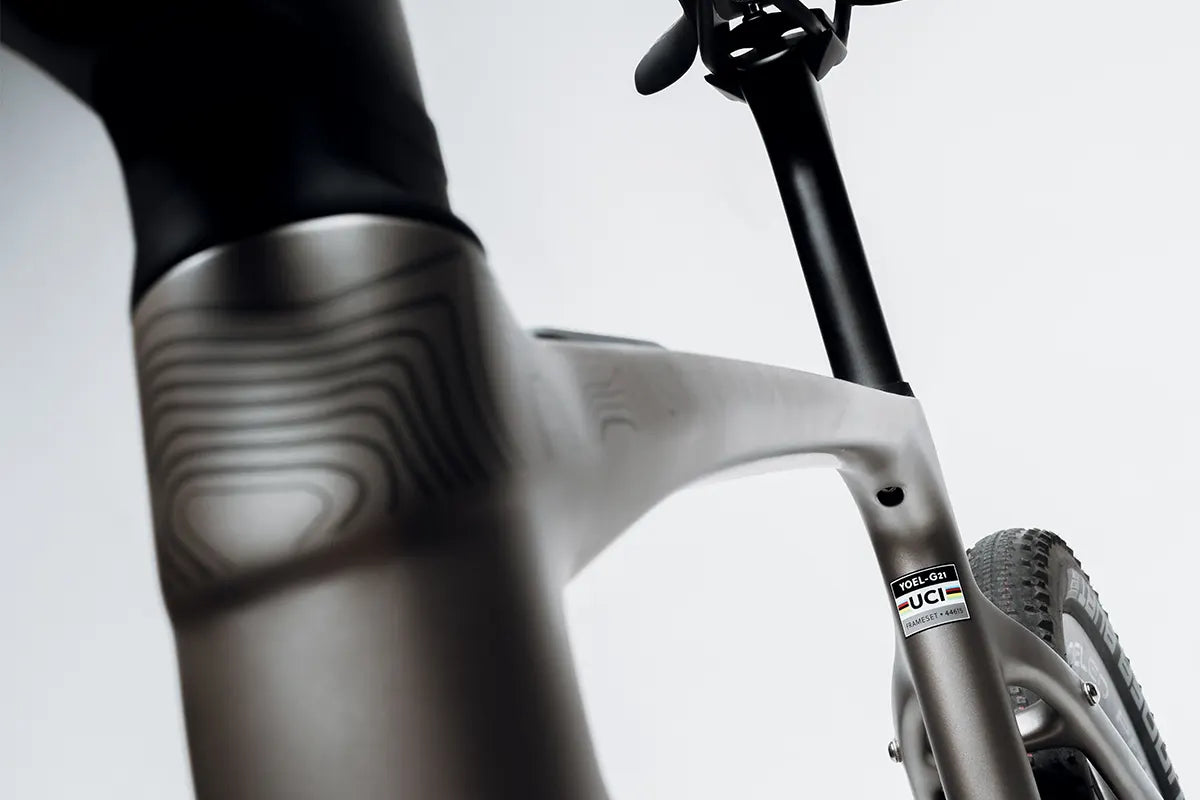
The Altera G21 was designed around the all-road premise — a carbon frameset that earns its place on tarmac and trail without compromise. Its 53mm tire clearance accommodates a 38mm fast road tire with room to spare. The 27.2mm Pro-Flex seatpost provides compliance that narrows the road-versus-gravel comfort gap. The T-47 bottom bracket and integrated in-frame storage remove the weight and complexity of bolted-on accessories. And it carries UCI approval and a 6-year warranty — the same standards applied to Yoeleo's pure road frames.

At the 2025 UCI Gravel World Championships, the Altera G21 took both the women's gold (Pravilova) and men's bronze (Verkuijl) — validation that the frame performs at the absolute top of the gravel category. That same frame, swapped to a fast road tire and adjusted pressure, is the one you can ride to your club's Sunday coffee stop tomorrow.
|
HOW THE ALTERA G21 WORKS AS YOUR ONE BIKE
• 53mm tire clearance — runs a 38mm road slick with room left over; swap to 50mm knobbly for gravel season
• 27.2mm Pro-Flex seatpost delivers road compliance without a separate comfort upgrade
• T-47 BB, UDH, and integrated storage reduce clutter and weight on pure road configurations
• UCI Gravel World Championship double podium in 2025 — performance proof at the highest level
• Tested beyond ISO 4210 standards; 6-year frameset warranty — engineered for years of all-road use
|
Frequently Asked Questions
How fast can you ride a gravel bike on road?
A gravel bike configured with a smooth 35–40mm tubeless tire at appropriate pressure will sustain road speeds competitive with most endurance road setups. The gap versus a race-geometry road frame is meaningful only at sustained speeds above 38–40 kph and on pure flat terrain.
What tires should I use on a gravel bike for road riding?
A smooth or semi-slick tire in the 35–40mm range is the best choice for road use on a gravel frame. Prioritise tubeless compatibility, a fast-rolling compound, and internal-rim-width compatibility. Rolling resistance testing databases (like Bicycle Rolling Resistance) are useful for comparing specific models.
Do I need to change gearing when riding a gravel bike on road?
Usually not. A 40–42T chainring with an 11-28 or 11-32 cassette covers road speeds up to 45–50 kph at normal cadence. Only high-speed group riding above 45 kph sustained will expose a top-gear limitation in a typical gravel drivetrain.
Is a gravel bike slower than a road bike on tarmac?
At endurance road speeds (28–36 kph), the difference is small and often offset by the gravel bike's wider tire rolling at optimised pressure. At race speeds above 40 kph on flat terrain, a pure road setup holds a measurable advantage. For mixed-surface riding or endurance events, a properly configured gravel bike is the more versatile and often faster overall choice.
Share:
Endurance vs Race Geometry: Which Frame Fits You?
Post-Crash Carbon Inspection: Frame and Wheel Checks