
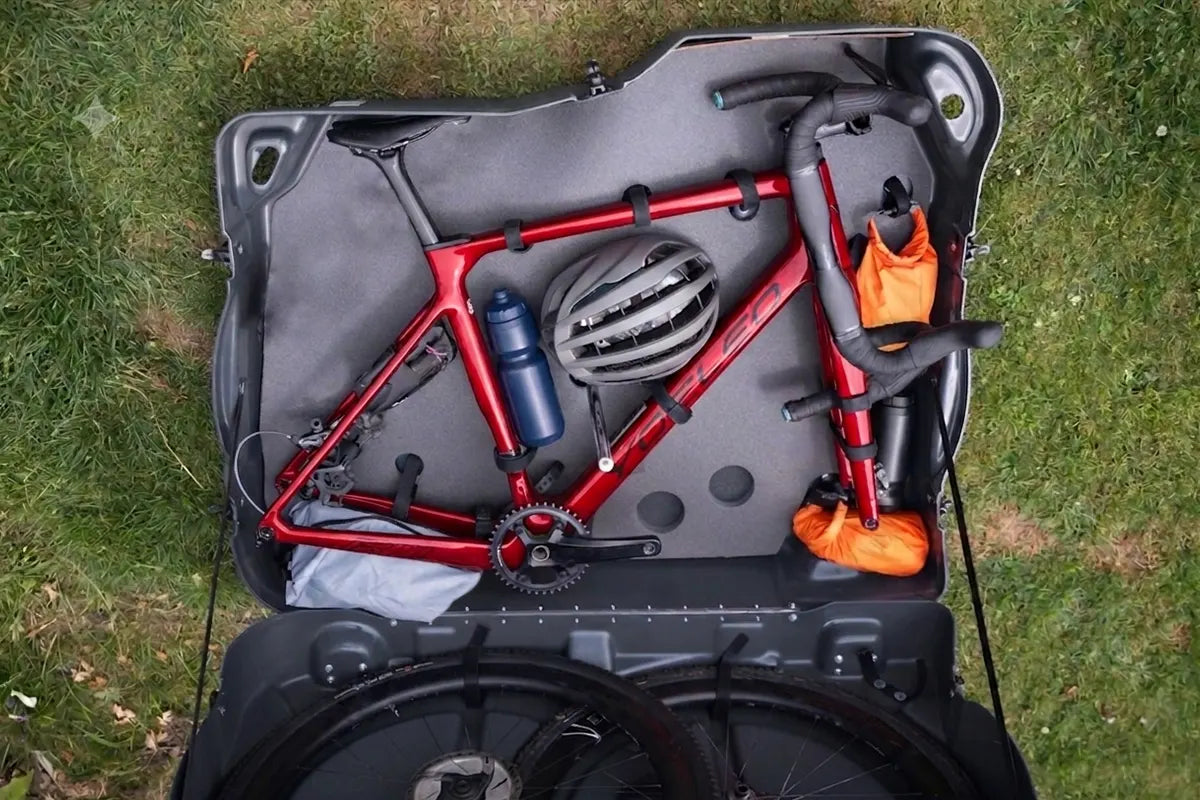
Flying With a Carbon Frameset: Packing So Nothing Cracks
A carbon frame rarely cracks from a clean drop. It cracks from a slow crush, one bag stacked on another in a cargo hold for four hours, pressing a hard case wall into a top tube that had nothing but a towel between it and the outside world. The frame looks fine when you unpack it. The crack shows up as a creak three rides later, or it doesn't show up at all until it fails under load.
The fix isn't a stronger case. It's knowing which six points on a frame actually take the load when a case gets stacked, dropped, or squeezed, and padding those specifically instead of wrapping the whole bike in bubble wrap and hoping. Airline handling hasn't gotten gentler. Your packing just has to get more targeted.
This covers case choice, the weight and size numbers that decide what a bike costs to check, what to remove before it goes in the case, and the six contact points worth the extra ten minutes.
How do you pack a carbon bike for a flight without damage?
Disassemble the parts that stick out, pad the six points where the frame contacts the case wall or another hard object, and pack so nothing inside the case can shift more than a centimetre once it's closed. Movement, not impact alone, is what turns a stacked cargo hold into a cracked frame.
Most damage happens in two ways: something rigid presses directly on a tube, a case wall flexing under stacked weight, a wheel jammed against the top tube, or something loose inside the case shifts during handling and hits a tube edge-on. Both are solved the same way, by removing anything that can move and padding the points that can't be removed.
Choosing a case: hard case, bike box, or soft bag
A hard case protects against crush and point impact but weighs 5-9 kg empty, eating into the weight allowance before the bike even goes in. A cardboard bike box, the kind shops give away, is lighter and inexpensive to replace if damaged, but offers less crush resistance and needs more internal padding to compensate. A padded soft bag sits in between:
lighter than a hard case, more crush-resistant than plain cardboard, but it relies entirely on how well you've padded the frame inside, since the shell itself won't stop a crush.
lighter than a hard case, more crush-resistant than plain cardboard, but it relies entirely on how well you've padded the frame inside, since the shell itself won't stop a crush.
There's no wrong choice as long as the packing inside matches the case. A hard case with sloppy internal packing performs worse than a cardboard box packed tightly, because a rigid shell transmits an impact straight to whatever's loose inside it.
Airline weight and size limits
These numbers decide whether a bike travels as a standard checked bag or an oversize item with a separate fee, and they're worth confirming with the airline 48-72 hours before departure since policies vary by route and change without much notice.
|
Limit type
|
Typical threshold
|
What happens over it
|
|
Linear size (length + width + height)
|
292 cm (115 in) on most major carriers
|
Oversize fee applies, or a flat bike fee replaces the standard rate
|
|
Weight, standard checked bag
|
23 kg (50 lb)
|
Overweight fee, often charged per weight bracket
|
|
Weight, absolute handling ceiling
|
32 kg (70 lb)
|
Many carriers refuse to check anything heavier at all
|
|
Advance notice window
|
48-72 hours before departure on some carriers
|
Bike may be denied or charged a higher walk-up rate
|
A bike under 23 kg (50 lb) in a case under 115 linear inches often checks in as a normal bag with the standard fee rather than a bike-specific surcharge. Low-cost carriers frequently apply a flat oversize charge regardless of the case's actual weight, so check the specific airline's current policy before booking, not the morning of the flight.
What to remove and disassemble first
Remove the pedals, the rear derailleur (hang it loose inside the case rather than leaving it on the hanger), and both wheels. Drop the seatpost to its minimum insertion mark rather than pulling it out fully, which keeps the seat tube clamp area less disturbed. Loosen the stem faceplate and turn the bar parallel to the top tube, or remove the bar entirely if the case is narrow.

Deflate tyres partially, not fully. A completely flat tyre offers no cushioning against rim impact; dropping to roughly half normal pressure keeps some shock absorption while removing the risk of over-pressure, which is minimal in a pressurised hold but not worth ignoring on unpressurised cargo routes.
Frame vulnerability map: the 6 contact points that crack
|
Contact point
|
Why it's high risk
|
Padding fix
|
|
Rear derailleur hanger
|
First thing to hit the ground if the case tips; bends or snaps under load
|
Remove the derailleur, protect the bare hanger with a foam block
|
|
Dropouts / thru-axle interfaces
|
Point-load bearing surface with little material around it
|
Insert axle spacers or a thru-axle protector block into both dropouts
|
|
Fork tips and steerer tube
|
Thin-walled and exposed once the front wheel is out
|
Foam end caps on the tips, steerer wrapped in pipe insulation foam
|
|
Top tube and down tube
|
Largest flat surface for a case wall or a shifted item to press against
|
Full-length foam pipe insulation, taped in place rather than just draped
|
|
Seat tube / seatpost clamp area
|
Compression point if a wheel or bag shifts onto it
|
Post left at minimum insertion, clamp area wrapped separately
|
|
Chainstays near the bottom bracket
|
Crankset or chainring can contact this area if not separated
|
Cardboard or foam sheet between the crank and the chainstay
|
Padding these six is worth more than padding the whole frame evenly. A generic wrap job spreads a fixed amount of foam thin everywhere; targeting the points that actually bear load puts real thickness, 20-25 mm, where it matters.

Protecting the wheels and rim or disc surfaces
Wheels travel best in their own padded sleeves or a dedicated wheel bag layer inside the case, never loose against the frame. A loose wheel is one of the most common sources of frame damage in transit, because it's heavy enough to dent a tube on impact and rigid enough not to absorb the hit itself.

For disc rotors, either remove them and pack flat between cardboard discs, or leave them mounted and protect with a rotor guard, a rigid disc slightly larger than the rotor that stops it bending if the wheel gets knocked. A bent rotor is a common flight-damage complaint and one of the easiest to prevent.
Final checks before you close the case
Shake the case gently once packed, if anything shifts or rattles, it will move more under real handling. Confirm nothing metal touches the frame directly, bolts, skewers, tools, anything loose should be in its own pouch, not floating near a tube. Weigh the case before you leave for the airport, not at the check-in counter, so an overweight surprise doesn't turn into a scramble to redistribute gear.
Worked example: packing an R11 frameset and SAT wheelset for a 2-bag flight
A rider is flying with the frameset and wheelset in a hard case, connecting through one layover.
Disassembly: 12 minutes, pedals off, derailleur unhooked and padded separately, both wheels out, seatpost dropped to the minimum mark, bar turned parallel and faceplate loosened.
Six-point padding: 15 minutes, foam pipe insulation on the down tube and top tube, foam blocks on the fork tips and rear dropouts, cardboard between the chainstay and crank, rotor guards left on both wheels.
Wheel packing: 5 minutes, each wheel in its own padded sleeve, tyres dropped from 80 PSI to 40 PSI.
Weigh-in: case weighs 21.4 kg against a 23 kg (50 lb) standard allowance, no oversize fee triggered at 108 linear inches against the 115 in (292 cm) threshold.
Total prep time: about 35 minutes, and every one of the six high-risk points has dedicated padding rather than a share of a single roll of bubble wrap.
Frequently Asked Questions
Do airlines charge extra for bikes?
It depends on the case's weight and linear size against that airline's standard checked-bag allowance, commonly around 23 kg (50 lb) and 292 cm (115 in) combined. Under those thresholds, many carriers charge the standard checked-bag fee; over them, an oversize or bike-specific fee applies, and this varies significantly by carrier and route.
Should I deflate tyres before flying with a bike?
Partially, not fully. Dropping to roughly half your normal pressure keeps some cushioning against rim impact while avoiding any risk from pressure changes in the hold. A fully flat tyre gives the rim no protection at all against a knock during handling.
Do I need to remove the rear derailleur when packing a bike?
Yes. The derailleur hanger is the single most exposed point on a packed bike and the first thing to take an impact if the case tips or gets set down hard. Unhook the derailleur, pad the bare hanger, and pack the derailleur loose inside the case.
What size bike box counts as a standard checked bag?
On most major carriers, a case under 292 cm (115 in) combined length, width and height, and under 23 kg (50 lb), checks in as a standard bag rather than an oversize item. Confirm the current figure directly with your airline, since it varies by carrier and can change.
Share:
The 5-Minute Pre-Ride Check for a Self-Built Carbon Bike
Off-Season Storage: Putting a Carbon Bike Away for Three Months