Climbing Technique: Cadence, Gearing, Seated vs Standing
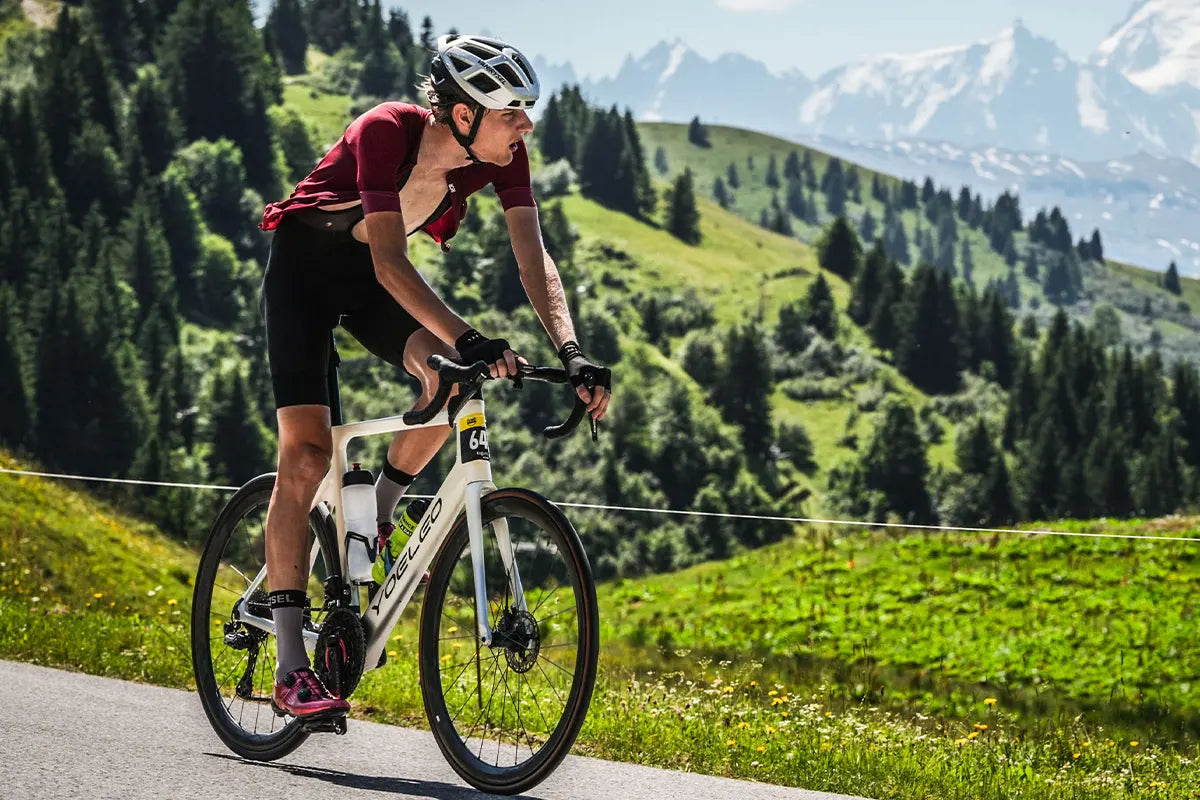
Most riders' climbing goes wrong in the first thirty seconds. A steep ramp appears, adrenaline spikes, and the natural response is to stand up and hammer—burning through the exact energy reserves needed for the rest of the ascent. Efficient climbing is not about short, unsustainable bursts of power; it is about selecting a cadence and gear ratio you can maintain, and knowing precisely when standing provides a biomechanical advantage versus when it simply accelerates fatigue.
Mastering a climb comes down to three variables: cadence target, gear selection, and body position. None of these require extra fitness—just biomechanics, drivetrain management, and pacing applied consistently.
What cadence should you actually climb at
Climbing cadence naturally drops below flat-road cadences (85–95 RPM), which is expected rather than a sign of being under-geared. On a moderate gradient, most riders settle into a range of 65–85 RPM. As the gradient steepens, natural cadence decreases because resistance per pedal revolution rises, making a high cadence increasingly difficult to maintain smoothly.
|
Gradient
|
Typical cadence target
|
Default position
|
|
0-4% (rolling)
|
80-90 rpm
|
Seated
|
|
4-8% (steady climb)
|
70-85 rpm
|
Seated
|
|
8-12% (steep)
|
60-75 rpm
|
Mostly seated, stand briefly to change muscle groups
|
|
12%+ (wall/ramp)
|
50-65 rpm
|
Standing becomes more common
|
Avoid two common mistakes:
-
Over-spinning: Shifting into an ultra-low gear to force a 90+ RPM cadence on a steep climb unnecessarily elevates heart rate without improving forward speed.
-
Low-RPM Grinding: Mashing a heavy gear at 40–50 RPM causes rapid neuromuscular fatigue and strain on joints, even if aerobic effort initially feels low.
The optimal climbing cadence distributes fatigue evenly between the aerobic system and skeletal muscles.

Gearing: giving yourself the range to stay seated
Proper gear selection keeps your cadence within an efficient window regardless of gradient. A compact or sub-compact chainring combined with a wide-range cassette ensures you can maintain cadence on a 12% ramp rather than grinding at an unsustainable cadence.
| Gradient |
Typical Cadence Target |
Default Position |
| 0–4% (Rolling) |
80–90 RPM |
Seated |
| 4–8% (Steady Climb) |
70–85 RPM |
Seated |
| 8–12% (Steep) |
60–75 RPM |
Mostly seated; stand briefly to alter muscle recruitment |
| 12%+ (Ramp) |
50–65 RPM |
Standing becomes biomechanically necessary |
Key Mechanics:
-
Shift early: Change gears before the gradient increases. Shifting under maximum torque stresses drivetrain components and causes a temporary loss of momentum.
-
Component performance: Reducing rotating weight improves accelerations during gradient changes. For example, upgrading to a light carbon options such as the Yoeleo SAT C35 DB PRO NxT SL2 wheelset (1,260g per pair) reduces rotational inertia, helping you react quickly to steep pitches.
Seated versus standing: what the research actually shows
Seated climbing is more efficient for sustained effort. A widely cited 2008 study by exercise physiologist Ernst Hansen found that road cyclists used around 5% more oxygen when climbing standing compared with seated at the same gradient, up until the gradient reached roughly 10%, at which point standing started to produce more usable power despite the higher oxygen cost.

That gives a practical rule: stay seated on anything under about 10%, where it's the more economical position for holding a pace over minutes rather than seconds. On steeper ramps, standing becomes genuinely useful, not just psychologically satisfying, because it lets you recruit more muscle mass and add body weight to the pedal stroke when a lower gear isn't available or isn't enough.
Standing briefly on a moderate climb still has a place even when it isn't the efficient choice. Getting out of the saddle for ten or fifteen seconds shifts load onto a slightly different set of muscles and can relieve pressure on the saddle and lower back, which matters on a long climb even if it costs a small amount of extra oxygen.
Worked example: 68 kg rider on an 8% gradient in a 34×28 gear
A rider targets 70 rpm on an 8% gradient using a 34-tooth compact chainring and a 28-tooth cassette cog, a gear ratio of 1.21:1. With a 700×25c wheel circumference of roughly 2.105 m, that works out to a climbing speed of:
70 rpm × 1.21 × 2.105 m = 178.8 m per minute, or about 10.7 km/h
At that cadence and gear, the rider stays seated, keeps a steady breathing rhythm, and has one gear left in reserve (a 34-tooth cog, if the cassette runs to it) for a steeper section further up. That reserve gear is the point: choosing 70 rpm at 34×28 rather than 55 rpm at 34×25 isn't just more comfortable, it leaves a lower option available for whatever the climb does next, instead of running out of gear on the steepest part.
Pacing: why even effort beats a fast start
The riders who fade badly on long climbs are usually the ones who started ten seconds too fast, not the ones with less fitness. A climb rewards even, sustainable output far more than it rewards a strong opening minute followed by a slow crawl to the top. If you have a power meter, target a number you know you can hold for the climb's expected duration. Without one, use breathing as the gauge: if you can't hold a short sentence in three or four words at your current effort, you're probably going out too hard for a climb of more than a few minutes.
Break a long climb into sections mentally, by gradient change or landmark, rather than thinking about the whole thing at once. It changes nothing physically, but it keeps pacing decisions smaller and easier to judge accurately.
Breathing and upper body
Keep your upper body relaxed and your grip on the bars light, whether seated or standing. A tense upper body wastes energy that doesn't contribute to forward motion, and it tends to shorten your breathing along with it. Breathe from the diaphragm rather than the chest where you can, and unclench your jaw and shoulders periodically; both are common places tension builds unnoticed on a long grind.
Frequently Asked Questions
What cadence is best for climbing hills?
Most riders climb efficiently between 60 and 85 rpm depending on gradient, dropping toward the lower end as the road gets steeper. Chasing a flat-road cadence of 90+ rpm uphill usually means you're under-geared for the climb.
Is it better to sit or stand when climbing?
Seated is more oxygen-efficient for sustained climbing up to roughly 10% gradient. Above that, standing produces more usable power despite costing slightly more oxygen, and briefly standing on any gradient can relieve saddle and back pressure.
What gear should I use on a steep climb?
Choose a gear that lets you hold 60-75 rpm without grinding. A compact chainring with a wide-range cassette gives the option to spin a manageable cadence on ramps over 10%, rather than forcing a very low cadence in too hard a gear.
Why do my legs burn early on climbs even when I'm fit?
Usually pacing, not fitness. Starting a climb faster than you can sustain burns through anaerobic capacity in the first minute, leaving your legs fatigued for the rest of the climb. Settle into a steady, sustainable effort from the base rather than attacking the first ramp.

Share:
Descending Technique: Body Position, Braking Points, Cornering Lines
Saddle Height and Setback Without a Fit Studio