
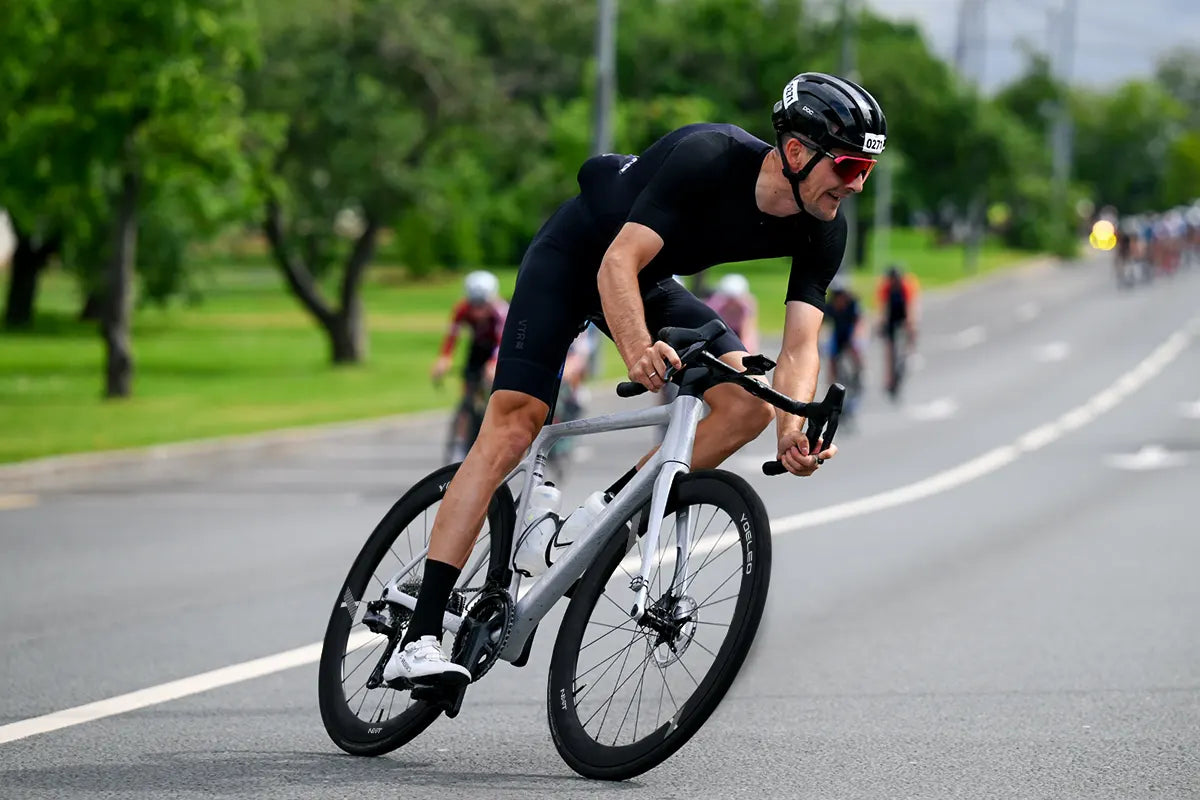
There's an old myth that you have to choose: a stiff, fast bike that beats you up, or a comfortable bike that feels like pedalling through syrup. Pick your poison. For long days in the saddle, that choice sounds miserable — and the good news is it's false.

Comfort and efficiency aren't enemies. They act in different directions, which means the right design can give you both at once. Understanding how is the endurance formula: where to want flex, where to demand stiffness, and how the frame and wheels split the job between them.
|
THE ENDURANCE FORMULA IN 30 SECONDS
• Stiffness and compliance are directional, not a single soft-to-hard dial
• Want vertical give for comfort; want lateral and torsional stiffness for power
• Most comfort comes from tyres and pressure first, then frame flex zones
• Wheels contribute stiffness in the lateral plane — not vertical comfort
|
Is a Stiffer Bike Always Faster?
No. Stiffness is a trade-off, not a virtue. A bike needs to be stiff where you put power — the bottom bracket and head tube — but compliant where it meets the road, or vibration drains your muscles and costs you speed over distance.
The key is that stiffness and compliance aren't a single dial running from soft to hard. They're directional. A well-designed bike flexes vertically to absorb the road while staying rigid torsionally and laterally so your pedalling and steering lose nothing. Get that separation right and the comfort-versus-speed trade-off mostly disappears.
Two Directions, Two Jobs
Frame and wheel behaviour splits into two planes that do completely different jobs — and the whole formula rests on keeping them separate.
Vertical compliance is the up-and-down give that soaks up road buzz and impacts. You want it, because a body that isn't being hammered stays fresher and produces more power late in a ride. Lateral and torsional stiffness is the side-to-side and twisting rigidity that turns your effort into forward motion and your steering input into a precise line. You want that too. The art of a good endurance bike is engineering high give in the vertical plane and high stiffness in the drive and steering planes — at the same time. They don't have to fight, because they point in different directions.
Where Comfort Actually Comes From
Most of your comfort doesn't come from the frame at all. It comes from your tyres and pressure first, then the frame's engineered flex, then — barely — the wheels.
Tyres are the biggest suspension system on the bike. Running a wider tyre at the right lower pressure absorbs far more road than any frame feature, which is why a supple 30 mm tyre at the correct pressure transforms ride feel more than most frame upgrades. After that, the frame contributes through deliberate flex zones: a slender or D-shaped seatpost, shaped seatstays, and tuned carbon layup that let the saddle move a few millimetres over bumps without sacrificing pedalling rigidity. The wheels come last for comfort — a radially stiff carbon wheel barely flexes vertically, so it adds very little to ride softness regardless of marketing claims.
Where Stiffness Actually Matters
Stiffness earns its keep in two specific places: the frame's power core and the wheel's lateral plane. Everywhere else, more stiffness mostly just adds harshness.

In the frame, a stiff bottom bracket and head tube mean your sprint and your steering happen instantly, with no vague wind-up. In the wheels, lateral stiffness is what you actually feel — a laterally rigid wheel holds its line under hard cornering and out-of-the-saddle efforts, where a flexible one feels disconnected and can wander. Wheel lateral stiffness comes from spoke count, spoke tension, and the bracing angle of the build, not from a deeper rim. So the wheel's contribution to the formula is stiffness in the side-to-side plane, while the frame and tyres own comfort in the vertical plane. Each part does the job it's actually good at.
The Endurance Formula, Assembled
Put the planes together and the recipe is simple: maximise vertical give, maximise drive-and-steering stiffness, and never confuse the two.
|
Quality you want
|
Comes mainly from
|
Plane
|
|
Comfort / less fatigue
|
Tyres + pressure, then frame flex zones
|
Vertical
|
|
Efficient power transfer
|
Bottom bracket + head tube stiffness
|
Torsional / lateral
|
|
Precise handling
|
Wheel lateral stiffness (spokes, tension)
|
Lateral
|
|
Road absorption
|
Tyres first, seatpost / seatstays second
|
Vertical
|
Comfort isn't the opposite of speed here — it's part of it. Road vibration causes measurable muscular fatigue, so a frame that filters buzz helps you hold power longer, according to ride-quality research discussed by Silca and others. On a five-hour day, the comfortable bike is frequently the faster one.
Engineering Both at Once
The endurance formula only works if a brand can build flex and stiffness into the same frame deliberately — not stumble into one and apologise for the other. That takes control over the carbon itself.
Yoeleo engineers the two planes separately. The R11 and R12 framesets use a D-shaped seatpost tuned to flex vertically for comfort while the bottom-bracket area stays rigid for power, and every frame is fatigue-tested well beyond the basics — 1,100 N across 100,000 pedalling cycles and 1,200 N across 50,000 vertical cycles — so that engineered flex lasts.
On gravel, the Altera G21's 27.2 mm Pro-Flex seatpost adds give for rough terrain. The wheels handle the lateral half: NxT SL2 builds use 24 hand-trued spokes tensioned to a verified standard for lateral precision, and the premium QianKun wheels add carbon spokes with 2:1 front lacing for stiffness without the harshness.
On gravel, the Altera G21's 27.2 mm Pro-Flex seatpost adds give for rough terrain. The wheels handle the lateral half: NxT SL2 builds use 24 hand-trued spokes tensioned to a verified standard for lateral precision, and the premium QianKun wheels add carbon spokes with 2:1 front lacing for stiffness without the harshness.
|
HOW YOELEO ENGINEERS THE FORMULA
• Durability of that flex: frames fatigue-tested at 1,100 N × 100,000 pedalling cycles
• Gravel give: Altera G21 27.2 mm Pro-Flex seatpost for rough terrain
• Accessible premium — comfort and efficiency designed in together, not traded off
|

It's accessible premium built on real engineering control — comfort and efficiency designed in together, the way the formula intends.
Frequently Asked Questions
Is a stiffer frame better for endurance riding?
Not on its own. A frame should be stiff at the bottom bracket and head tube for efficient power, but compliant vertically to absorb road vibration. Too much overall stiffness causes fatigue on long rides and can actually cost you power over distance.
Does frame compliance slow you down?
No. Vertical compliance absorbs road buzz without flexing in the pedalling plane, so it doesn't waste power. Because road vibration causes muscular fatigue, a vertically compliant frame often helps you sustain power longer on long rides — comfort and speed work together.
Do stiffer wheels make a real difference?
Yes, but only laterally. A laterally stiff wheel holds its line under hard cornering and sprints and feels more precise. Vertically, even a stiff carbon wheel barely flexes, so wheels add little to comfort — that job belongs to tyres and the frame.
What gives the most comfort on a road bike?
Tyres and pressure, by a wide margin. A wider, supple tyre at the correct lower pressure absorbs more road than any frame feature. After that, a frame's flex zones — seatpost and seatstays — add comfort, while wheels contribute the least.
Share:
Is DTC Carbon Gravel Race-Ready?
Cycling Aerodynamics: The Aero Hierarchy Explained