
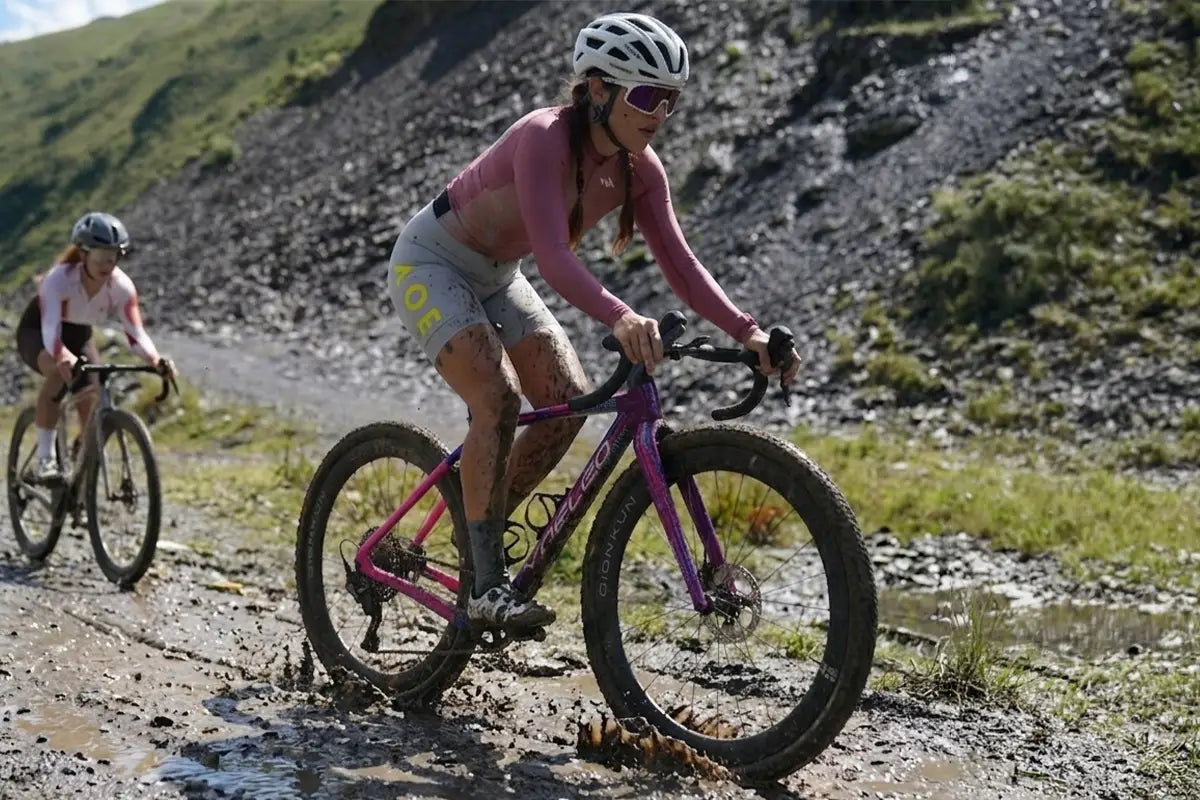

"How much clearance do I need?" is the wrong question. The right question is "what race calendar am I buying for?" Tire clearance is not a comfort number. It is a veto on which courses your bike can race and which surfaces it can handle at speed. This post is a practical guide to gravel tire clearance — 700c versus 650b, the 40 to 53mm range, and how mud clearance differs from stated clearance.
|
QUICK ANSWER
• For most riders: 45mm clearance is the smart default — covers 90% of gravel calendars.
• For technical/wet courses: 50mm+ clearance prevents mud lockup and unlocks 650b options.
• Below 42mm clearance: fine for tarmac-heavy gravel, limits race options significantly.
|
What does "tire clearance" actually mean?
Tire clearance is the maximum tire size a frame can physically fit with adequate room for mud, debris, and tire flex under load. Manufacturers publish a single number — "up to 700×45mm" — but that number assumes a dry tire, no debris, and a specific rim width. Real-world clearance is 3 to 5mm smaller than published once you add a reasonable mud buffer.
The tire itself also inflates wider than its labeled size on wider rims. A 40mm tire on a 25mm internal-width rim measures closer to 42mm. On a 21mm internal rim, it sits closer to 38mm. Always check the combined rim-and-tire measurement against the frame’s published clearance, not the tire’s label.
Is 700c or 650b faster for gravel?
700c is faster on rolling surfaces because the larger diameter produces lower rolling resistance at equal tire pressure and width. 650b is faster on rough surfaces because a 2.0 to 2.1in tire (nominally 50 to 53mm) produces more effective suspension than a 45mm 700c tire — absorbing the bumps that would otherwise cost forward momentum.
The crossover point is roughly 50% rough-surface content. Most gravel racing sits below that threshold, which is why 700c×42–45mm has become the default race setup. Courses with extended singletrack or wet roots are the exception.

Geometry changes between the two wheel sizes
A frame designed for 700c will accept 650b without breaking geometry — but the bottom bracket drops about 8mm, which changes pedal clearance and cornering. The Altera G21 is designed around 700c geometry and accepts 650b as a secondary configuration. Riders who plan to run 650b primarily should factor that geometry shift into their decision.
How much tire clearance do I need by race type?
Here is how stated clearance translates to race options. Use this as a filter when choosing a frame.
|
Stated Clearance
|
Race Fit
|
Typical Tire
|
Limitations
|
|
38–40mm
|
Tarmac-heavy gravel, club rides
|
35–38mm
|
Cannot run most modern gravel tires; mud locks up fast
|
|
42mm
|
European gravel classics, dry courses
|
38–40mm
|
No mud buffer; breaks down on wet courses
|
|
45mm
|
Unbound 100/200, most US/EU gravel races
|
42–45mm
|
Tight for 650b; singletrack-limited
|
|
50mm
|
Technical gravel, wet/root-heavy courses
|
45–47mm
|
Opens up 650b×2.0in option
|
|
53mm+
|
Bikepacking, mixed-surface, MTB-adjacent
|
50–53mm
|
None — race calendar fully open
|

Why mud clearance is the hidden number
Stated clearance assumes a dry tire. Mud clearance is what happens when 8mm of compacted trail debris wraps around the tire and tries to pass through the chainstay bridge. A frame rated for 45mm tires can lock up completely at 42mm once mud is in the picture. The physical gap between tire and frame needs to be at least 6mm on each side for reliable mud clearance on a race course.
This is why manufacturers who design for actual racing leave substantial mud buffer in their stated numbers. The Altera G21’s 53mm spec means a 47mm tire will clear mud reliably — which is the working number for a course like Unbound in a wet year.

Tubeless, hookless, and the rim-tire system
Modern gravel is tubeless. Tubeless tires roll faster at equal pressure because they can run 3 to 5psi lower without pinch flat risk — and lower pressure on rough surfaces produces lower rolling resistance. A tubeless setup requires a matched rim and tire, sealant, and a rim internal width matched to the tire.
Hookless rims are a separate decision. Hookless construction saves rim weight and is simpler to manufacture, but limits tire compatibility — not every gravel tire is rated for hookless use, and tire pressure limits are typically lower. Check the tire manufacturer’s hookless compatibility list before switching. This is an active debate in the industry, and the safety implications matter.
What the Altera G21 clearance spec actually gives you
The Altera G21’s 700×53mm clearance is not a marketing number. It is a race-calendar number. It means the same frame can race Unbound at 42mm, switch to 47mm for a wet Paris-Roubaix-style gravel course, and mount 650b×2.0in for a singletrack-heavy course — without owning three bikes. Paired with the T-47 bottom bracket, UDH hanger, and ProRoute internal routing, the clearance spec is what makes the Altera G21 a one-frame race season.
FAQ
What is the fastest gravel tire width?
For most race courses, 40 to 42mm on a 25mm internal rim is the fastest setup — it balances rolling resistance, tire volume for rough sections, and aero drag. Wider than 45mm is slower on pavement-heavy courses; narrower than 38mm is slower on rough surfaces.
Do I need 650b wheels for gravel?
Only if your race calendar includes significant technical singletrack or wet root sections. For 90% of gravel racing, 700c is faster. 650b shines when surfaces are rough enough that tire volume matters more than wheel diameter.
How much tire clearance is too much?
There is no "too much" on a gravel frame, but clearance above 53mm starts to overlap with hardtail MTB territory and may compromise road-bike handling characteristics. 50 to 53mm is the sweet spot for a dedicated gravel race frame.
Will a 45mm tire fit a frame rated for 42mm clearance?
Sometimes, depending on rim width and tire model, but with effectively no mud buffer. Not recommended for racing — one wet section will lock up the bike. The stated clearance number is a ceiling, not a target.
Does tire width affect rolling resistance on gravel?
Yes. On rough surfaces above about 5% rough content, a wider tire at lower pressure rolls faster than a narrower tire at higher pressure. This is why gravel has moved from 32mm to 42mm as the default race tire over the last decade.
Share:
What Makes a Gravel Bike Fast?
How to Choose Your First Gravel Bike