
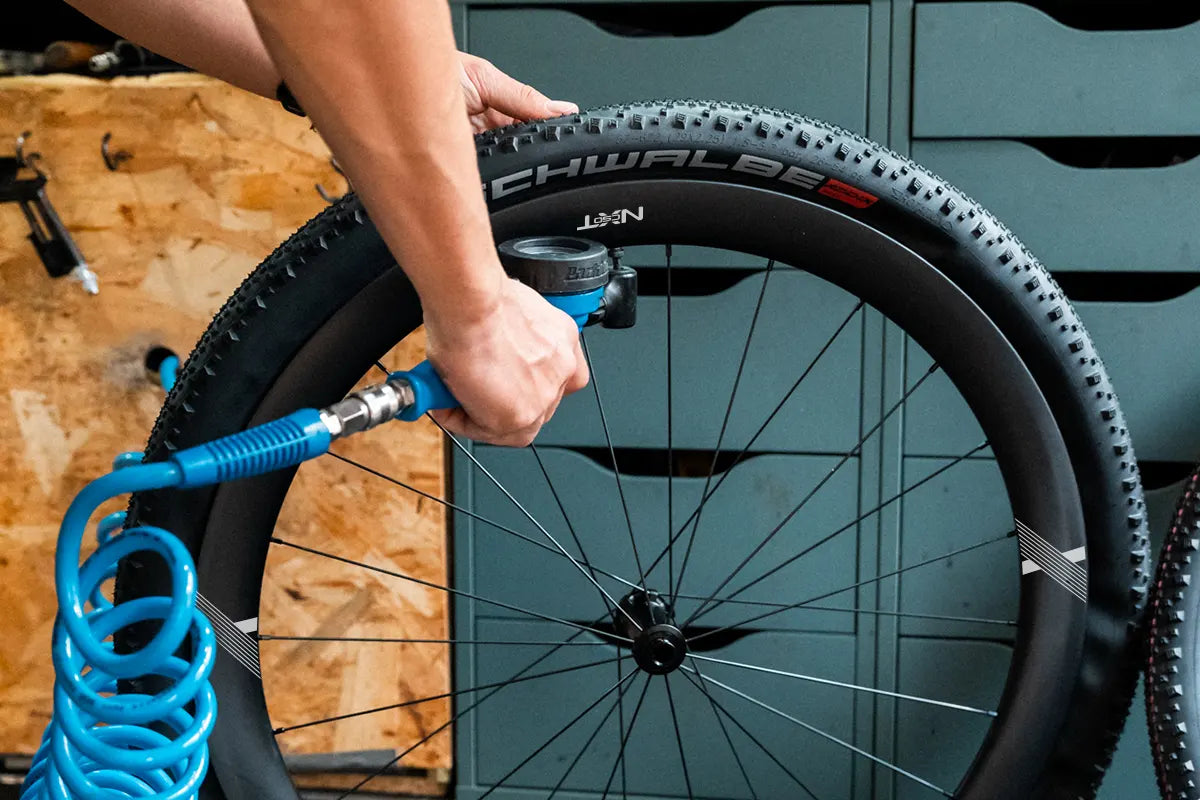
One of the most persistent myths in cycling is that there is a single correct tire pressure. Sixty-five PSI. Eighty PSI. Whatever your riding buddy swears by. The reality is that the ideal inflation point is a function of at least four variables — your total weight, your tire width, your rim internal width, and the surface you are riding. Get even one of those wrong, and you are trading grip, speed, or comfort for nothing.

Research published by rim and tire manufacturers, including testing summarized by outlets such as BikeRadar and Silca, consistently shows that most road cyclists run 10-20% too much pressure. Overinflation reduces the tire's contact patch, which in turn reduces grip and increases vibration losses on rough road — the opposite of the fast, efficient sensation riders are chasing.
|
TIRE PRESSURE IN 30 SECONDS
• Heavier riders need higher pressure; lighter riders need less — a 90 kg rider and a 60 kg rider on the same tire should not run the same PSI.
• Wider tires run lower pressure for equivalent feel — a 32c gravel tire runs 15-20 PSI lower than a 25c road tire at the same rider weight.
• Tubeless tires can run 5-8 PSI lower than tubed equivalents at the same weight — sealant prevents pinch flats at lower pressure.
• These numbers are starting points — ride feel, not a chart, should be the final calibration tool.
|
The Variables That Set Your Pressure
Before looking at a pressure chart, understand what is being calculated. The chart output is the minimum pressure needed to support the tire at the rider weight without rim strikes, multiplied by a factor for surface and rolling efficiency. Four variables drive the result:
-
Total system weight — rider + bike + kit + cargo. Not just rider body weight. A 70 kg rider on a 9 kg bike with 2 kg of kit is an 81 kg system.
-
Tire width — wider tires support the same weight at lower pressure because the footprint is larger.
-
Rim internal width — a 25mm internal rim makes a 28c tire sit wider than labeled, effectively making it a 30c tire. This changes the correct pressure.
-
Surface type — smooth tarmac tolerates higher pressures; rough road and gravel require lower pressure for grip and vibration management.
Road Tire Pressure Starting-Point Chart
The table below gives starting-point front and rear pressures for road tubeless tires on a 23mm internal width rim. Front pressure is consistently 5-10 PSI lower than rear; the rear wheel carries approximately 60% of total system weight on a road bike. All values assume tubeless setup; add 5-8 PSI for clincher with inner tube. These are starting points — adjust by feel on your regular routes.
|
System weight
|
25c (PSI F/R)
|
28c (PSI F/R)
|
30c (PSI F/R)
|
32c (PSI F/R)
|
|
Below 65 kg
|
60/65
|
55/60
|
50/55
|
45/50
|
|
65-75 kg
|
65/72
|
60/67
|
55/60
|
50/55
|
|
75-85 kg
|
70/78
|
65/72
|
60/67
|
55/60
|
|
85-95 kg
|
75/83
|
70/78
|
65/72
|
60/67
|
|
Above 95 kg
|
80/88
|
75/83
|
70/78
|
65/72
|

Gravel Tire Pressure Starting-Point Chart
Gravel adds the variable of surface roughness. Compact gravel follows the road chart closely. Loose gravel, chunky trail, and mixed terrain reward dropping pressure further — more grip, better momentum, lower rolling resistance on rough surfaces. Minimum pressure for a standard gravel tire is approximately 25 PSI to prevent rim strikes on large rocks; minimum for a tire with thick reinforced sidewalls is closer to 22 PSI.
|
System weight
|
38c (PSI F/R)
|
40c (PSI F/R)
|
45c (PSI F/R)
|
50c+ (PSI F/R)
|
|
Below 70 kg
|
28/32
|
25/28
|
22/26
|
20/23
|
|
70-80 kg
|
32/36
|
28/32
|
25/28
|
22/26
|
|
80-90 kg
|
36/40
|
32/36
|
28/32
|
25/28
|
|
90-100 kg
|
40/44
|
36/40
|
32/36
|
28/32
|
|
Above 100 kg
|
44/48
|
40/44
|
36/40
|
32/36
|
Hooked vs Hookless Rims: The Pressure Ceiling
Hookless rims have a maximum tire pressure rating — typically 73 PSI (5 bar) for road hookless and lower for some gravel-specific designs. This ceiling applies regardless of rider weight or tire width. If your chart-suggested pressure exceeds the hookless maximum, you do not go above that limit. Use a wider tire that reaches your required support pressure at a value below the rim maximum.
A 23mm internal hookless rim at 73 PSI maximum paired with a 28c tubeless tire will comfortably support system weights up to 90 kg within that ceiling. Beyond that on a 28c tire, move to a 30c or 32c tire to keep pressure within the rim limit. Our companion post on hookless vs hooked rims covers the full compatibility and safety picture.
Tubeless vs Clincher: The 5-8 PSI Adjustment
Tubeless tires eliminate the inner tube, which is the component most prone to pinch flats. Without the risk of pinching a tube, you can run 5-8 PSI lower than you would with the equivalent clincher setup at the same system weight. Lower pressure increases the tire footprint, improves grip, reduces vibration losses, and typically lowers rolling resistance on anything except glass-smooth tarmac. All values in the charts above assume tubeless. If running clincher with a butyl tube, add 5-8 PSI to the chart value.
Decision Table: My Situation — What Do I Do?
|
Situation
|
Action
|
|
Tire feels bouncy; hands feel every small bump
|
Reduce pressure 5 PSI; test on same route
|
|
Tire feels vague or squirmy in corners
|
Increase pressure 3-5 PSI; recheck front/rear split
|
|
Rim strike on a pothole at recommended pressure
|
Move to next wider tire or accept higher pressure
|
|
Running hookless rim; chart pressure above 73 PSI
|
Move to wider tire; never exceed 73 PSI on hookless
|
|
Running tubeless; chart value feels too high
|
Subtract 5-7 PSI and test; tubeless tolerates it safely
|
|
Mixed road/gravel ride in one outing
|
Use gravel pressure for whole ride — safer on rough sections
|
Why Rim Width Makes These Numbers Work
The charts above assume a 23mm internal rim width — which is where NxT SL2 and QianKun CS series wheels sit. A narrower rim (19mm internal) inflates the same tire to a narrower effective profile, meaning the footprint is smaller and you need slightly more pressure. A wider rim (25mm or above) expands the tire and means you need slightly less.

Yoeleo's NxT SL2 road wheelsets — C35, C50, C60, and C88 — are engineered with a 23mm internal width, optimized for 28-30c tires. The NxT Gravel C45 runs a 27mm internal width, optimized for 40-50c gravel tires. Both are tubeless-ready with no rim tape required, and both are engineered to an internal 120J impact standard — three times the UCI minimum. That engineering margin means the rim handles the occasional pressure spike from a hard hit without the structural vulnerability that turns a pressure mistake into a catastrophic failure.
|
HOW YOELEO WHEELS WORK WITH YOUR PRESSURE STRATEGY
• 23mm internal width on NxT SL2 road wheels pairs correctly with 28-30c tubeless for most rider weights
• 27mm internal width on NxT Gravel C45 is optimized for 40-50c gravel tire performance across rider weight ranges
• Tubeless-ready from the box — no rim tape required; enables the 5-8 PSI lower tubeless advantage immediately
• Engineered to an internal 120J impact standard (3x the UCI minimum) — structural confidence at real-world pressures
• QianKun CS50 and CS60 with individually replaceable carbon spokes pair with the same 23mm tire-width optimization
|
Frequently Asked Questions
What tire pressure should I run for my weight?
Use your total system weight (rider + bike + kit), not just your body weight. A 75 kg rider on a 9 kg road bike is an 84 kg system. On a 28c tubeless tire at 23mm internal rim width, that system typically runs 65 PSI front and 72 PSI rear as a starting point — then adjust by feel on your regular routes.
Should front and rear tire pressure be the same?
No. Front pressure should be 5-10 PSI lower than rear on road bikes, which carry approximately 60% of system weight through the rear wheel. Running equal pressure front and rear overinflates the front tire relative to what the wheel is actually supporting, reducing grip in corners.
Can I run lower pressure on tubeless tires?
Yes. Tubeless setups can safely run 5-8 PSI lower than clincher setups at equivalent rider weight because sealant prevents pinch flats — the main failure mode that requires higher clincher pressure. Lower tubeless pressure improves grip, reduces vibration, and typically lowers rolling resistance on real-world road surfaces.
What is the maximum pressure for hookless rims?
Most hookless road rims are rated to 73 PSI (5 bar) maximum. This is a firm ceiling regardless of rider weight — if your weight-based chart pressure exceeds that value, move to a wider tire that achieves the required support at a pressure below 73 PSI. Never exceed the rim manufacturer stated maximum on a hookless rim.
Share:
Tubeless Burping Fix: Solve Seating & Sealant Problems
C35 vs C50 vs C60: How to Choose Carbon Wheel Depth