
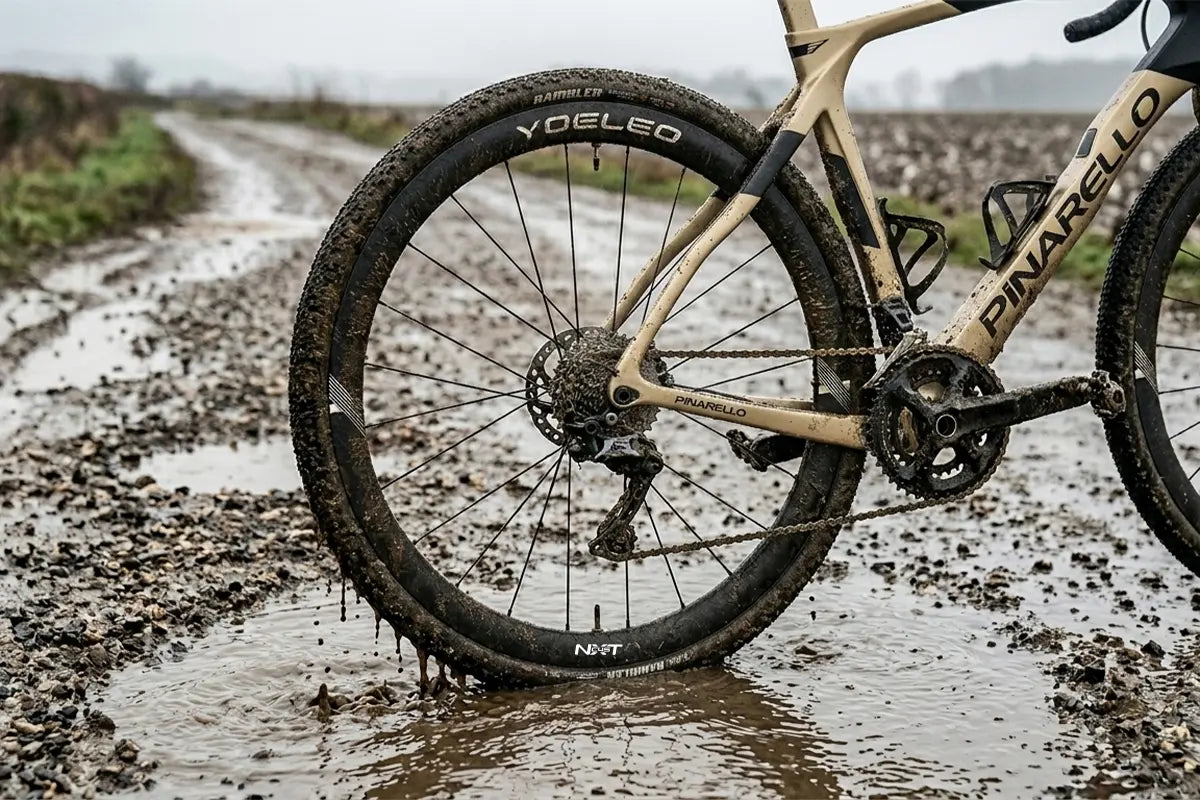
When Gravel Demands More Than Road Riding Ever Will
The third water crossing of the day, somewhere in the middle of a 6-hour gravel epic, is not the time to discover your spoke nipples have been quietly corroding for two seasons. But that is exactly what aluminum nipples let happen.
Road wheels live a sheltered life by comparison. A few hours each week on clean tarmac, stored dry between rides. The most hostile thing a road wheel typically encounters is a summer rain shower and the residue from a wet chain. Aluminum nipples handle that just fine — and their weight advantage, genuine and measurable, makes sense for pure road builds.
Gravel is a different discipline entirely. Mud, creek crossings, road salt in shoulder season, hours of vibration from loose aggregate, and overnight trips with wheels left wet and dirty in the back of a van. Under these conditions, materials that perform perfectly on road begin to reveal their limitations. Our testing of the NxT C45 Gravel across multiple seasons and conditions led to a clear engineering conclusion: the 2026 model moves to brass nipples.
Here is the complete explanation of why.
|
Quick Answer
Brass spoke nipples offer superior corrosion resistance and mechanical stability compared to aluminum in gravel conditions. On the NxT C45 Gravel's 24-spoke-per-wheel design, the switch to brass adds 0.7g per nipple — a total of 33.6g per wheelset — in exchange for significantly longer service life, more consistent spoke tension, and no galvanic corrosion at the stainless-steel spoke interface.
For the vast majority of gravel riders, this is an unambiguous engineering improvement.
|
What Are Brass vs Aluminum Spoke Nipples in Gravel Wheels?
Brass spoke nipples offer superior corrosion resistance and mechanical stability compared to aluminum in gravel conditions, at a weight cost of approximately 0.7g per nipple on a 24-spoke wheel.
Spoke nipples are the threaded fasteners that connect each spoke to the rim at the outer circumference of the wheel. They are what a wheel builder tightens to set spoke tension, and what a mechanic adjusts when truing a wheel over time. Despite being small — typically under 2g each — nipples bear significant mechanical load. Every spoke in a properly built wheel carries between 800–1,200N of tension (Wheel Fanatyk, 2024), and that tension runs directly through the nipple.
There are two practical materials for spoke nipples in carbon wheelsets: aluminum and brass. Aluminum is lighter. Brass is stronger against corrosion and more mechanically stable under long-term load. For decades, professional road racers weighted the aluminum side of the equation and largely won that argument. Gravel riding reopens the debate — and the physics land differently.
The Three Ways Aluminum Nipples Fail in Gravel Conditions
Aluminum nipples perform adequately on clean, dry roads. Put them through a gravel season, and three distinct failure modes emerge.
1. Galvanic Corrosion at the Spoke Interface
This is the most insidious failure mode — and the one most riders never see coming. Modern road and gravel spokes are almost universally stainless steel. Sapim, DT Swiss, and Pillar all use 302 or 316-grade stainless as standard. Stainless steel has a galvanic potential significantly different from aluminum alloy. When two dissimilar metals sit in contact with an electrolyte — water, sweat, road salt, muddy water from a creek crossing — they form a galvanic cell. Electrons migrate from the less noble metal to the more noble one.
In a stainless-steel-spoke / aluminum-nipple pairing, aluminum is always the less noble metal. It corrodes preferentially. Research on bi-metallic corrosion in cycling applications has found that in wet, contaminated conditions, aluminum-stainless interfaces can corrode to the point of mechanical bonding within 12–18 months of regular wet-weather riding — making the nipple effectively impossible to turn without destroying it (Mercer & Sons Wheelbuilding, 2023).
Brass, by contrast, sits much closer to stainless steel on the galvanic series. The potential difference is small enough that meaningful corrosion at the interface does not occur under normal riding conditions. Professional wheel builders who specialize in cyclocross, gravel, and mountain builds have standardized on brass for this reason for over 30 years.
2. Corner Rounding Under the Spoke Key
Aluminum is a relatively soft metal compared to the hardened steel of a spoke key. Over repeated truing sessions, the hex or square drive of an aluminum nipple rounds progressively. This is not catastrophically fast — but it is cumulative and irreversible. A nipple that has been adjusted a dozen times over two seasons of wet gravel riding may no longer hold a spoke key effectively, making precise tension adjustment difficult or impossible without slipping and further damaging the drive.
Brass is significantly harder and more wear-resistant in spoke key contact. It is the material professional wheel builders standardize on when building wheels intended for repeated adjustment and long service life — the exact profile of a gravel wheelset ridden year-round.
3. Tension Migration Under Cyclic Load
Aluminum has a higher creep susceptibility than brass under sustained cyclic mechanical loading — which is exactly the load profile of a gravel wheel over thousands of kilometres of rough terrain. The vibration, impact, and sustained tension of a properly built wheel can cause aluminum nipples to 'settle' gradually, allowing small reductions in spoke tension over time. This manifests as a wheel that requires more frequent truing to maintain its geometry.
Brass exhibits significantly lower creep under the same conditions. A properly built brass-nipple wheel maintains its true geometry more consistently across a full season of hard gravel use — reducing the number of workshop visits and keeping the structural integrity of the build where the wheel builder intended it.

The Honest Weight Conversation
The performance case for brass nipples is clear. The weight penalty is real, and we are not going to minimize it.
Each brass nipple in the 2026 NxT C45 Gravel weighs approximately 0.7g more than its aluminum equivalent. The NxT C45 Gravel runs 24 spokes per wheel — 12 drive-side and 12 non-drive-side — meaning 48 nipples across the full wheelset.
|
Weight Delta Calculation
0.7g additional weight per nipple (brass vs. aluminum)
× 48 nipples per wheelset (24 per wheel × 2 wheels)
= 33.6g total additional weight per wheelset
Equivalent to: approximately one small energy gel (32g).
Percentage of total wheelset mass: < 2.5%
|
At the 25–30 kph rolling speeds that characterize most gravel riding, the aerodynamic and rolling resistance effects of 33.6g of additional rotational weight are measurable only in a controlled wind-tunnel environment — not on a gravel track.
Where weight genuinely matters in cycling is during sustained climbing. For a rider on a 6% gradient at 12 kph, 33.6g of additional rotational mass adds approximately 1.2 seconds per kilometre of climbing — or roughly 12 seconds on a 10km gravel ascent. That is the honest, physics-correct number. For most gravel riders, 12 seconds over a 10km climb is an entirely acceptable tradeoff for superior corrosion resistance, a longer service life, and wheels that hold their tension across a full season.
The riders who should weigh this decision most carefully are those actively managing every gram in competitive ultra-distance events. For the large majority of gravel riders — endurance riders, bikepacking riders, weekend adventure riders, and shoulder-season racers — 33.6g is simply not a relevant consideration next to the durability and maintenance advantages.
What Changed in the 2026 NxT C45 Gravel
The 2026 update is a targeted material change. Everything that defines the NxT C45 Gravel's benchmark ride character and structural performance is unchanged.
|
Specification
|
NxT C45 Gravel 2026
|
|
Rim Depth
|
45mm
|
|
Internal Width
|
27mm
|
|
External Width
|
34.3mm
|
|
Sidewall Thickness
|
3.65mm
|
|
Carbon Grade
|
HI-MOD T800
|
|
Construction
|
ProMoldCore Technology
|
|
Spoke Count
|
24 per wheel (12 DS + 12 NDS)
|
|
Nipple Material
|
Brass ← 2026 Update
|
|
Hub
|
36T Ratchet Engagement
|
|
Impact Standard
|
120J (3× UCI 40J standard)
|
|
Brake Type
|
Disc
|
|
Price
|
$999 USD
|

The ProMoldCore manufacturing process, HI-MOD T800 carbon construction, 3.65mm sidewalls, 27mm internal width, 120J impact rating, 36T ratchet hub, and tubeless-ready rim profile are all unchanged. This is a precision engineering update targeting the most documented failure point of gravel wheelsets in wet-and-gritty conditions.
See Full Specs & Current Pricing
Common Myths About Spoke Nipple Material
Myth: Brass nipples are only for heavier riders who need extra strength.
Reality: Nipple material choice is about corrosion resistance and long-term mechanical stability, not static load capacity. Both brass and aluminum nipples handle well above the forces generated by any human rider at equivalent dimensions. The selection rationale is environmental, not structural.
Myth: You can coat aluminum nipples in anti-seize compound and get the same result.
Reality: Anti-seize compounds and corrosion inhibitors help regardless of nipple material, and professional wheel builders use them routinely. But they require reapplication and cannot prevent galvanic corrosion at the interface — only slow it. Brass eliminates the electrochemical potential difference that drives the corrosion in the first place.
Myth: Brass nipples mean the wheel is 'old-school' or lower technology.
Reality: Every leading professional wheel builder — DT Swiss, Sapim, Pillar, and most boutique custom builders — recommends brass for any wheel built for off-road, wet, or cyclocross use. The material selection reflects decades of engineering consensus, not a cost-cutting measure. Road wheels use aluminum nipples for weight. Gravel wheels use brass nipples for durability. Both are correct for their context.
Frequently Asked Questions
Why do gravel wheels need brass nipples more than road wheels?
Gravel riding exposes nipples to mud, water, road salt, and continuous vibration that creates the electrochemical conditions for galvanic corrosion between aluminum nipples and stainless spokes. Road wheels rarely encounter these conditions with the same frequency or duration, making the aluminum weight advantage worthwhile on road and not on gravel.
How much heavier are brass nipples than aluminum on the NxT C45 Gravel?
The 2026 NxT C45 Gravel uses 48 nipples across the full wheelset (24 per wheel). At 0.7g additional weight per nipple versus aluminum, the total weight delta is 33.6g per wheelset — the equivalent of approximately one small energy gel.
Do brass nipples change how the wheel is trued or serviced?
No — brass nipples use the same spoke key interface and truing process as aluminum nipples. The service procedure is identical. Brass is actually more forgiving over time because it resists corner rounding under the spoke key, keeping the drive interface sharp through multiple adjustments.
Will the brass nipple update affect the 6-year Yoeleo warranty?
The 2026 NxT C45 Gravel ships from the factory with brass nipples as standard. There is no warranty implication — the 6-year Yoeleo warranty covers the complete wheel as built and specified.
Can I retrofit brass nipples to an older NxT C45 Gravel?
Yes, but it requires a full rebuild — removing all spokes, replacing the nipples, and re-tensioning the wheel to factory specification. If your current wheels are performing well, this is only worth doing when the wheel next needs a complete rebuild or after corrosion-related truing issues emerge.

The Verdict
The 2026 NxT C45 Gravel brass nipple update is a durability-first engineering decision grounded in decades of wheel-building consensus. For riders who push their wheels through sustained wet, muddy, and technically demanding gravel conditions, the 33.6g weight addition is not a compromise — it is a deliberate choice that extends wheel life, reduces maintenance intervals, and eliminates a documented failure mode.
If you are building a race-weight setup for dry summer gravel racing and every gram is actively managed, the weight difference is worth factoring into your decision. For the majority of gravel riders — endurance riders, bikepacking riders, shoulder-season racers, and anyone who does not store their bike in climate-controlled perfection between rides — brass nipples make the NxT C45 Gravel a more capable, longer-lasting tool.
Share:
Is DTC Carbon Gravel Race-Ready?