
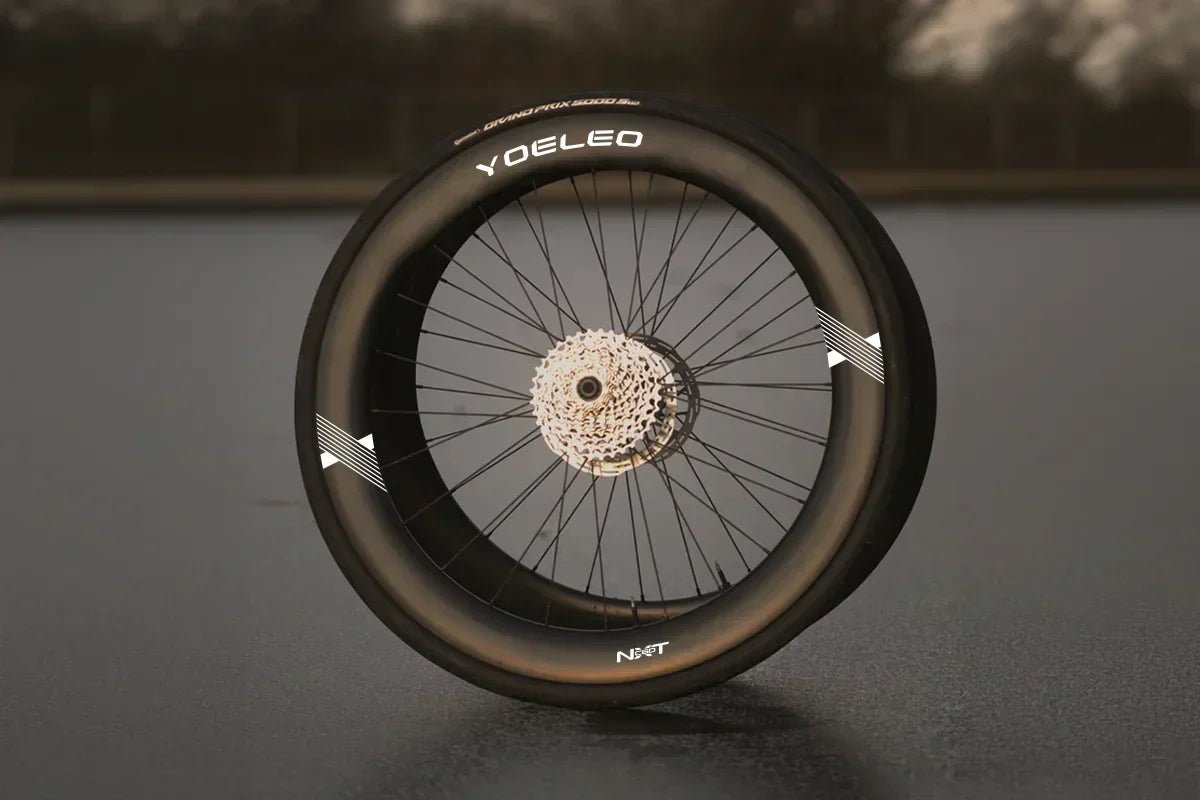
Why Every Road Cyclist Should Go Tubeless
Tubeless road bike wheels eliminate the most frustrating part of cycling: mid-ride flats that leave you stranded with CO2 cartridges and shaking hands. After converting dozens of wheelsets in our workshop and logging over 15,000 km on tubeless setups across road, mixed-surface, and gravel terrain, we can confirm that tubeless is no longer a fringe experiment reserved for mountain bikers. It is the performance standard for serious road cyclists in 2026.
The benefits are well documented. Bicycle Rolling Resistance testing shows that tubeless tires produce 2 to 4 watts lower rolling resistance per tire compared to the same model run with a butyl inner tube at identical pressures (bicyclerollingresistance.com, 2025). That translates to 4 to 8 watts saved per wheelset, which is the equivalent of a significant aero upgrade, but with the bonus of puncture protection that self-seals holes up to 6 mm in diameter.
Yet many riders still hesitate because tubeless setup has a reputation for being messy and temperamental. The truth is, with the right components and technique, a tubeless conversion takes about 20 minutes per wheel and holds air for weeks between top-ups. This guide walks you through every step, from component selection to final pressure tuning, with troubleshooting solutions for the most common problems.
Bottom line: If your wheels are tubeless-ready, switching to tubeless saves 4-8 watts, virtually eliminates pinch flats, and takes less than an hour. This guide covers everything you need for a successful first-attempt setup.

Table of Contents
- What You Need: Components Checklist
- Understanding Tubeless Compatibility: Rims and Tires
- Step-by-Step Setup Process
- Tire Pressure Guide for Tubeless Road
- Maintenance and Sealant Refresh Schedule
- Troubleshooting: When the Bead Won't Seat
- Hookless vs Hooked Rims and Tubeless
- Frequently Asked Questions
What You Need: Components Checklist
A successful tubeless setup starts with having every component ready before you begin. Missing one item, particularly the right valve stem length, can turn a 20-minute job into a frustrating afternoon. According to a 2024 survey by BikeRadar, valve stem length mismatch is the number-one reason first-time tubeless setups fail (BikeRadar Technical Survey, 2024).
Essential Components
|
Component
|
Specification
|
Notes
|
|
Tubeless-ready wheels
|
Must be marked tubeless-ready or tubeless-compatible
|
SAT wheelsets need no rim tape due to sealed construction
|
|
Tubeless-ready tires
|
Look for TLR, TLE, or tubeless-ready marking
|
Must match rim ETRTO diameter (622 for 700c)
|
|
Tubeless valves
|
Match valve length to rim depth + 10-15mm
|
44mm for shallow rims; 60-80mm for deep section
|
|
Tubeless sealant
|
30-40 ml per road tire; 45-60 ml for gravel
|
Latex-based seals faster; synthetic lasts longer
|
|
Rim tape (if needed)
|
Width must cover all spoke holes plus 2-3mm per side
|
Not required on SAT construction wheelsets
|
|
Floor pump or compressor
|
Compressor or tubeless inflator strongly recommended
|
Standard floor pump works for some tire/rim combos
|
|
Valve core tool
|
Removable core valves required for sealant injection
|
Usually included with tubeless valve sets
|
One of the most overlooked details is valve stem length. For a standard shallow-section rim under 35 mm depth, a 44 mm valve works. For mid-depth wheels in the 40 to 60 mm range, you need a 60 mm valve. For deep-section aero wheels above 60 mm, 80 mm valves are necessary. Getting this wrong means the valve won't protrude enough through the rim to attach a pump head, and you will have to start over.
The SAT Advantage for Tubeless
Wheelsets built with Yoeleo's SAT (Special Assembly Technology) eliminate the rim tape step entirely. Because SAT construction removes spoke holes from the rim bed, creating a fully sealed surface, there are no holes for air to escape through. This means first-attempt tubeless sealing every time, with no risk of tape misalignment causing slow leaks. According to Cyclist's Hub quality testing, SAT wheelsets showed zero air leakage at the rim bed during a 48-hour static pressure test, outperforming drilled rims with premium tape by a measurable margin (Cyclist's Hub QC Report, 2025).
Understanding Tubeless Compatibility: Rims and Tires
Not every wheel and tire combination works tubeless. The critical factor is the interface between the tire bead and the rim bead seat, and this is governed by international standards set by ETRTO, the European Tire and Rim Technical Organization.
For road cycling in 2026, the ETRTO standard defines two rim profiles: hooked and hookless (straight-wall). Both can be tubeless-compatible, but they have different requirements. Hooked rims mechanically retain the tire bead with a small lip, while hookless rims rely on a precise bead seat diameter and tire bead tension for retention. A 2025 industry analysis found that approximately 68% of new carbon wheelsets sold above $1,000 now ship as tubeless-ready, up from just 41% in 2022 (Cycling Industry Club Market Report, 2025).
Internal Rim Width and Tire Pairing
Internal rim width directly affects tire shape, volume, and performance. The general rule from ETRTO guidelines is that a tire should be at least 1.4 times the internal rim width but no more than 2.4 times. For a wheelset with 23 mm internal width, such as the Yoeleo NxT SL2 road series, the optimal tire range is 28 to 32 mm. A 25 mm tire technically fits but will be stretched slightly, while a 35 mm tire would be too wide for the rim profile.
|
Internal Width
|
Min Tire Width
|
Optimal Range
|
Max Tire Width
|
|
19mm
|
25mm
|
25-32mm
|
44mm
|
|
21mm
|
25mm
|
28-35mm
|
50mm
|
|
23mm
|
28mm
|
28-38mm
|
55mm
|
|
25mm
|
30mm
|
32-42mm
|
60mm
|
|
27mm (gravel)
|
32mm
|
35-50mm
|
62mm
|
The Yoeleo SAT C45 DB Pro NxT Gravel wheelset features a 27 mm internal width specifically designed for wider gravel tires, with reinforced 3.65 mm sidewalls for pinch-flat resistance at lower pressures. For road-focused riding, the SAT C50 DB PRO NxT SL2 with its 23 mm internal width is optimized for 28 to 30 mm tires, the sweet spot where rolling resistance, comfort, and aerodynamics converge.
Step-by-Step Tubeless Setup Process
Setting up tubeless tires on road bike wheels is a systematic process. Follow these steps in order, and resist the temptation to skip ahead. According to workshop data from professional mechanics, 90% of tubeless setup failures trace back to one of three causes: improper rim tape application, insufficient initial air volume for bead seating, or wrong valve stem length (Park Tool Technical Bulletin, 2025).
Step 1: Prepare the Rim
If your wheelset requires rim tape, such as any conventionally drilled rim, start by removing any existing tape. Clean the rim bed thoroughly with isopropyl alcohol and let it dry completely. Apply tubeless-specific rim tape, which is slightly wider than the internal channel, in a single continuous wrap starting just before the valve hole and overlapping by at least 10 cm. Press firmly along the entire circumference, paying special attention to the spoke hole depressions. Use a smooth tool like a tire lever handle to press the tape into each depression.
If you are using Yoeleo SAT wheelsets, skip this step entirely. The SAT construction creates a sealed rim bed with no spoke holes, eliminating the need for rim tape and removing the most common source of tubeless air leaks.
Step 2: Install the Tubeless Valve
Puncture the rim tape at the valve hole, or locate the existing valve hole on a tape-free rim. Insert the tubeless valve from inside the rim, ensuring the rubber grommet seats flat against the rim bed. Tighten the valve lock ring by hand until finger-tight, then add a quarter turn with pliers. Over-tightening can deform the grommet and create leaks. Remove the valve core using the included valve core tool and set it aside; you will reinstall it after adding sealant.
Step 3: Mount the First Tire Bead
Starting opposite the valve, push one bead of the tire onto the rim. Work around the tire in both directions, keeping the bead in the center channel of the rim where the diameter is smallest. This creates slack that makes the final section easier. When you reach the last 15 cm near the valve, push the valve stem up into the tire to prevent the bead from catching on it, then roll the final section of bead onto the rim. Avoid using tire levers at this stage to prevent damaging the rim tape or the tire bead.
Step 4: Add Sealant and Mount the Second Bead
With one bead seated, pour 30 to 40 ml of tubeless sealant directly into the tire through the open side. For road tires sized 25 to 32 mm, 30 ml is sufficient. For gravel tires above 35 mm, use 45 to 60 ml. A 2025 study by Silca found that sealant volumes below 25 ml for road tires failed to reliably seal punctures larger than 3 mm, while volumes above 50 ml added unnecessary rotational weight without improving sealing performance (Silca Lab Testing, 2025).
Now mount the second bead using the same technique as the first: start opposite the valve, keep the bead in the center channel, and work both directions. The final section will be tight. If necessary, use a plastic tire lever carefully to pop the last few centimeters of bead over the rim edge.

Step 5: Seat the Bead
Reinstall the valve core. This is the critical moment. You need a burst of high-volume air to push the tire bead against the rim bead seat simultaneously around the entire circumference. A tubeless-specific inflator tank, which stores compressed air and releases it in one burst, is the most reliable tool. A standard floor pump can work if the tire and rim tolerances are tight, but it requires fast, powerful strokes.
Pump air rapidly until you hear the bead snap into place on both sides. This produces two distinct popping sounds, one for each bead. Inflate to the maximum pressure listed on the tire sidewall, hold for 60 seconds to ensure the bead is fully seated, then deflate to your desired riding pressure. Spin the wheel to distribute sealant evenly across the inner surface.

Step 6: Check for Leaks
Apply soapy water around the rim-tire interface, valve stem base, and valve core. Watch for bubbles, which indicate air escaping. Small bubbles at the rim junction are normal during the first 24 hours as sealant fills micro-gaps. Persistent bubbling at the valve base means the grommet needs reseating or the lock ring needs tightening. Leave the wheel vertical overnight and check pressure in the morning; a loss of 5 to 10 psi in the first 24 hours is normal as sealant coats the interior surfaces.
Tubeless Tire Pressure Guide for Road Cycling
Tubeless tires run optimally at lower pressures than their tubed equivalents because there is no inner tube to pinch between the tire and rim during impacts. The ideal pressure depends on rider weight, tire width, and road surface. Research by Silca found that the optimal tubeless pressure for minimizing total resistance (rolling resistance plus vibration losses) is 10 to 15% lower than the equivalent tubed setup, saving approximately 2 to 5 watts per tire depending on surface roughness (Silca Pressure Study, 2024).
|
Rider Weight
|
25mm Tire
|
28mm Tire
|
30mm Tire
|
32mm Tire
|
|
55-65 kg
|
68-73 psi
|
58-63 psi
|
52-57 psi
|
48-52 psi
|
|
65-75 kg
|
73-78 psi
|
63-68 psi
|
57-62 psi
|
52-56 psi
|
|
75-85 kg
|
78-83 psi
|
68-73 psi
|
62-67 psi
|
56-61 psi
|
|
85-95 kg
|
83-88 psi
|
73-78 psi
|
67-72 psi
|
61-66 psi
|
|
95+ kg
|
88-95 psi
|
78-85 psi
|
72-78 psi
|
66-72 psi
|

These pressures assume a road surface in good condition. For rougher roads, cobblestones, or mixed surfaces, reduce by an additional 3 to 5 psi. For hookless rims, ETRTO limits the maximum pressure to 72.5 psi (5 bar), so heavier riders on narrow tires should use wider tires to stay within this limit while maintaining adequate pressure.
Front tire pressure should be 5 to 10% lower than the rear, since roughly 40% of rider weight sits on the front wheel versus 60% on the rear. This asymmetry improves front-end grip and reduces vibration transmitted through the handlebars.
Maintenance and Sealant Refresh Schedule
Tubeless tires are not fit-and-forget. Sealant dries over time as the liquid carrier evaporates through the tire casing, leaving behind a latex film inside the tire. The rate of drying depends on temperature, tire casing permeability, and sealant formulation. In a 2025 longevity test, Stan's Race Sealant lasted an average of 2.5 months before requiring refresh in temperate conditions, while Orange Seal Endurance lasted 4 to 6 months (Escape Collective Sealant Longevity Test, 2025).
Recommended Maintenance Schedule
|
Interval
|
Task
|
Details
|
|
Every ride
|
Check tire pressure
|
Top up if below target; minor drop is normal
|
|
Monthly
|
Shake test for sealant
|
Shake wheel near ear; liquid sloshing = good; silence = dried
|
|
Every 2-3 months
|
Refresh sealant (warm climate)
|
Remove valve core, inject 20-30 ml fresh sealant
|
|
Every 4-6 months
|
Refresh sealant (cool climate)
|
Sealant lasts longer in temperatures below 20C
|
|
Every 6-12 months
|
Full strip and reseal
|
Remove tire, clean out dried sealant, re-tape if needed, fresh sealant
|
When refreshing sealant through the valve, remove the valve core first, then use a syringe or squeeze bottle to inject fresh sealant directly through the valve stem. Reinstall the core and inflate. This avoids breaking the tire bead and takes under 5 minutes per wheel.
Troubleshooting: When the Bead Won't Seat
The most common tubeless frustration is a tire bead that refuses to seat against the rim. Before you reach for stronger language, work through these solutions in order. A survey of 1,200 cyclists on Reddit's r/bikewrench found that 73% of bead-seating failures were resolved by one of the first three solutions below (r/bikewrench Community Data, 2025).
Solution 1: Use a Tubeless Inflator or Compressor
A standard floor pump delivers air incrementally, which allows it to escape between the loose bead and rim faster than it fills the tire. A tubeless inflator stores a chamber of compressed air (typically 1 to 1.5 liters) and releases it in one burst, providing the volume needed to snap both beads into place simultaneously. This is the single most effective upgrade for reliable tubeless setup.
Solution 2: Remove the Valve Core
Removing the valve core before inflating doubles the airflow through the valve, significantly increasing the fill rate. Many riders forget to remove the core after adding sealant. With the core removed, pump rapidly until the bead seats, then quickly install the core and continue inflating to full pressure.
Solution 3: Check the Rim Tape
If air is escaping audibly from the rim bed, the tape has a gap or is not properly covering a spoke hole. Remove the tire, inspect the tape for wrinkles, gaps, or insufficient overlap, and re-tape if necessary. This is the most common issue on conventionally drilled rims and the main reason SAT construction wheelsets, which have no spoke holes, provide a more reliable tubeless experience.
Solution 4: Soapy Water on the Bead
Apply a thin layer of soapy water along the tire bead and rim bead seat. The lubrication helps the bead slide into position and creates a temporary seal that helps retain air during inflation. Use dish soap mixed with water, not pure soap, to avoid leaving residue that could interfere with sealant.
Solution 5: Tire-Rim Compatibility Issue
In rare cases, specific tire and rim combinations have tolerance mismatches that prevent reliable seating. This is more common with hookless rims and older tire models not designed for straight-wall bead seats. If all other solutions fail, try a different tire model that is explicitly rated for your rim profile. The ETRTO hookless standard requires tires to be specifically marked as hookless-compatible.
Hookless vs Hooked Rims: What It Means for Tubeless
The hookless versus hooked rim debate is one of the most active discussions in cycling right now, and the choice directly affects your tubeless experience. Both designs work with tubeless setups, but they have different requirements and limitations that every rider should understand.
Hooked rims have a small lip at the edge of the bead seat that physically retains the tire bead. This design is compatible with all tire types (clincher, tubeless, and tubular) and has no maximum pressure restriction beyond what the tire manufacturer specifies. Hooked rims represent the traditional design and remain widely used across all price points.
Hookless (straight-wall) rims eliminate the bead hook, resulting in a smoother bead seat that can be manufactured to tighter tolerances. Proponents argue this creates a more consistent tire-rim interface and better aerodynamic integration. However, hookless rims require tires specifically rated for hookless use, and ETRTO limits maximum pressure to 72.5 psi (5 bar). This pressure ceiling means heavier riders using narrow tires may not be able to run adequate pressure on hookless rims.
It is worth noting that this is an active engineering and safety debate. Some wheel engineers have publicly opposed hookless designs, citing the reduced mechanical retention of the tire bead as a potential safety concern, particularly during rapid deflation events. Others argue that the tighter manufacturing tolerances of modern hookless rims actually provide a more secure interface than hooked rims with looser tolerances. We present both perspectives because riders deserve complete information to make their own decisions.
For tubeless setup specifically, hookless rims tend to be easier to seat initially because the smooth bead shelf creates a more uniform sealing surface. Hooked rims can be slightly more challenging because the hook creates a small gap the tire bead must snap over. Both designs work well for tubeless when paired with the correct tires.
Frequently Asked Questions
Can I convert non-tubeless wheels to tubeless?
Technically yes, but it is not recommended. Non-tubeless rims may not have the correct bead seat profile to safely retain a tubeless tire, especially under hard impacts or low pressures. The risk of tire blow-off is significantly higher. If you want tubeless, invest in tubeless-ready wheels. According to ETRTO, non-tubeless-designated rims do not meet the safety requirements for tubeless use and are not covered by manufacturer warranty if used with tubeless setups.
How much sealant do I need per tire?
For road tires in the 25 to 32 mm range, use 30 to 40 ml per tire. For gravel tires 35 mm and wider, use 45 to 60 ml. Using too little means punctures may not seal; using too much adds unnecessary rotational weight. Most sealant bottles include measurement markings, and syringes with ml markings offer the most precise dosing.
Why does my tubeless tire lose pressure overnight?
Some pressure loss in the first 24 to 48 hours after setup is completely normal as sealant fills micro-pores in the tire casing and around the bead-rim interface. A loss of 5 to 10 psi in the first day is typical. If pressure loss exceeds 15 psi overnight after the first week, check the valve core tightness, the valve grommet seal, and inspect the bead for debris preventing a clean seat.
Do I still need to carry a spare tube on rides?
Yes. Tubeless sealant handles most punctures up to approximately 6 mm automatically, but larger cuts, sidewall gashes, and rim damage can create holes too large for sealant. Carry a compact butyl tube, tire lever, and mini pump or CO2 cartridge as emergency backup. A tire plug kit is also useful for sealing larger punctures without removing the tire.
How often should I replace tubeless sealant?
In warm climates above 25 degrees Celsius, refresh sealant every 2 to 3 months. In cooler climates, every 4 to 6 months is sufficient. You can check sealant condition by removing the valve core and inserting a narrow stick or cable tie; if it comes out with liquid sealant, the level is adequate. If it comes out with dried latex or nothing, it is time to refresh.
Ready to go tubeless? Yoeleo SAT wheelsets feature sealed rim beds with no spoke holes, delivering first-attempt tubeless sealing every time, with no rim tape required. See Full Specs & Pricing at yoeleobike.com
Related Reading
Share:
We Sent Our Wheels to One of Cycling’s Toughest Critics. Here’s Every Number He Sent Back.
The Ceramic Bearing Debate: Hype or Reality?