
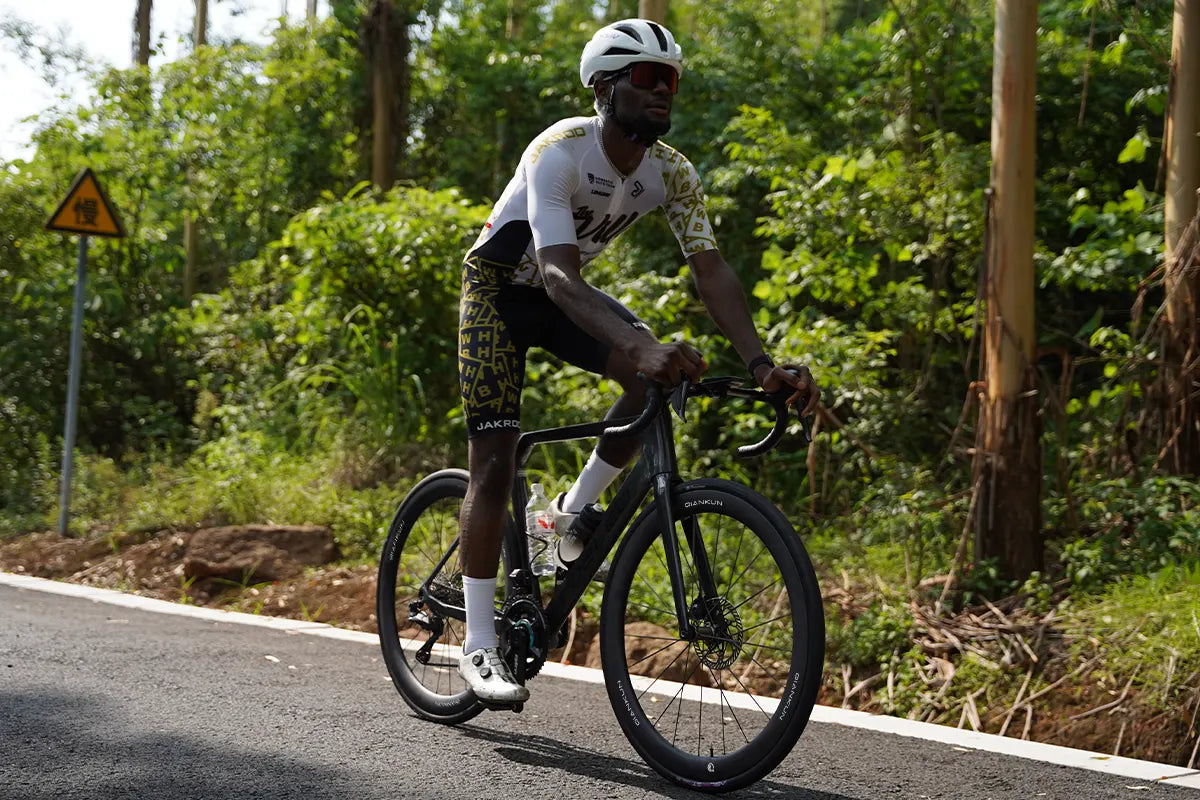
At some point in every endurance cyclist's life, the number 200 stops being abstract. It stops being something other people do on social media and starts being a quiet, uncomfortable question you ask yourself on the way home from a Saturday 80 km that left you bonking at km 70. Could you double that? Could you actually do 200 km in a single day?

The answer, for most riders, is not about talent. It is not about VO2 max or FTP or years of base miles. It is about whether you are willing to sit with the doubt long enough to find out. This is one version of how that journey goes — a composite of the questions, the stumbles, and the quiet victories that riders in this community share more often than they post about.
|
FIRST 200 KM IN 30 SECONDS
• Most riders who complete a first double-century say the training preparation — not the fitness — was the hardest part to get right.
• Back-to-back long days (e.g., 120 km Saturday + 90 km Sunday) teach the body more than single long efforts.
• Setup matters: rider position, saddle comfort, and tire pressure have more impact on a 200 km day than any single component spec.
• The bike becomes visible only at the end of the day — when it either let you down or simply wasn't a factor.
|
The Doubt Is the Starting Point
Riders who have done a first double-century almost universally describe the same starting point: not inspiration, but doubt. The number feels arbitrary and enormous at the same time. You can ride 80 km comfortably. Maybe 100 on a good day. But 200? That is a different conversation.
That gap is mostly psychological — and mostly useful. The doubt is what forces you to be intentional. Riders who chase 200 km casually, without changing anything about how they train or prepare, often get to km 150 and discover the wall is real. Riders who treat the target seriously — who restructure their training weeks around it — tend to arrive at the finish with more in reserve than they expected.
What the Training Actually Looks Like
A common mistake is trying to build volume by adding one massive ride per week and leaving everything else the same. The more durable approach is progressive back-to-back loading: pairing a moderately long ride on Saturday with a deliberately fatigued effort on Sunday. The body adapts not just to duration, but to riding tired — which is exactly what km 150–200 will feel like.
-
Build the long ride incrementally: 100 km → 120 km → 140 km → 160 km over 6–8 weeks before attempting 200 km.
-
Add a Sunday ride of 60–90 km after each long Saturday. Pace is irrelevant — consistency and completion are the goal.
-
Practice fueling strategy on every ride over 90 km. Most first-200 failures are nutritional, not physical.
-
Taper for 10–14 days before the attempt. Freshness is a legitimate performance variable.
-
Ride the actual route — or something close to it — at least once in training. Surprises at km 170 are not fun.
The Setup Questions That Actually Matter
Before the question of which bike becomes relevant, there are setup decisions that matter more. Saddle fit is one of them. At 200 km, a saddle that is tolerable at 80 km becomes a source of genuine suffering. Many riders who DNF a first double-century cite saddle discomfort as the primary factor — not legs, not lungs.
Tire pressure is another. Lower pressures reduce rolling resistance on real roads, reduce vibration fatigue, and improve grip. Most riders run their tires too hard for long days. The difference between 90 psi and 70 psi on a 200 km road ride is not academic — it is cumulative comfort over six to ten hours.
|
Setup Variable
|
Common Mistake
|
Better Approach for 200 km
|
|
Saddle
|
Using a saddle that is 'fine' for short rides
|
Get a professional fit; test on 3+ rides over 100 km before the attempt
|
|
Tire pressure
|
Inflating to maximum rated pressure
|
Reduce by 10–15 psi from your short-ride norm; test in training
|
|
Bar reach / drop
|
Aggressive position optimized for power
|
Slightly longer stem or shallower drop to reduce neck and back fatigue
|
|
Gearing
|
Assuming current gearing is sufficient
|
Check the route's max gradient and confirm your lowest gear handles it comfortably
|
|
Luggage / nutrition load
|
Winging it on the day
|
Test your full nutrition load and pockets or bags on at least two long training rides
|
The Day Itself
Most riders describe the first 80 km of a double-century as the most dangerous section — psychologically. You feel strong. The temptation to push the pace, to drop into a group going faster than your plan, is real. Riders who surrender to it almost always pay for it between km 130 and 160.
The middle 80 km, roughly km 80 to 160, is where the day is won or lost. This is where fatigue becomes a presence rather than a background note. This is where nutrition strategy either holds or falls apart. This is where the rider who trained the back-to-back days banks a return on that investment — and the rider who just did long solo efforts starts rationing energy they do not have.
The final 40 km are a different kind of riding altogether. The legs are not fresh. The mind is not sharp. But riders who have arrived here — who have done the training and held the pace and fueled correctly — describe something unexpected: a kind of clarity. A simplification. The question of whether you can do this is no longer open. You are doing it.
What the Bike Does (and Doesn't Do)
Here is the honest version: the bike does not make you a double-century rider. Training does. Discipline does. Fueling strategy and setup intelligence do. The bike's job, on a day like this, is to get out of the way — to be quiet, reliable, and invisible in the best possible sense.
What that actually means is: no mechanical anxiety. No comfort issues that trace back to the frame or fork. No questions about whether the wheels are tracking true after 150 km of road. A bike that performs its role silently is worth more on a 200 km day than a bike that impresses you at a standstill.
Where the R-Series Fits Into This Narrative
While a perfect bike fit is the absolute foundation of completing a 200 km ride, the frame underneath you dictates how long you can maintain that fit comfortably. A frame's geometry and layup shouldn't demand your attention; they should quietly work to reduce road vibration and muscle fatigue over eight hours.
This is where purposeful engineering matters. The Yoeleo R12, for example, features an endurance-optimized geometry that naturally supports a sustainable, upright riding position. Furthermore, both the R11 and R12 are built to withstand 100,000 pedaling fatigue cycles at 1,100 N—ensuring that the frame remains a stiff, reliable, and entirely silent partner from kilometer 1 to 200.

For riders whose first 200 km involves gravel sectors, mixed surfaces, or simply want a more versatile platform, the Altera G21 provides the tire clearance (up to 53 mm on a 700c wheel) and bikepacking-ready geometry to handle terrain that would stop a pure road bike. It is the platform that carried riders to a double podium at the 2025 UCI Gravel World Championships — gold and bronze — which is perhaps the most honest summary of what it is designed to do.

|
HOW YOELEO SUPPORTS THE LONG DAYS
• R12 geometry engineered for endurance positioning — designed to reduce upper-body fatigue over extended hours in the saddle.
• R11 and R12 framesets tested to 100,000 pedaling fatigue cycles at 1,100 N — an internal standard that exceeds ISO 4210 minimums.
• Altera G21: 53 mm tire clearance, Pro-Flex 27.2 mm seatpost for road vibration absorption, and full internal cable routing via ProRoute.
• Independent reviews from Cyclist's Hub, Peak Torque, and Hambini have validated build quality and real-world performance — not in a sales context, but because they tested the product.
• DTC efficiency means accessible premium pricing: the platform that reached the UCI Gravel Worlds podium is the same frameset available to you direct, without a retail markup.
|
Frequently Asked Questions
How long does it take to train for a first 200 km ride?
Most riders need 8–16 weeks of structured endurance training from a base of comfortable 80–100 km rides. The key is progressive back-to-back loading rather than just adding one very long ride per week.
What is the most common reason riders DNF a first double-century?
Nutritional failure and pacing errors in the first half are the most common causes. Riders who go out too hard and under-fuel between km 80 and 120 rarely finish strong. Training the fueling strategy is as important as training the legs.
Does the bike frame matter for a 200 km ride?
Setup and fit matter more than the frame's spec on paper. A well-fitted standard frame will outperform a premium frame with poor positioning over 200 km. That said, geometry, compliance, and weight become meaningful over 6–10 hours in a way they are not on a 2-hour ride.
What tire pressure should I use for a long endurance ride?
Lower than you think. Many riders find 65–75 psi (on 28–32c tires) reduces vibration fatigue significantly on real roads compared to their usual 85–95 psi. Test in training before the attempt. See our guide on tire pressure and high-volume road wheels for more detail.
Share:
Road Bike Comfort on Long Rides: 5 Setup Changes
7 Bike Buying Myths That Cost Cyclists Real Money