
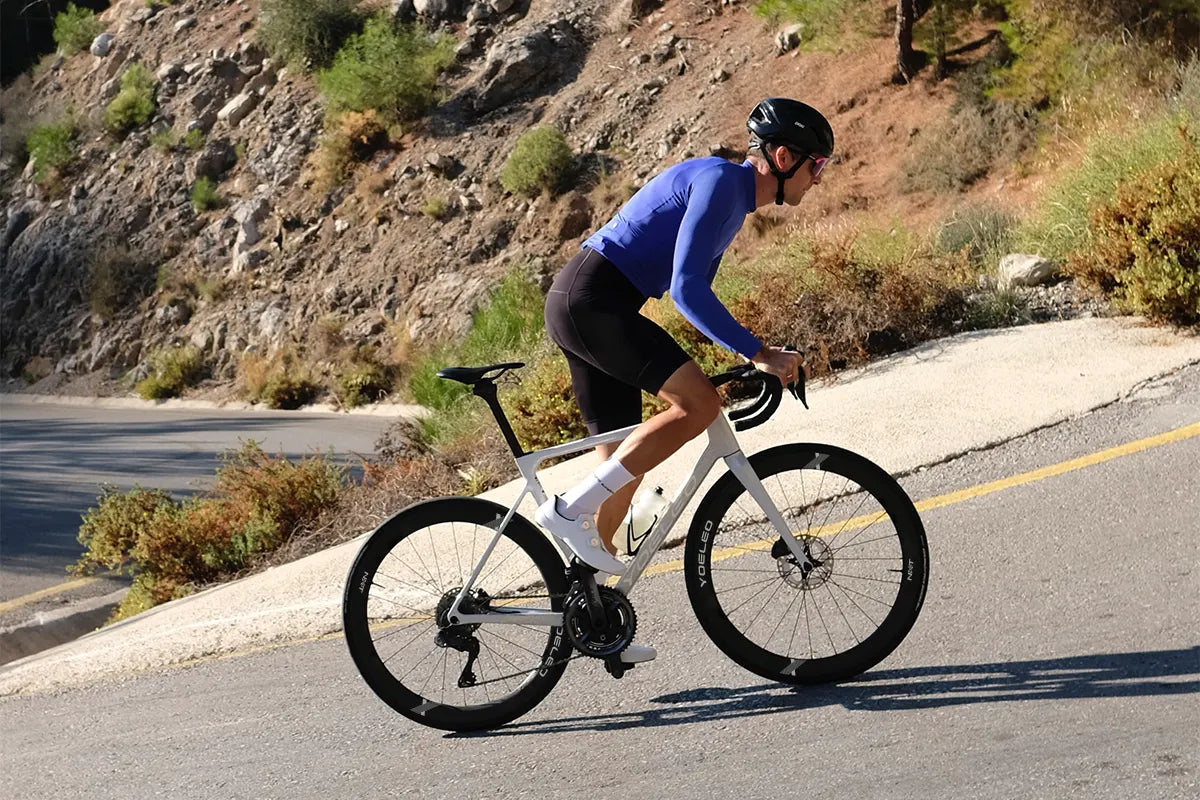
You've felt it. On a shallow drag your deep-section wheels hum along and you wonder why anyone rides anything else. Then the road kicks up to a real climb, your lighter-wheeled friend drifts away, and you start doing the weight math in your head. Somewhere between those two moments is a tipping point — the gradient where the advantage flips from aerodynamics to weight.

The good news: that crossover isn't a mystery or a marketing opinion. It's physics, and we can put a number on it. Here's the real answer to aero vs lightweight wheels, where the tipping point sits, and how to choose rim depth for the roads you actually ride.
|
THE 30-SECOND ANSWER
• For most riders the crossover is around a 6% gradient
• Below it, aero wheels are faster; above it, lighter wheels win
• The point rises with power: ~5.2% at 200W, ~6.8% at 300W, ~8.3% at 400W
• Modern aero wheels weigh so little more that the tipping point keeps moving up
|
At What Gradient Do Aero Wheels Lose to Weight?
For most riders, the crossover sits around a 6% gradient. Below it, aerodynamic wheels are faster; above it, lighter wheels win. The exact point rises with your power output — stronger riders stay faster on aero wheels to steeper gradients.
That's the answer in three sentences, but the why is what lets you choose well. The tipping point moves depending on how hard you push and — increasingly — on how little modern aero wheels actually weigh.
The Physics: Two Forces, Two Regimes
Cycling speed is a fight against two main enemies, and which one dominates depends entirely on gradient. On flat and rolling roads your energy goes almost entirely into pushing air aside. On a steep climb it goes into lifting you and the bike against gravity.
The numbers frame it cleanly. Each kilogram saved is worth roughly 5 watts of effort on a climb, while at 40 km/h, switching from shallow rims to deep aero wheels can be worth about 10 watts, according to testing summarized by BikeRadar. On the flat, aero is the bigger lever; as the road tilts up your speed drops, the air matters less, and weight takes over. The tipping point is just the gradient where those two effects trade places.
The Crossover, by the Numbers
The crossover gradient isn't a single value — it scales with rider power, because a stronger rider climbs faster and keeps benefiting from aerodynamics longer.
Testing reported by Cyclist and others puts it like this: around 200 watts the crossover is near 5.2%; at 300 watts it climbs to about 6.8%; at 400 watts a rider stays faster on aero wheels up to roughly 8.3%. Broadly, aero gains beat weight savings up to about a 5% slope for an average recreational rider and up to about 8% for a pro.
|
Rider power (steady climb)
|
Approx. crossover gradient
|
What it means for you
|
|
~200 W (recreational)
|
~5.2%
|
Aero wins on flats, rollers, gentle climbs
|
|
~300 W (strong amateur)
|
~6.8%
|
Aero wins on almost everything but real mountains
|
|
~400 W (pro)
|
~8.3%
|
Aero stays faster well into steep terrain
|
The takeaway is liberating: unless you live in the mountains or weigh very little, you spend far more of your riding life below the tipping point than above it.
Why the Tipping Point Keeps Moving Up
Here's the development most “aero vs light” arguments haven't caught up to: modern aero wheels barely weigh more than dedicated climbing wheels anymore. As the weight gap shrinks, the tipping point shifts further up the mountain — meaning aero wins more often than it used to.

Look at a current carbon range. A 35mm climbing wheelset, a 50mm all-rounder, and a 60mm aero wheelset can sit within roughly 70–80 grams of each other. When the aero wheel is only a flask of water heavier than the climbing wheel, the weight penalty you'd pay for aerodynamics on a climb is tiny — and the gradient at which it costs you real time gets steeper and rarer. The old trade-off of “fast on the flats, anchor on the climbs” mostly belongs to a previous generation of deep wheels.
A Quick Word on Rotational Weight
You'll hear that rim weight “counts twice” because it both moves with the bike and spins. It's a real effect, but a small one for the question at hand.
Rotating mass costs a little extra during acceleration — repeated surges, sprints, sharp pitches. But on a steady climb at constant speed, what matters is total mass being lifted, not where it sits. Rim weight is worth a thought if you race criteriums full of accelerations; for sustained climbing, judge the wheel on total weight and aerodynamics, not on rotational-weight folklore.
How to Choose Wheels by Terrain
Stop choosing wheels by what pros ride and start choosing by your roads and your power. Here's the simple framework.
|
Your terrain
|
Suggested rim depth
|
Why
|
|
Flat to rolling, group rides, racing
|
50–60mm
|
You live below the tipping point; aero is free speed
|
|
Mixed — everything roads
|
40–50mm
|
The all-round sweet spot of aero, weight, and handling
|
|
Steep mountains, light rider, gusty coast
|
~35mm
|
Above the crossover and easier in crosswinds
|
If you own one wheelset and ride varied terrain, a 45–50mm depth is wrong the least often. Mixed-depth setups — shallower front for stability, deeper rear for aero — let you tune both ends to taste.
Choosing Across the Range, Not Guessing
The tipping point is useful precisely because it turns a brand argument into a personal one: match the depth to your power and terrain, and the aero-vs-light debate mostly dissolves.
Yoeleo's NxT SL2 wheels are built around exactly that idea — a depth for each regime rather than one compromise. The C35 (1,260 g) is the climber's wheel for terrain above the crossover; the C50 (1,320 g) is the do-everything all-rounder; the C60 (1,345 g) leans aero for flats and rollers; and the C88 is the time-trial weapon. Notice how little separates the C35, C50, and C60 on the scale — that's the shrinking weight gap doing its work. They're engineered with the same testing behind them: impact-tested to 120J, three times the 40J industry standard, with individually replaceable spokes on the QianKun-equipped builds so a damaged wheel is a repair, not a write-off.
|
MATCH THE WHEEL TO THE RIDER
• C35 (1,260 g) — climber's wheel for terrain above the crossover
• C50 (1,330 g) — all-rounder; wrong the least often on mixed roads
• Impact-tested to 120J (3x the 40J industry standard); individually replaceable spokes
|

Pair a deeper set with the aero R12 or a lighter set with the climbing-focused R11, and you've matched the wheel to the rider instead of to the hype. That's value measured the right way — in time saved on your roads.
Frequently Asked Questions
At what gradient do lightweight wheels beat aero wheels?
For most riders the crossover is around 6%. It rises with power: roughly 5.2% at 200 watts, 6.8% at 300 watts, and 8.3% at 400 watts. Below that gradient aero wheels are faster; above it, lighter wheels gain the advantage.
Are aero wheels worth it for climbing?
Often, yes. Each kilogram saves about 5 watts on a climb, but modern aero wheels weigh only marginally more than climbing wheels — sometimes within 70–80 grams. Unless climbs are very steep or you're very light, the aero benefit on the approaches usually outweighs the small weight penalty.
What rim depth is best for all-around road cycling?
A 40–50mm rim depth offers the best balance of aerodynamics, weight, and crosswind stability for most riders on mixed terrain. Go deeper (50–60mm) for flat and rolling roads, or shallower (around 35mm) for steep mountains, lighter riders, or consistently windy conditions.
Does rotational weight really count twice?
Slightly, and only during acceleration. Rim weight adds a small extra cost when speeding up — sprints, surges, steep ramps — but on a steady climb at constant speed, total weight is what matters. For sustained climbing, judge wheels on total mass and aerodynamics.
Share:
Road Tire Width: The Debate That Could Change Your Race
The Fatigue Factor: Why Upgrade to Carbon Wheels