
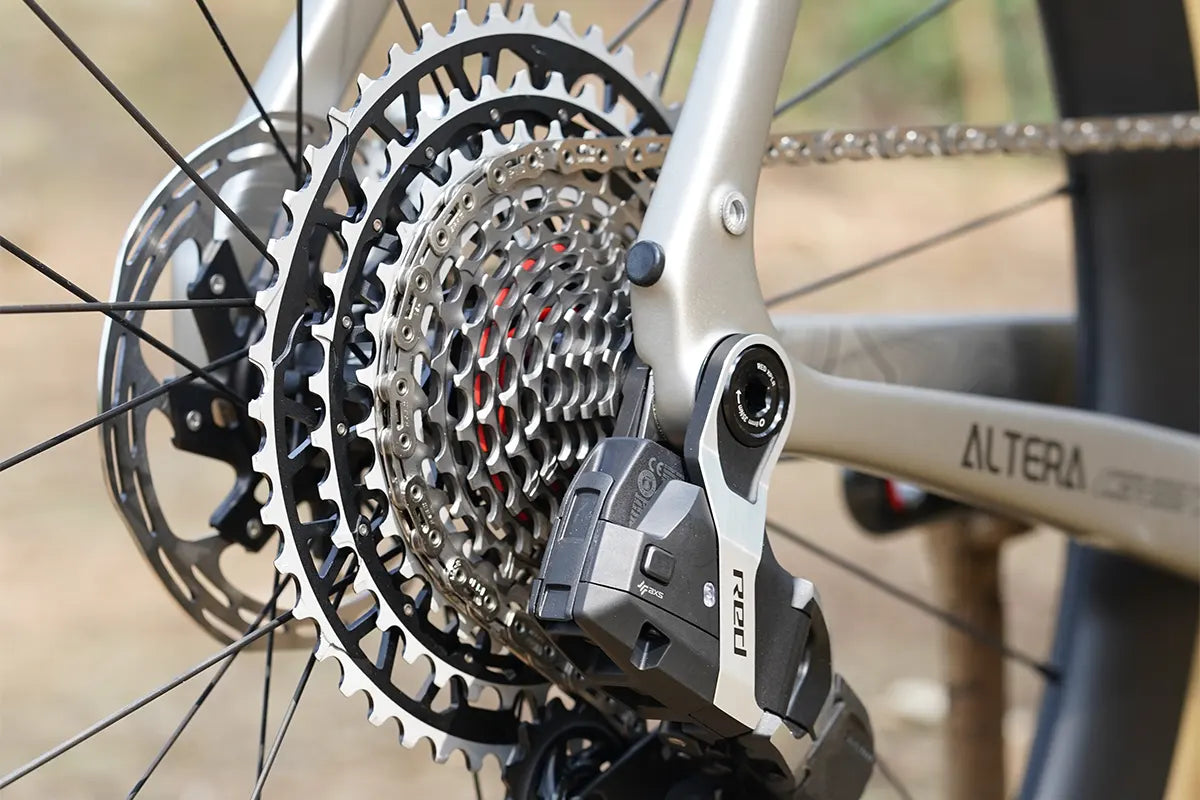
Chain Wear: How to Measure It and Why It Saves Your Cassette
The chain still shifts cleanly. It doesn't look worn, and it isn't making noise. Meanwhile the cassette is wearing out underneath that quiet chain, one pedal stroke at a time, and by the time you feel it, a skip under load on a climb, a chain that won't sit still in the smallest cogs, you're not buying a chain anymore. You're buying a cassette too, and sometimes a chainring set on top of that.
Chain wear isn't really about the chain snapping. Modern chains are strong enough that outright failure from stretch alone is rare. The real cost is what a worn chain does to everything it touches: the teeth on the cassette and chainrings reshape themselves to match the stretched pitch, and once that happens, a new chain won't seat properly on old teeth. You end up replacing parts that had years of life left, because nobody measured the one part that was actually due.
This is a five-minute check with a ruler, not a workshop job. Here's the real elongation math, why the clip-on go/no-go tools many riders trust can flag a chain as worn before it actually is, and how to measure it properly.
How do you measure chain wear?
Measure the distance across 12 full links, pin centre to pin centre, with a steel ruler, and compare it to the new-chain length of 304.8 mm (12 in). Anything beyond that nominal length is elongation, and the acceptable amount before replacement depends on how many sprockets your cassette has.
A chain doesn't stretch in the sense that the metal itself gets longer. Each link is a pair of plates joined by a pin, and every pedal stroke puts a tiny amount of wear into the contact surface between the pin and the bushing around it. Multiply that by tens of thousands of revolutions and the gap between pin centres grows, link by link, until the whole chain runs slightly longer than it did new. That elongation is what a ruler measures directly, and it's the same thing a cassette tooth feels every time the chain wraps around it.
Why elongation happens faster than you'd think
Grit is the accelerant. Dry lube, wet roads, gravel dust, all of it works its way between the pin and the bushing and turns every pedal stroke into a tiny grinding pass. A chain ridden clean and lubricated on tarmac can last two or three times longer than the same chain ridden gritty and under-lubed, even at identical mileage.
Load matters too, though less than cleanliness. Sprinting and climbing out of the saddle put more force through each link, but a chain that's kept clean and correctly tensioned will still outlast a dirty one under light loads. If you want one habit that extends chain life more than any other, it's wiping the chain before applying fresh lube rather than lubing over what's already there.
The wear thresholds by drivetrain speed
The acceptable elongation before replacement gets tighter as cassettes get narrower. An 11- or 12-speed cassette has less material per cog and tighter shift tolerances, so it starts showing damage from a stretched chain earlier than an older 8- or 9-speed setup with wider cogs and more forgiving spacing.
|
Drivetrain
|
Replace at
|
12-link ruler reading
|
Added length
|
|
11-speed / 12-speed
|
0.5%
|
306.3 mm (12 1/16 in)
|
+1.5 mm
|
|
8- / 9- / 10-speed
|
0.75%
|
307.1 mm (12 3/32 in)
|
+2.3 mm
|
|
Single-speed / hub gear
|
1.0%
|
307.8 mm (12 1/8 in)
|
+3.0 mm
|
If you run a modern 12-speed cassette and wait for 0.75% elongation because that's the number you remember from an older bike, you're already deep into cassette damage territory. Check the number against your own drivetrain, not a figure from a different setup.
Diagram showing how to measure chain wear against a 0.25 to 1.0 percent elongation scale
The ruler method, step by step
-
Shift onto the big chainring and a middle cog, then get the chain reasonably taut, either on the bike with the rear wheel off the ground or on a bench.
-
Line up the "0" mark of a steel ruler or a dedicated chain-wear ruler with the centre of a pin.
-
Count 12 full links along the chain, which is 24 individual pins, and read the ruler at the centre of that 24th pin.
-
Compare the reading to the thresholds above for your drivetrain's speed count.
-
Repeat the check at a second point on the chain, since wear isn't always even around the loop, and use the higher of the two readings.
A steel ruler with millimetre graduations gives a more precise reading than most riders expect. If the two readings you take disagree by more than about half a millimetre, take a third measurement and treat the chain as being at the higher figure.
Why a go/no-go checker can over-read wear
Clip-on gauges work by seating a fixed tooth against one roller and a spring-loaded tooth against another, then reporting whether the second tooth drops into the gap created by elongation. It's fast, and for a quick yes-or-no answer it's usually close enough. The problem is what it's actually measuring.

A checker's teeth contact the rollers, not the pins directly, so it registers roller-bore wear and manufacturing tolerance in roller diameter alongside true pin elongation. Rollers wear against the sprocket teeth independently of pin stretch, particularly on a chain that's seen grit, and that roller wear shows up in the gauge reading as if it were pitch stretch even though it isn't the same thing. The result is a tool that can call a chain "worn out" at what it reads as 0.75% when a ruler measured across 12 full links shows closer to 0.4%. If a clip-on gauge says replace and you're not sure, the ruler measurement is the one to trust, because it's measuring the dimension that actually matters for how the chain seats on cassette teeth.
Worked example: 8,000 km on an 11-speed chain
A rider on an 11-speed drivetrain checks chain length every 1,000 km with a steel ruler. At 6,000 km, the 12-link reading comes back at 306.1 mm, which works out to 0.43% elongation, still under the 0.5% cutoff. At 7,500 km it reads 306.4 mm, or 0.53%, just past the threshold. The chain gets replaced that week.
Compare that to a rider who only checks when shifting starts to feel off, which typically doesn't happen until well past 1.0% elongation on an 11-speed setup. By then the cassette's tooth profile has usually reshaped itself around the stretched chain, and dropping in a fresh chain on those teeth produces skipping under load, meaning a new chain and a new cassette get bought at the same time. Catching wear at 0.5% instead of 1.0% is the difference between replacing one part and replacing two.
How often to check
Every 300-500 km is a reasonable interval for a rider putting in regular weekly mileage, and it's worth checking more often through a wet or gritty block of riding, since contamination accelerates wear well beyond what mileage alone predicts. A ruler check takes under a minute once you've done it a few times, which makes it one of the highest-value habits in bike maintenance relative to the time it costs.
Frequently Asked Questions
How often should I check my chain for wear?
Check every 300-500 km, or roughly monthly for a regular rider. Increase the frequency during wet, muddy or dusty riding blocks, since grit between the pin and bushing accelerates wear well beyond what mileage alone would suggest, especially through a winter ridden in road spray and grit.
Can I flip a chain around to extend its life instead of replacing it?
No. Modern derailleur chains have directional plates and specific inner/outer link geometry, so flipping a chain doesn't reset wear or reduce elongation. The pin-to-bushing wear that causes stretch is already built into the chain regardless of which way it runs on the cassette.
Does a worn chain damage the cassette and chainrings at the same time?
The cassette wears faster, because each cog engages the chain far more often per rotation than the chainrings do. Left long enough, a badly stretched chain will eventually reshape chainring teeth too, but the cassette is almost always the first casualty.
Is a chain at 0.5% wear unsafe to ride, or just inefficient?
It's not a failure risk at that point, it's a cost risk. A chain at 0.5% elongation still functions and won't snap under normal riding, but it's starting to reshape cassette teeth, and every week ridden past the threshold adds to that damage.
Share:
Diagnosing Creaks: A Systematic Elimination Method
Reading Tyre Wear: When to Replace, Rotate, or Bin It